
Biography · The Era of the Great Awakening
From tortured ascetic of the Oxford Holy Club, to the flame that ignited the soul of a continent.What did he come to understand — that he spent the very last moment of his life bearing witness to the gospel?
1714 — 1770

📖 Table of Contents
- The Holy Club: Asceticism and Spiritual Crisis
- The Book That Changed Everything
- The Cross of Asceticism vs. the Cross of Christ
- The Great Awakening Unfolds
- Key Timeline: 1735–1770
- Legacy and Lasting Influence
- Why Whitefield Still Matters Today
- 6 Personal Lessons from His Life
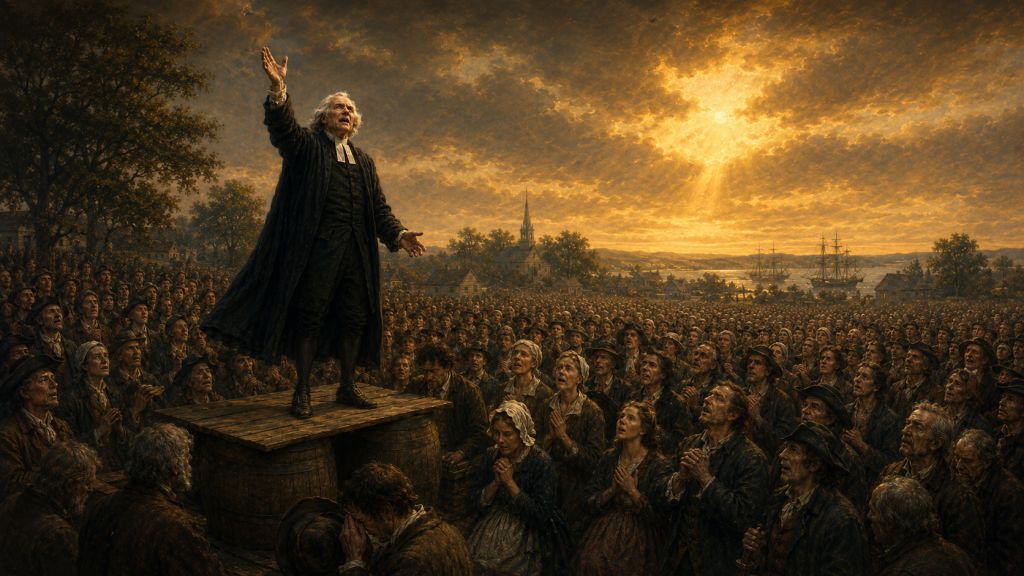
On the evening of September 29, 1770, dusk was settling over New England. An old man stood on a makeshift platform — boards laid across two barrels — and preached to a crowd of four thousand for a full two hours. He suffered from severe asthma; every breath was a struggle. A friend urged him to go to bed.
“True, sir,” he answered. Then he looked upward and prayed quietly:
“Lord Jesus, I am weary in Your work, but not of Your work. If I have not yet finished my course, let me go and speak for You once more in the fields, seal Your truth, and then come home and die.”— George Whitefield, his final prayer, September 1770
He pressed on. At six o’clock the following morning, he passed away peacefully in the minister’s house — and, according to his own wishes, was buried beneath the pulpit. That was his place. The stage of his entire life.
This man was the central figure of the First Great Awakening, called by historians “America’s spiritual Founding Father.” But his story begins with an ascetic on the verge of complete collapse.
Oxford Holy Club · 1732–1735 Asceticism and Breakdown: Trying to Earn God’s Favor
In 1732, the eighteen-year-old Whitefield entered Pembroke College, Oxford, paying his way by waiting on wealthier students. There he met John and Charles Wesley and joined their “Holy Club” — a small fellowship devoted to strict religious discipline, mocked by other students as “Bible Moths” and “Bible Bigots.”
Their lives were a study in rigid rule-keeping: fixed hours of prayer, regular fasting, visiting prisoners, rigorous self-denial. Whitefield threw himself in with extraordinary intensity — to the point of self-destruction.
📜 Historical Record
According to the historical accounts, Whitefield subjected himself to prolonged and harsh fasting, deliberately wore insufficient clothing in the depths of winter, prayed on his knees until he was utterly exhausted, and even locked himself in his room refusing to see friends — his body nearly broken. In his journals he recorded that no matter how diligently he kept the law and performed religious duties, he never found peace in his heart.
The pattern is strikingly similar to the early Peter of Quo Vadis, or the Pharisees of the Gospels — trying to earn God’s approval through outward religious suffering, only to find that the harder they tried, the deeper the emptiness and despair. Whitefield later confessed: “My friends at Oxford inclined toward mystical piety. They knew nothing of the new birth.”
His body gave out under the extremity of his asceticism and he was forced to return home to Gloucester to recover. It was in that dark season that everything changed.
❌ The Logic of Asceticism (The Way of the Law)
I must earn God’s acceptance through fasting, prayer, and good works. Religion is a system of rules — if I try hard enough, God will accept me. Inner peace is the reward for self-discipline.
✦ The Logic of the New Birth (The Way of Grace)
True religion is not the observance of outward rules, but a living union of the heart with Christ. A person cannot be saved by works — only by receiving God’s free grace through faith. Salvation is a gift, not a wage.
The Turning Point · 1735 The Book That Changed Everything: “I Finally Understood What True Religion Is”
The turning point came through a single book: The Life of God in the Soul of Man by Scottish theologian Henry Scougal, given to Whitefield by Charles Wesley. Recalling that moment in later life, Whitefield wrote that though he had fasted, watched, prayed, and received the sacraments for so long, it was only when God placed that book in his hands that he first understood what true religion really was.
“Oh, says the author, they that know anything of religion know it is a vital union with the Son of God — Christ formed in the heart. At that moment, a ray of divine life broke in upon my poor soul.”— Whitefield, recalling the experience in a 1769 sermon
After that moment he exhausted every resource within himself, tried every method available — and still could not attain that peace through self-effort. Only when he was completely spent, and finally abandoned all attempts at saving himself, did he at last take hold of Christ by faith alone.
He later wrote that it was not a gradual process — it happened in an instant. The Holy Spirit flooded in, joy overflowed, and he immediately knew he was saved. For the rest of his life, whenever he passed the room in Oxford where he had knelt, he could not help running to look at that spot again.
🔑 The Core Theological Breakthrough: Justification by Faith Alone
What Whitefield grasped was the central insight of the Reformation — Justification by Faith Alone: a person is not saved by works, rituals, fasting, or sacraments, but by living faith in Christ, freely receiving God’s grace. This is not moral improvement — it is a renewal of one’s very existence: the “New Birth.” This became the sole core message of his next thirty-four years of ministry, and the theological engine of the entire First Great Awakening.
Theological Contrast The Ascetic’s Cross vs. the Cross of Christ: What It Truly Means to Die to Self
Whitefield’s experience of asceticism calls to mind one of the central questions of the Christian faith — a theme explored in Quo Vadis and in the theological backdrop of A Great Awakening: what does it truly mean to die to self?
There is one kind of “death” — the religious ascetic’s kind: using outward pain, fasting, and self-punishment to accumulate merit and compel God’s acceptance. This is death in the spirit of the Law — an upgraded version of the self’s own will. That was the early Whitefield at Oxford.
But there is another kind of “death” — at the cross of Christ, fully recognizing one’s own helplessness, laying down every effort at self-rescue, surrendering completely to grace. This is not bodily suffering; it is the death of pride, the complete surrendering of “I.” This is the true meaning of what Christ said: “Take up your cross and follow me.”
The Ascetic’s Cross
Atoning through outward pain, hoping God will accept the effort. Inner motivation: I must do well enough. Outcome: deeper despair or deeper pride. Whitefield’s early path.
✦ The Cross of Christ
Acknowledging one’s own helplessness, trusting solely in Christ’s finished redemptive work. Inner motivation: I am loved, therefore I love. Outcome: genuine peace, a transformed life. The revelation Whitefield received.
The Great Awakening · 1736–1770 From One Man to a Continent: Flame in the Wilderness
Once Whitefield grasped the mystery of the “new birth,” everything changed. He read Scripture on his knees, page by page — no longer to complete a duty, but out of love. He began sharing his discovery with friends; even in small Gloucester, people were touched.
Ordained as a deacon in 1736, he preached his very first sermon in Gloucester — and people were so deeply moved by the Holy Spirit that they wept on the spot. The established church complained immediately. But the fire was already lit.
Churches began closing their doors to him. He walked into the open fields. In 1739, he preached his first open-air sermon to the coal miners of Kingswood near Bristol — the people most abandoned by society. He wrote afterward: “Blessed be God that I have now broken the ice! I believe I was never more acceptable to my Master than when I was standing to teach these hearers in the open fields.”
His close friend Benjamin Franklin — a noted skeptic — described a remarkable experiment: he deliberately stood at the outer edge of the crowd as Whitefield preached, steadily stepping backward to measure the limits of the man’s voice, and ultimately calculated that Whitefield could be heard clearly by thirty thousand people. The two became lifelong friends, though Franklin never received the gospel himself.
Key Dates George Whitefield Timeline: 1735–1770
1735 Experienced the “new birth” at Oxford; grasped the truth of justification by faith alone
1736 First sermon in Gloucester; immediately drew large crowds and sparked church controversy
1738–39 First voyage to America; established an orphanage in Georgia; began open-air preaching upon returning to England
1739–41 First great preaching tour of America; sparked the First Great Awakening — single sermons drew crowds of 20,000–30,000
1740 Preached on Boston Common to approximately 23,000 people — more than the entire population of Boston at the time
1740–1770 Made 13 transatlantic crossings; preached at least 18,000 sermons; estimated total audience of over 10 million hearers
September 29, 1770
Preached two hours in an open field in Exeter, New Hampshire — his final sermon. Died peacefully the following morning, September 30, 1770
Historical Impact George Whitefield’s Legacy: What Did He Leave Behind?
Spiritual Foundation of American Democracy
Historians consider Whitefield the central figure in transforming scattered colonists into Americans. The Great Awakening planted the conviction that all people are equal before God — directly preparing the spiritual climate for the Revolutionary War and shaping the religious liberty clause of the First Amendment.
🏫 Pioneer of Education and Charity
The orphanage he founded in Georgia was one of the earliest charitable institutions in the Americas. The Great Awakening gave birth to Dartmouth College, the predecessor of Princeton University, and several other institutions — rooted in the belief that every soul is worth educating and caring for.
🎤 Father of Modern Mass Evangelism
He invented open-air preaching, interdenominational itinerant evangelism, and a model for communicating the gospel to the masses rather than the elite. He was history’s first true “mass-media personality” — two hundred years before radio broadcasting.
✝️ Father of the Evangelical Movement
The “new birth” theology he established, the spirit of cross-denominational cooperation, and the emphasis on a living personal relationship with Christ became the core DNA of global Evangelicalism — shaping hundreds of millions of believers worldwide.
🔥 Template for All Future Revivals
From Charles Finney to D.L. Moody, from Billy Graham to many revival movements today — all directly inherited Whitefield’s model of open-air preaching, calling for a decision, and interdenominational partnership.
⚖️ A Complex and Honest Legacy
He preached to enslaved people and acknowledged their equal standing in Christ — yet in his later years supported the institution of slavery. This was the gravest moral failure of his life. His story reminds us that God can work through broken people, while human cultural blind spots remain real and serious.
Relevance for the 21st Century Why George Whitefield Still Matters Today
We live in a profoundly divided age — politically, culturally, and religiously. American society is experiencing a deep hollowness of soul: material abundance alongside a scarcity of meaning; technological explosion alongside existential lostness. Anxiety, nihilism, and anger spreading across generations have led many people to ask again: what is real in life?
He tells us that the forms of religion cannot save anyone. Many people today live inside substitute religions — moral performance, social activism, or self-help culture — that are in essence no different from Whitefield’s early asceticism: trying to fill an inner emptiness with outward “goodness.” But that road, followed to its end, leads only to deeper despair.
He tells us that genuine transformation begins in the heart. Social change does not begin with policy — it begins with individual souls that are truly changed. In Whitefield’s era, the Great Awakening brought not merely religious enthusiasm but a comprehensive renewal of moral culture — families, communities, cities. People began singing psalms in the streets, because something real had taken root within them.
He tells us that love that crosses every boundary is possible. In an age of rigid class divisions and denominational fractures, he preached to miners, to slaves, to the wealthy, and to the poor. He did not care whether someone was Anglican or Baptist — he asked only one question: have you experienced the new birth? This kind of unity that transcends every identity label is the very thing our fractured world most needs to witness.
“Works! Works! A man gets to heaven by works! I would as soon think of climbing to the moon on a rope of sand.”— George Whitefield, his final sermon, September 29, 1770
✦ 6 Personal Lessons from the Life of George Whitefield ✦
Whitefield’s life leaves six specific questions and signposts for anyone asking what makes life meaningful:
- Examine Your Own “Asceticism”Are you using some form of performance to earn acceptance — from God, from others, or from yourself? Religious observance, moral achievement, social contribution… when these become the source of your sense of worth, you are in the same position as the early Whitefield. Ask yourself honestly: beneath all of it, do I have peace in my heart?
- Find the Book That Will Change YouWhitefield’s transformation began with a single book. Are there important books, genuine communities, or deep conversations you have been avoiding? Expose yourself to real ideas rather than simply reinforcing your existing assumptions.
- Distinguish Religious Performance from Inner TransformationWhitefield’s central message — the “new birth” — is not moral improvement but a renewal of one’s very existence. Genuine faith produces inner peace, love for others, and a changed way of living — not to prove something, but because one has been loved.
- Don’t Wait Until You Feel “Ready” to ActWhitefield began preaching at twenty-two. He never waited for the perfect moment; he treated every moment as potentially his last opportunity. His dying prayer was the testimony of a man who had lived every single day as if it were his final breath.
- Become a “Wilderness Preacher” in Your Own SphereWhen the churches shut their doors, he went to the open fields. Where is your “wilderness”? The people forgotten by the mainstream? The places no one wants to go? The questions no one wants to touch? Genuine conviction always finds a way to break through boundaries.
- Honestly Face Your Own Limitations and ContradictionsWhitefield failed gravely on the question of slavery. His story reminds us that God uses imperfect people, but human cultural blind spots are real and consequential. Honest self-examination is the work every generation must do. Do not assume that holding correct theology means you are free from cultural blindness.
“I would rather wear out than rust out.”
— George Whitefield
Sources: Britannica · Christian History Institute · Banner of Truth · Crossway · Georgia Encyclopedia · American Heritage Education Foundation · Wikipedia · Southern Seminary Towers
Keywords: George Whitefield biography · First Great Awakening · new birth theology · Holy Club Oxford · George Whitefield legacy · evangelical revival · A Great Awakening film · justification by faith · colonial American Christianity


