

1. The Core Issue: Not a “Ban” but “Control”
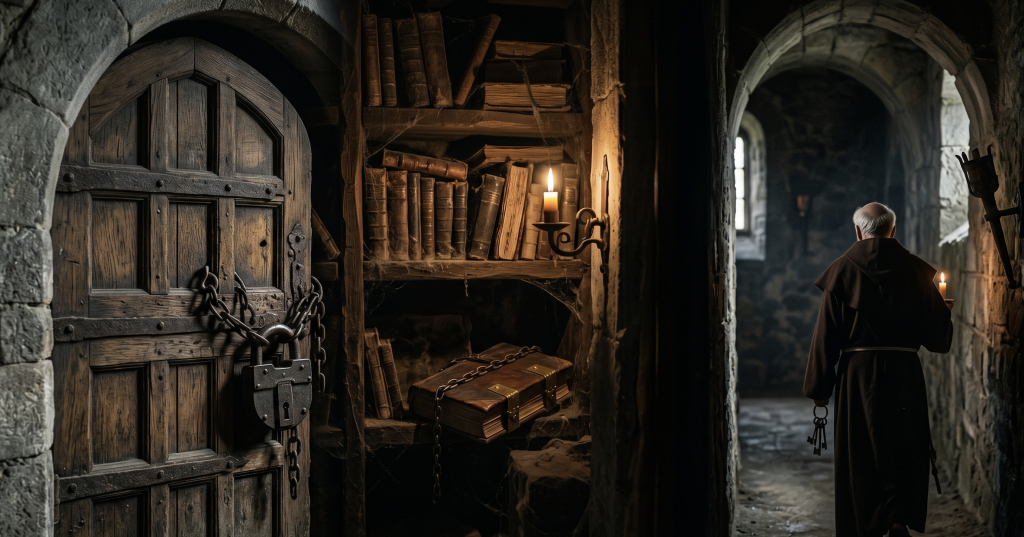
To be precise, the medieval Catholic Church did not completely forbid the Bible. On the contrary, Scripture was the Church’s most sacred text. However, the Church strictly controlled who could read it, in what language, and with what interpretation. Understanding the structure of that control is the key to everything.
2. The Three Pillars of Control
First, the language barrier — the Latin monopoly. In the late 4th century, Jerome’s Latin translation, the Vulgate, became the Church’s official Bible. The problem was that 99% of medieval European commoners could not read Latin. The Bible was, quite literally, an unreadable book. Even many priests failed to properly understand Latin. Scripture sat as a sacred object on the altar — not a book meant to be read.
Second, the monopoly on interpretation — “Only the Church interprets the Bible.” The Church developed the theory of the Magisterium early on. The meaning of Scripture could not be determined by individuals; only the authoritative interpretation of the Pope and Church councils was valid. This logic had a theological defense — preventing chaos in biblical interpretation. But in practice, it was a monopoly on knowledge and power.
Third, the Inquisition — a vernacular Bible was evidence of heresy. In the 12th and 13th centuries, the Waldensians and Cathars, who read and taught Scripture in their native languages, were condemned as heretics and massacred. The Council of Toulouse in 1229 officially banned laypeople from possessing vernacular Bibles. The Constitutions of Oxford in 1408 made it a heresy in England to translate or possess an English Bible without permission. Reading the Bible could be grounds for death.
3. What Did the Church Fear So Deeply? — An Anatomy of Power
To read the medieval Church’s control of Scripture simply as “a conspiracy of wicked clergy” is to miss the history entirely. In reality, there were far more complex, structural fears layered upon one another — theological fear, economic fear, political fear, and fear of social disorder.
Fear 1: The Collapse of Theological Authority — “Without Us, There Is No Salvation”
Medieval Catholic theology designed salvation as a series of processes managed by the Church. All seven sacraments — baptism, confirmation, Eucharist, penance, anointing of the sick, holy orders, and matrimony — could only be administered through a priest. In this structure, the priest was not merely a pastor but a gatekeeper of salvation.
The sacrament of confession was especially central. To receive forgiveness of sins, one had to confess to a priest, and the priest alone could pronounce absolution. Without a priest, there was neither forgiveness nor salvation. This was enormous power. The priest knew the most intimate sins and secrets of his parishioners, and through that knowledge could exercise psychological control over entire communities.
But when laypeople read Scripture directly, uncomfortable questions arose immediately. Jesus himself said:
“I am the resurrection and the life. Whoever believes in me, though he die, yet shall he live.” (John 11:25)
“For by grace you have been saved through faith. And this is not your own doing; it is the gift of God.” (Ephesians 2:8)
There is no priest in any of these passages. Faith alone suffices. The doctrines of purgatory, indulgences, and the system of saintly intercession all struggle to find direct grounding in Scripture. The moment these structures were placed before the question — “Where is this in the Bible?” — the entire thousand-year system of mediated salvation trembled. The Church knew this. And so it was afraid.
Fear 2: The Collapse of an Economic Empire — How Wealthy Was the Medieval Church?
At its height, the medieval Catholic Church owned approximately 30% of all land in Western Europe. In England, the figure was around 25–30%, and similar proportions held in France, Germany, and Italy. The Church was not simply a religious institution — it was Europe’s largest landowner and economic power.
Its revenue streams were diverse: land rents, compulsory tithes, benefices (whereby absent clergy collected income without rendering service), Mass offerings, fees for weddings, funerals, and baptisms, income from pilgrims, and, most infamously, the sale of indulgences.
An indulgence was originally a theological concept — a substitution for acts of penance. But by the 12th century it had degenerated into a cash transaction. Your sins, your ancestors’ sins, the suffering of souls in purgatory — all of it could be purchased with money. The sales pitch of Johann Tetzel, who provoked Luther’s fury in 1517, has passed into history:
“As soon as the coin in the coffer rings, the soul from purgatory springs.”
Pope Leo X was running this massive indulgence campaign to raise funds for the construction of St. Peter’s Basilica. The magnificent buildings of Rome were being built with the “salvation fees” of European commoners. When laypeople read Scripture, they encountered passages like these:
“Silver and gold have I none.” (Acts 3:6) — Peter’s own confession
“The love of money is a root of all kinds of evils.” (1 Timothy 6:10)
“Jesus lived without a single coin — so why is the Pope wealthier than the Emperor?” The spread of the Bible among the people meant the dismantling of the Church’s most profitable business model.
Fear 3: The Dissolution of Political Power — How Did the Pope Bring the Emperor to His Knees?
In 1076, Holy Roman Emperor Henry IV was excommunicated by Pope Gregory VII. Excommunication was not merely a religious sanction. Once excommunicated, a ruler’s subjects were released from their oaths of loyalty. Excommunication was, in effect, a political weapon capable of legally dismantling royal authority.
In January 1077, Henry IV stood barefoot in the snow before the castle of Canossa for three days, waiting for the Pope’s forgiveness. This was the Walk of Canossa — the moment the highest secular power in the world knelt before religious authority.
In 1302, Pope Boniface VIII declared in the papal bull Unam Sanctam:
“It is absolutely necessary for salvation that every human creature be subject to the Roman Pontiff.”
Every king, every emperor, every secular power — all were declared subordinate to the Pope. But when believers read the Gospels themselves, they discovered what Jesus said about power:
“The rulers of the Gentiles lord it over them… It shall not be so among you. But whoever would be great among you must be your servant.” (Matthew 20:25–26)
“My kingdom is not of this world.” (John 18:36)
Where in Scripture was the justification for the Pope reigning above emperors, bishops above nobles, and priests above commoners? The moment this question was asked aloud, a thousand years of political theology began to crack.
Fear 4: The Dissolution of Social Order — The Terror of “Neither Slave nor Free”
Medieval society was a rigidly stratified order. Serfs were born and died bound to the land. Nobles believed they governed by divine appointment. The Church provided the theological justification for this feudal order: “God has assigned each person their place. To remain in that place is faithfulness.” But what happened when a commoner read Galatians?
“There is neither Jew nor Greek, there is neither slave nor free, there is no male and female, for you are all one in Christ Jesus.” (Galatians 3:28)
The Song of Mary in Luke 1 — the Magnificat — is even more striking:
“He has brought down the mighty from their thrones and exalted those of humble estate; he has filled the hungry with good things, and the rich he has sent away empty.” (Luke 1:52–53)
Depending on who read it, this was the language of revolution. And indeed, in the German Peasants’ War of 1524–1525, peasants rose up with the Bible in their hands. Their Twelve Articles demanded, as the very first point, “the right to elect and dismiss our own pastors according to Scripture.” For the Church and the nobility, the spread of vernacular Bibles was not merely a religious matter. It was the detonator of social revolution.
Fear 5: The Chaos of Interpretation — The Most Sincere Theological Concern
To be fair, among the Church’s fears there was also a genuine theological concern. The Bible is not a simple book. Hebrew poetry, apocalyptic literature, the dense theological argumentation of the Pauline epistles — read without background knowledge, these texts invite misreading. And indeed, after the democratization of Scripture, numerous heretical interpretations and sects emerged.
The Church’s argument ran: “If uneducated people misread the Bible, their souls are placed in greater danger. We must teach them correctly.” This concern was not entirely without merit. The problem, however, was that this sincere worry was co-opted as an instrument of power. The stated intention to “protect” became the actual practice of “control.”
4. Those Who Stood Against the Injustice — The Blood of the Forerunners
Even before the Reformation, there were those who tried to return the Bible to the people. Every one of them paid a price.
John Wycliffe (1320–1384). An English theologian who declared that “the Bible is the law of every Christian, and every person must read it directly.” He translated the first English Bible. He died of natural causes during his lifetime, protected by powerful patrons — but thirty-one years after his death, in 1415, a Church council ordered his remains exhumed and burned. His ideas had already spread to Bohemia.
Jan Hus (1369–1415). A Bohemian theologian shaped by Wycliffe’s influence. He proclaimed: “The authority of Scripture is higher than that of the Pope.” He was given a guarantee of safe conduct to appear before a Church council — only to have that promise broken. He was burned at the stake. Just before his death he said: “Today you burn a goose” — Hus means goose in Czech — “but in a hundred years, a swan will come that you will not be able to burn.” A hundred years later, Luther came.
William Tyndale (1494–1536). The first person to translate the Bible directly from the Hebrew and Greek originals into English. He smuggled printed English New Testaments secretly into England. He was captured, strangled, and burned in 1536. His dying prayer: “Lord, open the King of England’s eyes.” Three years later, Henry VIII ordered an English Bible to be placed in every church in the land.
5. The Reformation — Three Weapons in the Fight
Weapon 1: The Printing Press — Gutenberg’s Revolution
Gutenberg’s movable-type printing press in 1450 changed the board of history. A single monk copying a Bible by hand required one to two years. The press produced hundreds of copies in the same time. The greatest physical barrier by which the Church controlled knowledge collapsed. Luther grasped it immediately:
“Printing is the ultimate gift of grace that God has given us.”
Weapon 2: Luther’s Two Principles
Martin Luther’s Reformation, which began with the Ninety-Five Theses in 1517, stood on two theological pillars.
Sola Scriptura — Scripture alone is the supreme authority for faith and life. Neither Pope, nor council, nor tradition may stand above it.
The Priesthood of All Believers — Every believer can stand directly before God. The priest as mediator is unnecessary.
These were not merely theological arguments. They were demolition charges placed at the very foundation of a thousand years of Church power. In 1521, standing before the Diet of Worms under threat of excommunication, Luther declared:
“My conscience is captive to the Word of God. I cannot and will not recant anything, since it is neither safe nor right to go against conscience. Here I stand. God help me.”
Weapon 3: Translation into the Vernacular
Luther, sheltered in Wartburg Castle, translated the New Testament into German in just ten months — an achievement that also unified the German language itself. Ordinary people read Scripture in their own tongue for the first time. Calvin translated into French, Zwingli into Swiss German, Tyndale into English. Across Europe, vernacular Bibles poured forth.
6. The Meaning of the Victory — Yet Still Incomplete
Did the Reformers win? Half the answer is yes.
The Bible finally reached the hands of ordinary people. It was translated into the languages of Europe, and the printing press produced hundreds of thousands of copies. Literacy rose, and the foundations of modern education were laid. The Protestant culture of “read Scripture for yourself” became the seed of modern democracy and the freedom of individual conscience.
Yet the victory also gave birth to new problems. The diversity of biblical interpretation produced hundreds of denominations and unleashed the tragedy of the Wars of Religion. The Catholic Church began its own reform through the Council of Trent (1545–1563), and today actively encourages laypeople to read Scripture.
7. A Final Theological Reflection
Seen through the eyes of faith, this history reveals a single great paradox. The Church hid the Word of God in the name of protecting it. But that Word ultimately opened its own way.
“The word of God is not bound.” (2 Timothy 2:9)
When Tyndale was burned, the Bibles he had smuggled had already passed through thousands of hands. When Hus was burned, his ideas had already caught fire in Luther. When Wycliffe’s bones were burned, his translation already existed in hundreds of manuscript copies scattered across the land.
The medieval Church was not a simple religious institution. It was the operating system that ran all of European civilization — theological, economic, political, and social. The democratization of the Bible was like releasing the source code of that operating system to everyone. Once the source code is public, anyone can find the bugs. Anyone can build a different version. The Church feared that.
And that fear was an accurate prophecy. The Reformation shook all of it. But what history has proven is this — there is no power capable of holding the living Word of God behind locked doors forever.
“The grass withers, the flower fades, but the word of our God will stand forever.” (Isaiah 40:8)
#Reformation #HistoryOfTheBible #MedievalChurch #MartinLuther #SolaScriptura #PriesthoodOfAllBelievers #WilliamTyndale #JanHus #Wycliffe #Indulgences #CatholicHistory #ChurchHistory #BibleTranslation #FaithAndHistory #HistoryOfChristianity


