

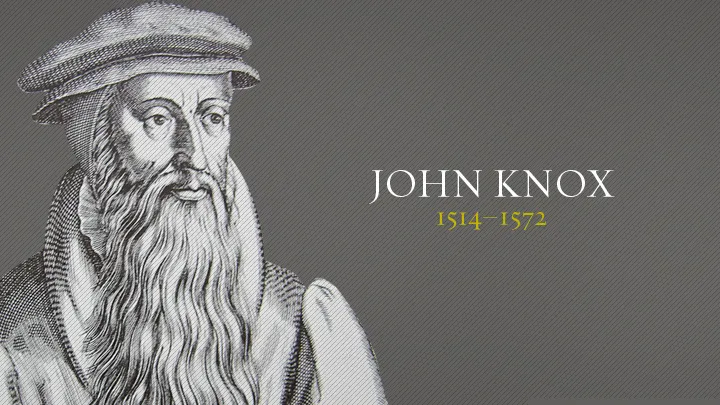
1. Scotland: The Land Where Reform Blazed
When we trace the deep roots of the Reformation, our journey naturally leads us to Scotland. While Luther proclaimed in Germany and Calvin taught in Switzerland, it was John Knox (c. 1514–1572) who blazed like fire in Scotland. He was no mere theorist. Even chained as a slave aboard a galley ship, he never lost his faith — and upon his return, he transformed the entire structure of a nation’s church and society.
Walking the cobblestoned streets of Glasgow and Edinburgh, one feels the weight of centuries of faith pressing through the very stones underfoot. John Knox stands at the center of that history.
2. A Teacher’s Death Awakens a Reformer — George Wishart
The decisive turning point in Knox’s life was the martyrdom of his mentor, George Wishart. Wishart was a forerunner who brought Reformed faith to Scotland, but was condemned as a heretic by the Catholic authorities and burned at the stake in 1546. Knox witnessed or heard closely of his teacher’s execution, experiencing a profound shock and awakening.
His teacher’s death set Knox ablaze. “Why does the Church fear the Word of God? The Scriptures comfort the weak and lift up the suffering — why does power seek to silence them?” These questions drove him onto the path of reform. He could no longer remain silent.
3. Slave on a Galley — Suffering Forges a Reformer
Knox’s life was anything but smooth. Scotland at the time was caught in complex political tensions with England and France, and Reformed believers faced constant threats amid the shifting Anglican establishment and royal power. Knox was eventually captured and forced to labor as a slave aboard a French galley ship.
Like a scene from the film Ben-Hur, he was chained and compelled to row for approximately two years under brutal conditions. Through storms, starvation, and extreme physical suffering, his faith did not break. On the contrary, suffering refined him. God’s Word was engraved ever deeper in his soul, and his conviction to one day return and build a church upon that Word only grew more fervent.
Suffering is sometimes God’s most powerful instrument. The galley could not destroy Knox. Instead, a harder, more enduring reformer was forged in that very place.
4. Meeting Calvin in Geneva — Completing the Theological Foundation
After his release from the galley, Knox traveled between England and the Continent, keeping his faith alive. He eventually arrived in Geneva, where John Calvin was at work.
Calvin, having fled persecution in France, had settled in Geneva and was building a Scripture-centered community of faith, freely teaching the Word and reforming the church. Knox found his theological framework fully shaped under Calvin’s instruction.
Knox would later describe Geneva as “the most perfect school of Christ that ever was in the earth since the days of the Apostles.” That experience in Geneva became the foundational axis that directed the entirety of his subsequent ministry.
5. Return to Scotland — Establishing Reform as Institution
Armed with Calvin’s theology, Knox returned to Scotland. His proclamation was bold. He did not shrink from confronting the Catholic forces that held the Scottish court — especially the regency of Mary of Guise under French influence, and later Mary Queen of Scots.
He did not merely preach. He gave Reformed faith institutional and structural form. The result was the Presbyterian Church. Presbyterianism, grounded in Calvin’s theology and institutionally established in Scotland by Knox, became a lasting expression of the Reformed faith community.
In 1560, the Scottish Parliament officially adopted Protestant Christianity as the national religion, and the Scots Confession — to which Knox was a principal contributor — was proclaimed. This stands as one of the earliest and most representative instances of Reformation faith being established at a national and institutional level.
6. Sola Fide, Sola Gratia, Sola Scriptura
The pillars of the Reformed faith Knox built upon were three:
Sola Fide — Faith Alone Sola Gratia — Grace Alone Sola Scriptura — Scripture Alone
These were not mere theological slogans. They were the confession of a life that refused to let go — on a galley ship, before royal power, in the face of death itself. They were a declaration that not human tradition or authority, but only the Word of God, is the final standard for the Church and for life.
The Word of Scripture comforts the weak, raises the suffering, and proclaims freedom to those who groan under oppression. There is no reason to fear such a Word. Rather, the Church must be continually reformed before that Word. This was Knox’s cry — and it is the heritage of faith we must hold fast today.
7. Knox’s Legacy — What He Left for Us
John Knox died in Edinburgh in 1572. A single line is said to have been inscribed near his grave:
“Here lies one who neither flattered nor feared any flesh.”
The legacy he leaves us today is clear. Reform does not end with one generation. The Church must always return to stand before the Word. Whenever institutions calcify and authority seeks to override Scripture, a voice like John Knox’s must ring again through history.
Upon the cobblestones of Scotland, in the chains of a galley ship, from the pulpit before royal power — the Word Knox proclaimed is still alive. We stand upon that Word.
Bible Verses for Meditation
“God is our refuge and strength, a very present help in trouble.”→ This was the confession Knox held onto even while bound in the chains of a French galley. No earthly power can strip away the refuge we find in God.
“All Scripture is breathed out by God and profitable for teaching, for reproof, for correction, and for training in righteousness, that the man of God may be complete, equipped for every good work.”→ The declaration of Sola Scriptura (Scripture Alone). These were the words Knox established as the sole standard for the reformation of the Church.
“For in it the righteousness of God is revealed from faith for faith, as it is written, ‘The righteous shall live by faith.'”→ The foundation of Sola Fide (Faith Alone). This is the core of the Gospel passed down from Luther to Calvin, and from Calvin to Knox.
“For by grace you have been saved through faith. And this is not your own doing; it is the gift of God, not a result of works, so that no one may boast.”→ Sola Gratia (Grace Alone). This represents the essential truth of the Gospel that the Reformation sought to restore to the world.
“But they who wait for the Lord shall renew their strength; they shall mount up with wings like eagles; they shall run and not be weary; they shall walk and not faint.”→ A passage revealing the source of a faith that remains unexhausted even in extreme suffering. It was likely the strength that sustained Knox through his two brutal years as a galley slave.
“But Peter and the apostles answered, ‘We must obey God rather than men.'”→ This is the reason Knox never compromised before monarchs or religious authorities. His refusal to fear any man was rooted firmly in this command.
“Be faithful unto death, and I will give you the crown of life.”→ A verse that reminds us of the martyr George Wishart and the promise the Reformers clung to at the risk of their lives. Faithfulness in Christ is far stronger than any threat the world can pose.


