

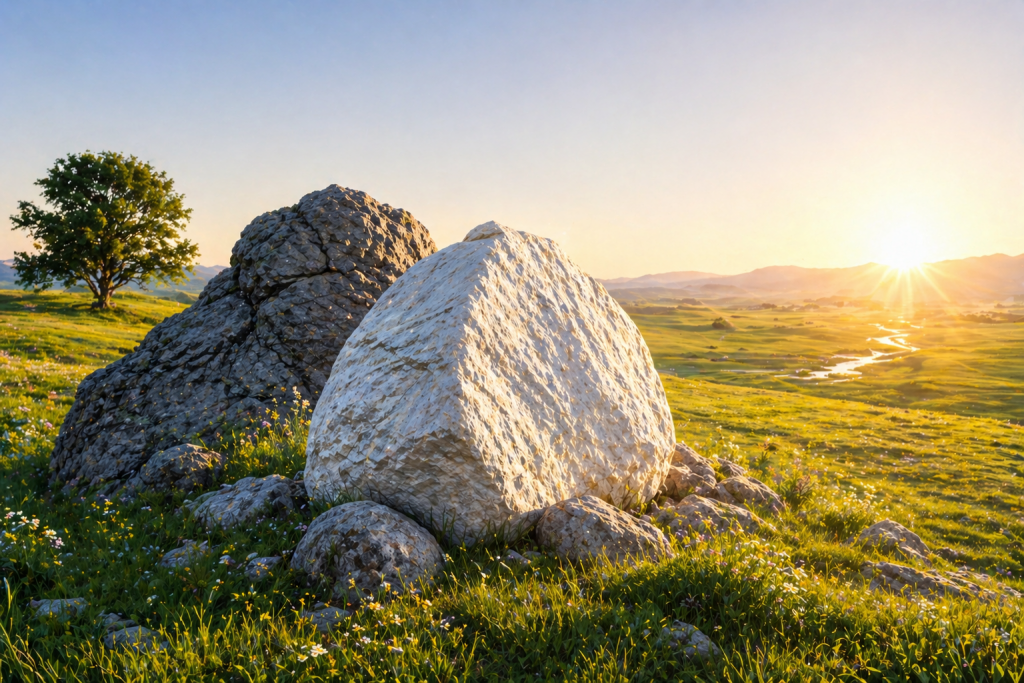
Peter’s name in Greek means “rock.” This was no accident. When Jesus said to Simon, “You are Peter,” he was declaring an identity — an unshakeable foundation. A rock is solid, steadfast, capable of bearing weight.
But what Peter confesses in chapter 2 of his letter is not just any rock. It is a living stone.
“As you come to him, the living Stone — rejected by humans but chosen by God and precious to him.” (1 Peter 2:4)
The two words together seem like a contradiction. A stone is dead — static, fixed, immovable. But this stone is alive. Alive means having life, having the ability to act, to work, to move, to pass life on to others. Not a stone fixed in one place, but a stone that can become a foundation anywhere, in any circumstance. This is Jesus Christ.
Rejected by People, Chosen by God
When Peter wrote these words, his readers were people pushed to the margins of society — slaves, women, believers persecuted by the Roman Empire. In the eyes of the world, they were the rejected ones. And the one they believed in had also been rejected. Rejected by religious leaders, abandoned by his own disciples, nailed to a cross — like a stone thrown aside by builders as useless and worthless.
But God chose that stone and placed him as the cornerstone. The direction of the entire building is determined by this one stone. What does this mean for us? It means that being rejected by the world is not the same as being rejected by God. The rejection, the misunderstanding, the being overlooked that you have experienced — that is not your ending, just as the cross was not his ending.
You Are Living Stones Too
“You also, like living stones, are being built into a spiritual house to be a holy priesthood.” (1 Peter 2:5)
You are also living stones. Not spectators, not an audience inside the building, but the building material itself. You are placed into this spiritual house, fitted together with other living stones, together becoming the dwelling place of God.
The nature of a living stone is that it passes life on. Peter stood unshaken through persecution, stood firm in Rome even facing death, and the life inside him has been passing down to this day. What was the foundation he stood on? Two unshakeable confessions.
The first is a confession of Christology: “You are the Messiah, the Son of the living God.” (Matthew 16:16) Jesus is not a good teacher, not a moral example. He is God himself entering history, becoming flesh, coming to save us. The second is a confession of Soteriology: “Salvation is found in no one else, for there is no other name under heaven given to mankind by which we must be saved.” (Acts 4:12) These were Peter’s words before the Sanhedrin, filled with the Holy Spirit. Salvation does not come through human effort, through religious ritual, through anything we do — it comes through one name alone: Jesus Christ.
These two confessions are the true foundation that kept Peter standing as a living stone, unmoved by any persecution. We can study a great deal of theology and grasp all kinds of concepts, but if they remain only knowledge in our heads and never become unshakeable confessions in our lives, they are of no use. The purpose of theology is not to make us more learned — it is to make us more like Peter: a living, unshakeable stone.
Are You a Living Stone or a Dead Stone?
A stone can be dead — fixed in place, silent, passing no life to anyone. Faith can be dead too — you hear it, you walk away, you forget it. But a living stone is different. A living stone moves, works, and lets life flow out to the people around it.
So how do we become living stones? We need the help of the Holy Spirit. We need to pray.
Elisha gives us the clearest example. When Elijah was about to be taken away, Elisha could have asked for anything. What he asked for was this: “Let me inherit a double portion of your spirit.” (2 Kings 2:9) He saw in Elijah a life that could not be shaken, an anointing and power of God’s Spirit, and he wanted nothing else but for that same Spirit to fill him. The Spirit who worked in Peter, the Spirit who worked in Elijah — it is the same Spirit, and he can work in you and me today.
Don’t settle for being a silent, dead stone. Ask the Holy Spirit to come. Let those two confessions become not just things you know in your head, but the unshakeable foundation of your life. Let him make you a living stone — one that moves, works, and passes life on to others.“As you come to him, the living Stone — rejected by humans but chosen by God and precious to him — you also, like living stones, are being built into a spiritual house to be a holy priesthood, offering spiritual sacrifices acceptable to God through Jesus Christ. For in Scripture it says: ‘See, I lay a stone in Zion, a chosen and precious cornerstone, and the one who trusts in him will never be put to shame.'”— 1 Peter 2:4-6


