

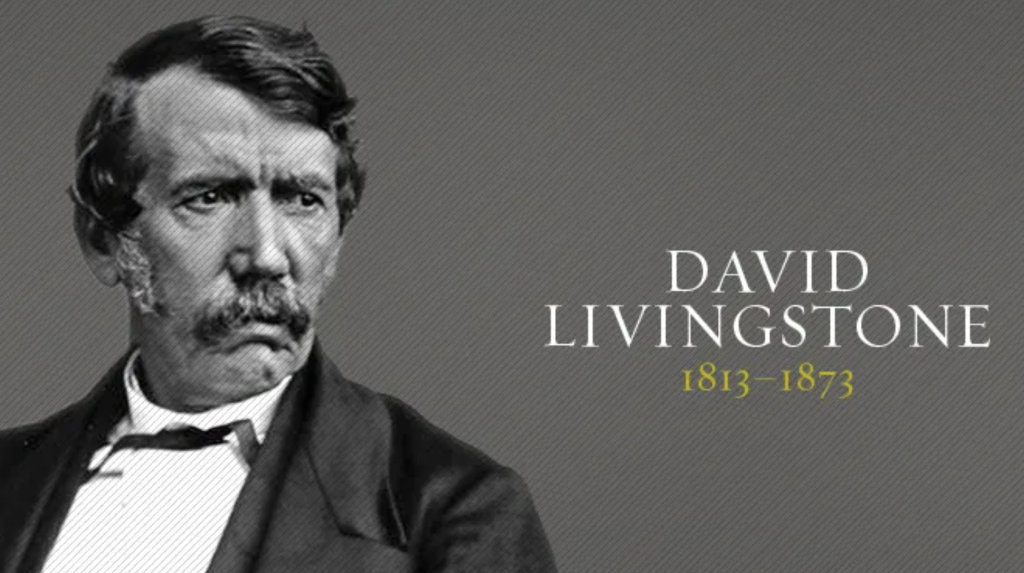
Introduction — One Man’s Calling
History is filled with people who swam against the tide of their age, responding to the voice of conscience. David Livingstone (1813–1873) was one of them. He was neither a mere explorer nor a vanguard of imperialism. He was a missionary and a man of God who felt a profound sense of responsibility before the enormous evil of Africa’s slave trade, and who devoted his entire life to that land out of love.
His motto is still engraved on his statue at Victoria Falls to this day — “Christianity, Commerce, and Civilization.” These three words were no mere slogan. They were one man’s declaration of faith — his commitment to liberating a suffering Africa through the gospel.
1. A Poor Boy Receives His Calling
Livingstone was born in 1813 in Blantyre, Scotland, one of seven children in an impoverished family. His family lived in a single room of a tenement, and Livingstone was put to work in a cotton mill at the age of ten. Yet he studied at school by night after working in the factory by day, fueled by an indomitable hunger for knowledge. With part of his first week’s wages, he bought a Latin grammar.
He was a devoted evangelical Christian whose conversion came when he realized that faith and science were compatible. He trained in medicine at Anderson’s College in Glasgow while preparing for the path of medical missionary, and was accepted by the London Missionary Society (LMS) in 1838.
He had originally intended to go to China, but the Opium Wars closed that door. In its place, a conversation with Robert Moffat — who would become his father-in-law — redirected his life entirely. Moffat said to him: “There is a vast plain to the north where, in the morning sun, I have sometimes seen the smoke of a thousand villages — where no missionary has ever been.” Livingstone’s heart caught fire.
2. To Africa — Confronting the Horror of Slavery
On March 14, 1841, Livingstone set foot for the first time in Cape Town, South Africa. From the very beginning, he felt a fierce revulsion toward the attitudes of Europeans who exploited the African people. Mingling freely among the local people, healing their diseases, and disarming their hostilities in unusual ways, he soon concluded that “a noble and true heart was a better mainspring to overcome and direct raw natives than the abuse heretofore given them.”
The deeper he pressed into the interior, the more horrifying the reality of the slave trade became. He witnessed the Portuguese and Arab-Swahili traders trafficking in human lives, and saw over three hundred Africans massacred before his eyes. For Livingstone, this was not merely a humanitarian outrage. Human beings, created in the image of Christ, being sold like livestock — this was rebellion against God Himself.
He made the abolition of Africa’s slave trade his primary goal. His conviction was that the combination of Christian mission and legitimate commerce could replace the slave trade, and in doing so, restore the dignity of Africans in the eyes of Europeans.
3. Exploration and Mission — Walking to Open the Way
Livingstone’s approach to mission was revolutionary for his time. He refused to remain at a single mission post, pressing ever onward into unknown interior territory. His conviction was simple:
“I shall open up a path into the interior, or perish.”
Over the course of a thirty-two-year missionary journey, he walked 29,000 miles across the African interior, preaching the gospel and mapping the continent.
Along the way, he became the first European to see Victoria Falls in 1855, and the first European to cross the full width of the African continent. His book Missionary Travels and Researches in South Africa, published in 1857, became a bestseller in Britain, igniting the hearts of countless young people with the passion for mission.
Britain was in the grip of powerful Christian revival at the time, and a series of Livingstone’s addresses at Cambridge University so fired young students that the Universities’ Mission to Central Africa (UMCA) was founded in 1860.
4. Malawi — The Land Where the Gospel First Arrived
On September 17, 1859, Livingstone became the first missionary to bring the gospel to the land now known as Malawi. At Cape Maclear, a tree still stands under which he used to sit and study Scripture, preparing to evangelize the Yao people.
His exploration of Malawi opened the door for countless missionaries who came after him. Today, Malawi is one of the African nations with the highest proportion of Christians in its population. The footsteps of one man shaped the entire faith history of a nation.
5. A Solitary Death and an Eternal Legacy
Livingstone’s final years were a succession of loneliness and suffering. His wife Mary died of fever on the banks of the Zambezi in 1862. Even as his body weakened, he refused to leave Africa.
In 1871, American journalist Henry Stanley found the long-silent Livingstone near Lake Tanganyika. The words from that historic encounter — “Dr. Livingstone, I presume?” — have echoed through history ever since.
In 1873, his servants found him dead, kneeling in prayer. They embalmed his body and carried it overland to the Indian Ocean — a journey of nine months. He was buried in Westminster Abbey in a solemn national funeral.
The news of his death shook the world, and moved thousands of people to embrace his lifelong conviction — “the end of the exploration is the beginning of the enterprise.” Africa at once became the most favored field for missionary work across virtually every Christian denomination.
6. His Imprint on Christian History
Livingstone’s legacy in the history of Christianity can be summarized in three enduring contributions.
First, the pioneer of Central African Christianity. Every land he walked through is now home to large Christian communities. In a very real sense, Livingstone is the pioneer of Central African Christianity.
Second, the spiritual force behind the abolitionist movement. He understood the abolition of slavery not merely as humanitarian work but as a demand of the gospel itself. His testimony and writings moved the British Parliament and the international community, exerting direct influence on the abolition of the East African slave trade.
Third, the popularization of the missionary movement. Livingstone’s life and writings became one of the most powerful motivating forces drawing young men and women in Europe and North America to the mission field in the latter half of the nineteenth century. His legacy inspired and influenced thousands of believers to reckless abandonment to the Great Commission and the fight against human slavery.
Conclusion — Footsteps of Atonement
Livingstone was not a perfect man. He was a father who failed his family, sometimes a dogmatic leader, and a man who could not fully escape the limitations of the imperialist age in which he lived. Yet he was a man seized by God’s love for Africa.
His life puts a question to each of us: How do we respond to the sins of our age? Do we remain comfortable in the face of injustice — or do we go out, compelled by the love of Christ, to open the way?
He confessed:
“I am a missionary, heart and soul. God had an only Son, and He was a missionary and a physician.”
True to that confession, Livingstone remained a missionary until his final breath. His last posture — found kneeling in prayer — was itself a sermon.
📖 Related Scripture Passages
- Isaiah 6:8 — “Then I heard the voice of the Lord saying, ‘Whom shall I send? And who will go for us?’ And I said, ‘Here am I. Send me!'” — The archetype of Livingstone’s calling
- Matthew 28:19–20 — “Therefore go and make disciples of all nations…” — The Great Commission, the foundation of his life
- Luke 4:18 — “The Spirit of the Lord is on me, because he has anointed me to proclaim good news to the poor…” — The integration of gospel and liberation
- Galatians 3:28 — “There is neither Jew nor Gentile… for you are all one in Christ Jesus.” — The theological basis for opposing slavery and racial hierarchy
- John 15:13 — “Greater love has no one than this: to lay down one’s life for one’s friends.” — The self-sacrificial nature of mission
- Psalm 2:8 — “Ask me, and I will make the nations your inheritance.” — God’s intention for all peoples
- Romans 10:14–15 — “And how can anyone preach unless they are sent? As it is written: ‘How beautiful are the feet of those who bring good news!'” — A biblical tribute to the missionary’s footsteps


