

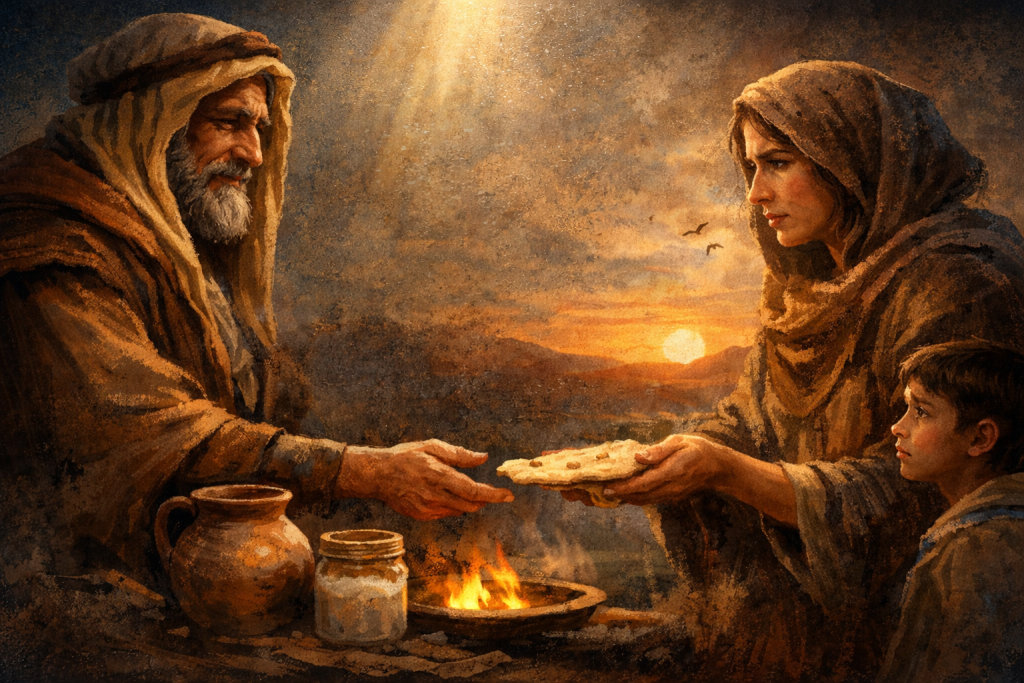
Three thousand years ago, a woman bent down to pick up firewood.
Not for warmth. For her last meal.
Her jar held only a handful of flour. Her jug, only a little oil. After she and her son ate this meal, they would wait to die. This wasn’t metaphor, wasn’t self-pity — it was literal. Eat. Then die.
At that exact moment, a stranger walked up and said: “Give me a little water to drink.”
Then: “Bring me a piece of bread too.”
Was This Man Robbing Her?
That anger is reasonable.
When a person is at their most destitute, most desperate, closest to death — and someone walks up and asks for something — what’s your first reaction? This man is insane? Heartless? Or simply doesn’t care whether poor people live or die?
Elijah was a prophet. In ancient culture, prophets held sacred authority. Which raises the question: did that authority give him the right to take what little this woman had left?
There’s a distinction here worth thinking through carefully.
Authority means you occupy a position and act in service of something larger than yourself. Elijah didn’t come to this woman to fill his own stomach — if that were all, God could have fed him in countless other ways. His arrival was meant to trigger a turning point in her life. He was an instrument, not a beneficiary.
Authoritarianism means you exploit that position to make yourself appear higher, stronger, more important. The authoritarian takes to prove that he can take. At its core, authoritarianism is self-inflation.
Elijah’s request looked like exploitation on the surface. In reality, it was an invitation. What he was saying was: “Do you believe that after you give it away, there will still be more?”
This wasn’t plunder. It was a test of trust — not trust in Elijah, but trust in whether life itself is generous.
What Kind of Struggle Did That Woman Go Through?
Let’s not skip over this question.
The moment she heard his request, a war must have broken out inside her.
On one side: This is all I have left. I still have my son. Why should I? Who are you?
On the other side — something she couldn’t quite name. Maybe a certainty she saw in this stranger’s eyes. Maybe a hope she had long since abandoned but hadn’t quite let die. Or maybe just the strange clarity that comes when you’ve hit absolute bottom: I’m going to die anyway. Might as well bet on something.
What she said out loud was: “We will eat it, and then we will die.”
That sentence carries exhaustion, resignation — but also a strange kind of openness. People who have truly lost everything sometimes make the bravest choices, precisely because there’s nothing left to lose.
What she relied on wasn’t certainty about the future. It was trust in the choice itself, in that present moment.
She made the bread. She gave it away first.
And then — the flour did not run out. The oil did not fail. She, her son, and Elijah ate for many days.
What Does This Have to Do With Us?
Many people read this and think: that’s a miracle, a religious story — nothing to do with my real life.
But set the miracle aside for a moment and look at the structure.
A person on the edge of exhaustion is asked to give first. She gives. And she discovers that she didn’t die from it — instead, she entered a kind of ongoing provision.
That structure shows up in every relationship we have.
In Marriage
After two people have been together for a while, they almost always hit this point: I’ve already given so much. I’m tired too. I need to be taken care of too. Why is it always me who gives first?
That exhaustion is real and shouldn’t be dismissed.
But here’s something worth noticing: when both people are waiting for the other to give first, the relationship enters a slow withering. Everyone is keeping score, everyone is on defense, everyone is waiting for the other to say sorry first, reach out first, show vulnerability first.
“Giving first” is not weakness. It’s not people-pleasing. It’s not the absence of boundaries.
It’s a deliberate choice — I refuse to let this relationship die in the waiting.
The widow of Zarephath didn’t wait for the famine to end before she gave. She gave at her emptiest. Some relationships find their turning point precisely in that moment when you least want to give — and you give anyway.
In the Workplace
Servants and masters, employees and bosses, staff and leadership — these relationships are full of tension.
True authority is not suppression. It’s direction. A leader with genuine authority exists to make the people around them better, not to make themselves irreplaceable. When they ask something of others, it’s to draw something out — not to take possession.
Likewise, a subordinate who truly respects leadership doesn’t follow blindly. They understand the direction, and then they’re willing to bring their best — not out of fear, but out of trust that the thing they’re part of is worth it.
In an authoritarian workplace, everyone is in self-preservation mode. Nobody dares bring their real best, because bringing it out only means it gets taken — not seen.
But some teams have a strange vitality — people go beyond their job descriptions, because they believe their effort will flow back to them somehow, in some form. That belief is the widow standing in her kitchen before she lights the fire.
In Family
Parents and children. Children and parents.
The most common mistake parents make is turning sacrifice into debt. “Look at everything I’ve done for you” — underneath that sentence is: you owe me. That’s not giving. That’s investment, and investment that demands a return. What the child feels isn’t love — it’s pressure. It’s a kind of hostage-taking. This is authoritarianism: using sacrifice to establish control.
Much of what looks like teenage rebellion isn’t resistance to guidance. It’s resistance to the structure of “you must be grateful, you must listen, I decide.”
True giving looks like this: I give to you not so that you’ll owe me, but because I believe that when you receive this, you’ll become someone better — and that itself is enough for me.
Children feel the difference. It’s free. It doesn’t come with conditions.
In a World That’s Always Grabbing — Where Is the Living Hope?
We live inside a story of scarcity.
We’re told that resources are limited, positions are limited, love is limited, time is limited — so grab, move fast, guard yourself, get there first.
That story isn’t entirely false. Resources really are finite. Competition really does exist.
But it leaves something out: some things increase the more you give them away.
Not everything works this way. Money given away is gone. Time given away is spent.
But trust given away tends to bring back more trust. Respect offered tends to open respect in return. When you’re willing to lower your defenses first in a relationship — to admit you need help, to say “I need you” — the other person’s defenses often soften too.
The widow’s flour didn’t diminish. The oil didn’t run dry. Taken literally, that’s a miracle. But in the dimension of human relationships, it’s a dramatic expression of a universal pattern: when you’re willing to give at your emptiest, you enter a different kind of economy.
Not because giving guarantees a return.
But because the act of giving itself transforms you — from someone defending to someone flowing. A person in defense is closed. Nothing can get in. A person in flow is open to receive.
Finally
That woman picking up firewood didn’t wait for conditions to improve before she gave.
At her worst moment, she made a choice that went against instinct — she gave first.
Not because she had any guarantee. But because in that moment, she chose to believe another possibility existed.
This isn’t religion. It’s a posture toward life.
In your marriage, your work, your relationship with your parents, your friendships —
Maybe right now you’re also picking up firewood. Maybe your jar holds only a little flour and your jug only a little oil.
Of course you’re afraid to give it away.
But sometimes, inside that fear, there is a door.


