

Introduction
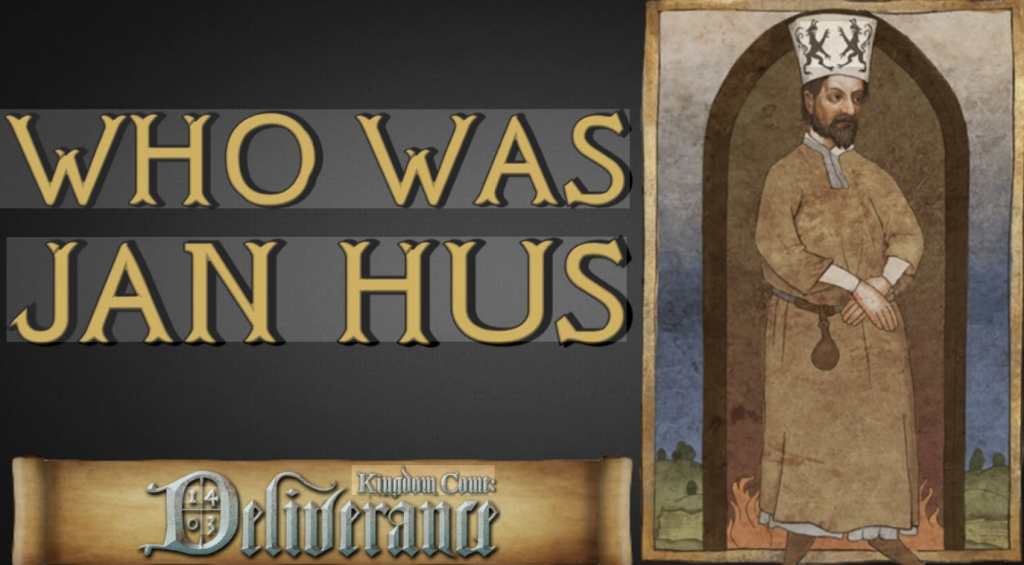
On July 6, 1415, a Bohemian theologian was led to a stake in the square of Constance. His name was Jan Hus. Before the fire was lit, he cried out: “Truth prevails (Pravda vítězí).” Exactly one hundred and two years later, Martin Luther nailed his Ninety-Five Theses to the door of the Wittenberg Castle Church. Hus’s flame had not been extinguished. It had spread underground, waiting to rise again as a fire that would transform all of Europe.
1. Who Was Jan Hus?
Jan Hus was born in 1369 in a humble farming family in southern Bohemia, in what is now the Czech Republic. He studied at the University of Prague, eventually rising to serve as its rector, and became a brilliant preacher and theologian. The corruption of the Church in his day had reached an extreme: simony (the buying and selling of church offices), the traffic in indulgences, and the worldliness of papal power had become the norm. Through the writings of the English theologian John Wycliffe, Hus found the spark of reform. He then carried that fire directly to the people, preaching in Czech at the Bethlehem Chapel in Prague.
His core arguments were simple yet revolutionary. First, Scripture holds a higher authority than popes or councils. Second, the head of the Church is Christ, not the pope. Third, the full communion of both bread and wine must be restored to the laity. Fourth, the moral corruption and financial abuses of the clergy must be reformed at once. These were not merely personal grievances — they were a theological challenge to the entire structure of medieval Christianity.
2. The Council of Constance and Martyrdom
In 1414, Holy Roman Emperor Sigismund promised Hus safe conduct and asked him to appear before the Council of Constance to defend his views. Hus accepted, seeing it as an opportunity to present his case openly. But the council was, from the beginning, a trial. Condemned as a heretic, Hus was offered only one choice: to recant.
He refused.
“I am willing to retract anything from my teaching that can be proven to be in error. But I cannot recant what is in accordance with the truth of Scripture.”
On July 6, 1415, he was burned at the stake. According to accounts passed down through history, as the executioner lit the fire, Hus was singing. That flame became the signal of a religious awakening that would shake Bohemia — and ultimately all of Europe.
3. The Hussite Movement and Its Historical Legacy
After Hus’s martyrdom, Bohemia was plunged into upheaval. His followers took up arms against the crusades launched by the pope and the Holy Roman Empire. This was the Hussite Wars (1419–1434). Remarkably, the Hussite forces — outnumbered and outmatched on paper — repelled five successive crusades. This demonstrated to all of Europe that the medieval Church was not invincible.
The most moderate wing of the Hussite movement eventually formed the Bohemian Brethren (Unitas Fratrum). This community, after the Reformation, became the Moravian Church, which went on to play a significant role in the eighteenth-century evangelical revival movements.
4. Luther’s Confession: “We Are All Hussites”
At the Leipzig Debate of 1519, Luther’s opponent Johann Eck accused him of holding the same heretical views as Jan Hus. Luther was initially unsettled by the comparison. But after reading Hus’s writings directly, he was struck — and he made a remarkable declaration:
“We are all Hussites (Nos omnes Hussitae sumus)!”
The central pillars of Luther’s Reformation — Sola Scriptura, the rejection of papal infallibility, the condemnation of indulgences — were themes Hus had already raised a century earlier. Hus was not merely a source of inspiration for Luther. He was a theological precedent and a living example that faith could indeed be worth dying for.
5. Hus’s Place in the Stream of Reformation
The Reformation did not begin suddenly with Martin Luther. It was a long current running from Wycliffe to Hus, and from Hus to Luther. Hus was its most decisive link. He refined the theological arguments, sealed them with his martyrdom, and through the Hussite movement proved to history that reform was not only necessary but possible.
In the Czech Republic today, Jan Hus is remembered both as a national hero and as a martyr of the faith. His statue stands in the center of Prague’s Old Town Square. But in a deeper sense, he was a man of faith who demonstrated — with his very life — that it is possible to stand before power and hold to truth alone.
The flames consumed him. But the truth survived.
Seven Key Scripture Passages
1. John 8:32 “You will know the truth, and the truth will set you free.” This verse runs through the entirety of Hus’s life. He believed the truth of Scripture stood higher than papal authority, and he chose death over the abandonment of that truth. Paradoxically, his death set millions free within that truth.
2. Acts 5:29 “We must obey God rather than human beings.” When the Council of Constance pressured him to recant, Hus held to this principle. He demonstrated with his life that obedience to God’s Word, above any human institution or authority, is the believer’s first and highest duty.
3. 2 Timothy 3:16–17 “All Scripture is God-breathed and is useful for teaching, rebuking, correcting and training in righteousness, so that the servant of God may be thoroughly equipped for every good work.” Hus’s insistence on Scripture as the supreme authority over papal decrees was rooted in this passage. The sufficiency and authority of the Bible was the starting point of his theology — a conviction that bloomed fully in Luther’s Sola Scriptura.
4. Matthew 16:18 “On this rock I will build my church, and the gates of Hades will not overcome it.” Hus emphasized that the head of the Church is Christ, not the pope. The true Church is not built on human institution but on Christ the Rock. This was the cornerstone of his ecclesiology.
5. Revelation 2:10 “Be faithful, even to the point of death, and I will give you life as your victor’s crown.” Hus did not waver before the stake. His martyrdom was a living testimony to these words. He chose the life of heaven over the life of earth — and that choice altered the course of history.
6. Romans 1:17 “The righteous will live by faith.” The gospel of grace and faith that Hus proclaimed stood upon this verse. When Luther found in this passage the spark of the Reformation, he was walking the same road Hus had walked a century before.
7. Isaiah 40:8 “The grass withers and the flowers fall, but the word of our God endures forever.” The council that condemned Hus, the flames that consumed him — all of it has faded into history. But the Word of God he gave his life to protect survived, spreading across all of Europe through the Reformation. Truth did indeed prevail.


