

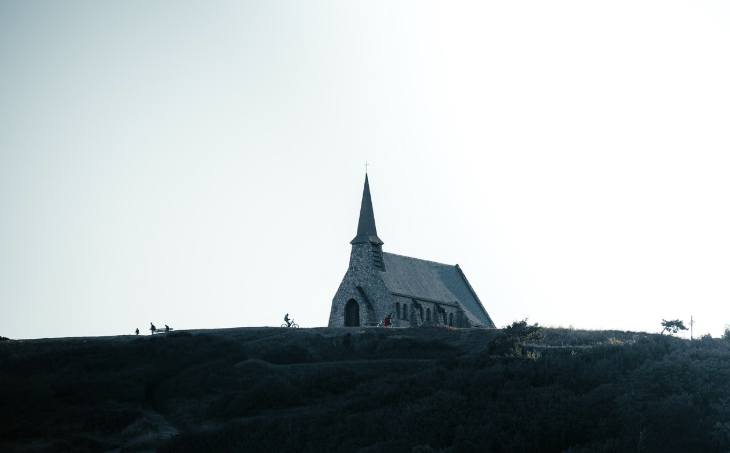
Most churches today revolve around a single Sunday gathering. The doors open on Sunday morning and close by noon, and the congregation scatters back into their individual lives. In the meantime, the world never stops. YouTube algorithms pour out messages around the clock, social media continuously shapes how people see the world, and the digital public square never falls silent. But the church?
This is not merely a question of how often we meet. It is a question about the very nature of the church — what it means to be a community (κοινωνία, koinonia). The early church did not gather daily out of obligation. The presence of the Holy Spirit drew them together, love for one another bound them, and the urgency of bearing witness to the world propelled them forward.
Why the Early Church Gathered Every Day
The daily gathering of the Jerusalem community was no accident. After the outpouring of the Holy Spirit at Pentecost (c. AD 30), three thousand people were baptized in a single day, and this new community immediately formed four rhythms of life: the apostles’ teaching, fellowship (koinonia), the breaking of bread, and prayer (Acts 2:42).
Within the social structures of the Roman Empire, these gatherings were anything but ordinary religious meetings. Slave and free, Jew and Greek, rich and poor sitting at the same table — that itself was a revolution. They gathered daily because they were experiencing the real presence of the living Christ among them. The risen Lord was with them, and that reality drew them together day after day.
The church father Tertullian (c. 155–220) recorded in his Apologeticus that pagans who witnessed the Christian community were astonished at the extraordinary love they saw among believers. The shared nature of their faith flowed into the shared nature of their lives, and the shared nature of their lives became a testimony to the world. How often they gathered was a measure of the temperature of their faith.
The Church That Opens Only on Sundays: What Have We Lost?
After the Reformation, the Protestant church rightly established Word-centered Sunday worship as its core. This was a proper emphasis. The church order that John Calvin (1509–1564) established in Geneva centered on Sunday worship but wove together Wednesday and Friday prayer meetings, small-group Bible study, and local community relief work alongside it. Sunday worship was the center — but it was never meant to be the whole.
Somewhere along the way, we began to reduce Sunday worship to “the totality of the Christian life.” Once a week, ninety minutes — this became the average Christian’s religious activity. The remaining 167 hours were left to the individual.
But the world never leaves those 167 hours empty. Netflix uploads new content every day, influencers propose ways of living, and social media delivers anger, anxiety, and desire with algorithmic precision. The world’s sanctuary is open 24 hours a day. The church opens its doors on Sunday morning and closes them by noon.
What has been lost is not merely the frequency of gathering. We have lost the community’s capacity for discernment — the ability to read Scripture together, to pray together, to interpret the world together through the eyes of God. When that is gone, believers are exposed to the waves of the world one by one, alone. How exhausting it is to swim against the current by yourself — and we are now paying the price for that exhaustion.
The World Never Stops Sending Its Messages
Media theorist Neil Postman warned as early as 1985, in his landmark book Amusing Ourselves to Death, about the ways television was flattening public discourse. Forty years later, we each carry a personal broadcasting station in our pockets. Algorithms learn our preferences and are engineered to provoke outrage and anxiety in order to maximize the time we spend scrolling.
This is spiritual warfare. Paul writes in Ephesians 6, “For we do not wrestle against flesh and blood.” Today, much of that wrestling takes place on our smartphone screens and within the logic of algorithms. World views are formed there. Values are eroded there. Desires are shaped there. Every one of those places demands a counter-narrative from the church.
The believers of the early church gathered daily in part because the world they inhabited was never hospitable to the gospel. Surrounded by emperor worship, polytheistic culture, and the constant threat of persecution, they could not stand alone. They came together to hear the Word, to reinterpret reality through God’s eyes, and then went back into the world carrying the power of that interpretation. The digital environment we face today may be threatening the faith of believers just as relentlessly as the persecuting culture of the early church.
Salt and Light: How Do We Recover What Has Been Lost?
In the Sermon on the Mount, Jesus declared to his disciples, “You are the salt of the earth… You are the light of the world” (Matt. 5:13–14). Salt penetrates and prevents decay; light shines out and drives away darkness. Both images show that the church’s way of being in the world is not inward gathering but outward penetration.
Yet to penetrate, one must first be salt. To give light, one must first be on fire. The fundamental reason the church fails to influence the world is not that it has failed to go out into the world — it is that believers go out before they have been sufficiently formed within the community of the church. The less time we spend gathering together, the more easily we are absorbed into the grammar of the world.
So what is to be done? The answer is not elaborate programs. The early church’s way was simple: they met in homes. They shared tables. They entered into one another’s lives. Today, this might look like a small group, a house church, or a midweek gathering facilitated online. More important than the form is the question it asks: “Are we still together after Sunday?”
What the church needs to recover is not simply a higher frequency of meetings, but the communal texture of everyday life — eating together, praying together, chewing on the Word together, going to our neighbors together. The rhythm of that life is what must be restored. The church in the digital age needs a more resilient, embodied community. In an age when algorithms isolate individuals, the table of the church must grow wider.
Again — Day by Day
The author of Hebrews writes: “And let us consider how to stir up one another to love and good works, not neglecting to meet together, as is the habit of some, but encouraging one another, and all the more as you see the Day drawing near” (Heb. 10:24–25). Eschatological urgency becomes the engine of communal gathering. The closer the Day of the Lord, the more we must draw together — not scatter.
The early church did not gather daily merely because of their particular historical circumstances. It was the logic of the gospel itself. The body of Christ (σῶμα, soma) is made complete not in isolation but in fellowship. When one member suffers, all the members suffer together — that organic union is the church.
The world sends its messages today without ceasing. They are sophisticated, sensory, and addictive. The church must answer. That answer is not more polished content — it is a more genuine community. A church that gathers day by day, believers who go deep into one another’s lives, the body of Christ sharing the same table and then going out to face the world together — that is a light the world cannot overcome.
Sunday worship is the starting point. It was never meant to be the period at the end of the sentence.


