

Sometimes I find myself wondering: “Why Korea, of all places?”
Looking across Asia, there is only one Catholic nation — the Philippines — and only one Protestant nation — South Korea. On a vast continent of billions, it is this one small peninsula that carries the Christian faith as part of its national identity. It is far too dramatic a history to be mere coincidence.
Pyongyang — The Jerusalem of the East
Today, Pyongyang brings to mind the Kim dynasty, nuclear weapons, and a closed-off state. But a hundred years ago, it was known by an entirely different name: “The Jerusalem of the East.”
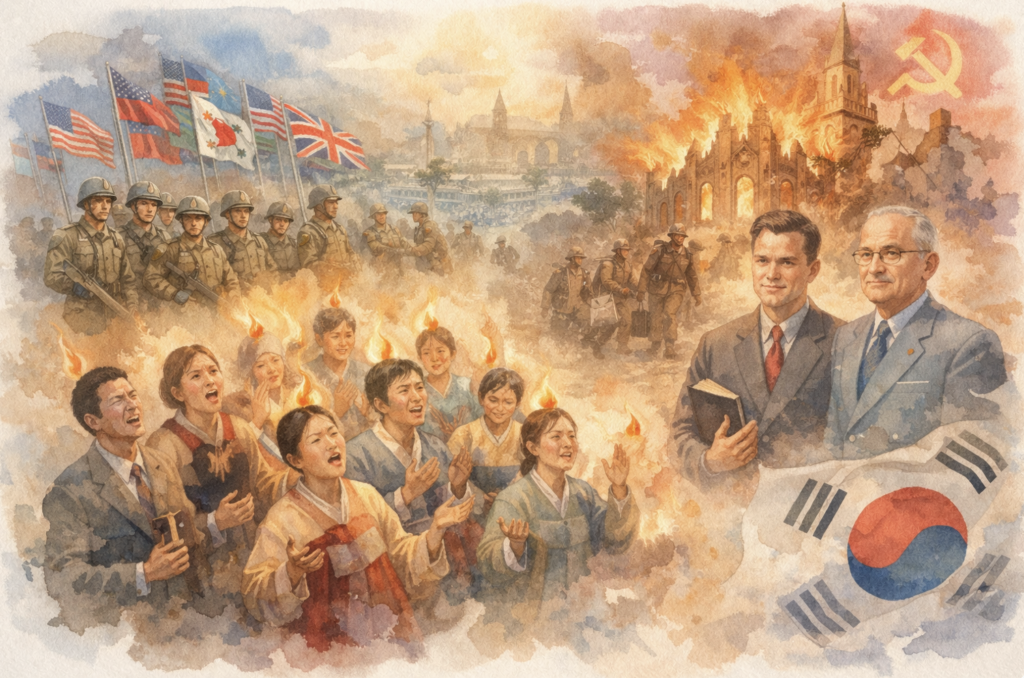
In 1906, a great revival broke out on Azusa Street in Los Angeles, California. That flame crossed the Pacific and reached the shores of Korea. In 1907, a revival began at Jangdaehyeon Church in Pyongyang and swept across the entire nation. People wept in repentance, confessing their sins with tears. Every church blazed with early morning prayer. Pyongyang became the heart of Christianity in Asia.
The fire burned so intensely that missionaries writing home described it this way: “We are witnessing Pentecost.”
The Red Tide — The Flame Nearly Dies
But history was brutal.
After liberation in 1945, Soviet-backed communist forces seized control of North Korea, and churches came under immediate persecution. Pastors and believers who refused to abandon their faith were executed or dragged off to labor camps. In the wake of Stalinism, it was not merely church buildings that disappeared — entire communities of faith were erased.
Hundreds of thousands of Christians began fleeing south to escape with their lives. They left everything behind — but one thing they did not leave behind. Their faith.
1950 — What Sixteen Nations Defended
In June 1950, North Korean forces crossed the 38th parallel. The war looked as though it would swallow the entire peninsula in an instant.
Then the United Nations acted. Sixteen nations — including the United States, Great Britain, Canada, Australia, Turkey, and Ethiopia — dispatched combat troops. President Harry Truman of Missouri made the decision to intervene militarily despite fierce political opposition, and that decision changed history.
Billy Graham, a fierce anti-communist, used his sermons and public platform to insist that the free world must stand against communism. Having witnessed how churches had been destroyed under the Soviet system, he preached relentlessly that the defense of religious freedom was not merely a political matter.
The war dragged on for three years. Millions perished. But South Korea survived.
The Seeds of Revival Come South
The countless Christians who had nurtured their faith in Pyongyang settled in South Korea. They were refugees — but they also carried within them the seeds of revival. In the ruins of war, the church grew explosively. In the midst of pain and loss, people found in faith a reason to live.
The growth of the Korean church did not happen by accident. It was built on the blood of martyrs, on the tears of refugees, and on the foundation of countless prayers.
The Korean Church Today
Today, South Korea sends more missionaries abroad than any country in the world except the United States — over twenty thousand missionaries to more than 170 nations.
It is a remarkable thing. Barely seventy years ago, the church in this land nearly ceased to exist. And now, it is sending the gospel to the ends of the earth.
South Korea — the lone Protestant nation to survive in Asia. This is not coincidence. It is a miraculous history forged through the devotion and sacrifice of countless souls.
7 Bible Verses for Meditation
- Isaiah 43:2 — “When you pass through the waters, I will be with you; and when you pass through the rivers, they will not sweep over you. When you walk through the fire, you will not be burned; the flames will not set you ablaze.” The Korean Church was not consumed even in the flames of communism. God was present in the very midst of it.
- Psalm 46:1 — “God is our refuge and strength, an ever-present help in trouble.” In the midst of war and persecution, this is the word countless believers held onto.
- Matthew 16:18 — “I will build my church, and the gates of Hades will not overcome it.” Neither Stalin nor war could defeat the Church. The Lord’s promise is always fulfilled.
- Romans 8:28 — “And we know that in all things God works for the good of those who love him, who have been called according to his purpose.” Even division and war became instruments of church growth in the hands of God.
- John 12:24 — “Unless a kernel of wheat falls to the ground and dies, it remains only a single seed. But if it dies, it produces many seeds.” The blood of martyrs, the tears of refugees — those seeds produced the Korean Church of today.
- Acts 1:8 — “But you will receive power when the Holy Spirit comes on you; and you will be my witnesses in Jerusalem, and in all Judea and Samaria, and to the ends of the earth.” The flame that began in the Pyongyang Revival is now advancing to the ends of the earth across 170 nations.
- Habakkuk 3:2 — “Lord, I have heard of your fame; I stand in awe of your deeds, Lord. Repeat them in our day, in our time make them known.” This was the prayer of the believers in Pyongyang in 1907 — and it remains our prayer today.


