

Introduction
History is often written by the victors, or told through the stories of those most widely heard. The transatlantic slave trade is well known to many today, yet another vast history of human exploitation — unfolding across the Mediterranean and Black Sea during the same era — remains relatively unknown. This is the story of the Ottoman Empire, when millions of white Christians were taken as slaves.
This article seeks to examine that history through the lens of both faith and historical inquiry.
1. How They Became Slaves — Three Routes of Supply
Christian slaves in the Ottoman Empire entered bondage primarily through three channels.
The first was war captives. Soldiers and civilians seized during campaigns across the Balkans, Hungary, Poland, Ukraine, and Russia were reduced to slavery en masse. After the fall of Constantinople in 1453, thousands of Byzantine Christians became slaves overnight.
The second was the periodic raids of the Crimean Tatars. The Crimean Khanate, a vassal state of the Ottomans, repeatedly struck Poland-Lithuania, Russia, and Ukraine from the 16th through the 18th centuries. Historians estimate that approximately two to three million Slavic Christians were abducted during this period. For hundreds of years, it was routine for raiders to descend on peaceful villages at dawn, bind the young and the children, and drag them away.
The third was the Barbary pirates. Operating from bases in North Africa — Algiers, Tunis, and Tripoli — these pirates ranged across the Mediterranean and even appeared off the coasts of Ireland and Iceland, abducting Europeans. According to the research of historian Robert Davis, more than one million European Christians were enslaved through this route in the 17th century alone.
2. Sold in the Market — The Reality of the Slave Trade
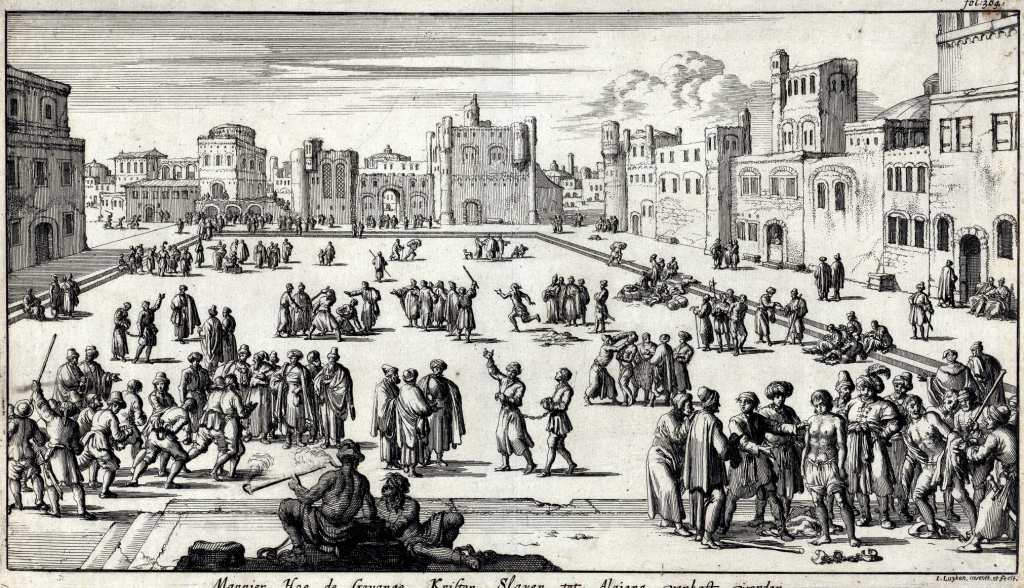
The Bedesten of Constantinople and the slave markets of Cairo were among the largest in the world at the time. These were places where human beings were displayed as merchandise, priced, and handed over to strangers.
Upon arrival, captives were immediately stripped of their names. Islamic names were assigned, and families were torn apart on the spot. Young women and children fetched the highest prices. Venetian diplomatic records describe the separation of mothers from their children as a commonplace scene in the marketplace. In a single moment, everything that makes a person human — name, language, faith, family — was taken away at once.
3. What Life They Lived — Types and Treatment of Slaves
The conditions slaves endured varied depending on where they were assigned, but none were free.
Galley slaves faced the most brutal fate. They rowed for sixteen to eighteen hours a day, chained to their oars, eating, sleeping, and relieving themselves in the same spot. The average life expectancy after enslavement was only three to five years. Those who collapsed from exhaustion were thrown overboard.
Harem slaves (Cariye) were the fate of young Christian women deemed attractive. Assigned to the harems of sultans and nobles, they were subjected to sexual exploitation. The irony of history is that many of the sultan’s mothers in the later Ottoman period were themselves of Slavic Christian origin. Roxelana — known as Hürrem Sultan — is the most famous example. Born a Christian girl in Ukraine, she was abducted and brought into the harem, where she eventually became the beloved wife of Suleiman the Magnificent.
The Devşirme (the “boy levy”) was a system of forcibly conscripting young boys from Christian households. Torn from their parents, the boys were compelled to convert to Islam and trained as Janissary soldiers or imperial administrators. Some rose to high positions within the empire, but this came at the cost of the complete erasure of their original identity.
4. Losing Their Faith — The Deepest Wound
There was a wound deeper than physical suffering: the stripping away of faith.
Christian worship was forbidden or severely restricted. Baptismal names were erased. The pressure to convert to Islam was relentless. Children could not be raised as Christians. As decades passed, many came to forget who they had originally been.
Faith is not merely a religious practice. It is the root by which a human being knows who they are, where they come from, and where they are going. The anguish of having that root forcibly severed is something no language can fully express.
5. The Road to Freedom — Ransom and Liberation
The Knights of Malta and the Holy See regularly organized ransom operations (Riscatto) to free Christian slaves. Churches and monasteries raised funds, and families sold everything they owned to gather the ransom money.
Yet the ransom required was equivalent to several years’ wages for an ordinary laborer of the time. Some did return home after decades in captivity, but what awaited them — changed in language, custom, and appearance — was yet another kind of estrangement.
6. Why This History Must Be Remembered
This history has long been insufficiently addressed even in Western scholarship. A combination of political sensitivity, regional bias, and the inability of the victims’ descendants to raise an organized voice has kept it in the shadows.
But history that is not remembered repeats itself. And the stories of those who suffered — whoever they may be — deserve to be told.
Millions of Christians, because of their faith or simply because they were born Christian, were robbed of their freedom, their names, their families, and their faith. That suffering is not a footnote to history. It is a story the Church must remember and mourn with seriousness.
Paul wrote: “If one member suffers, all the members suffer with it” (1 Corinthians 12:26). Before the suffering of these brothers and sisters in faith who lived before us, we must stand in humility.
Closing
Studying history is not merely the accumulation of knowledge. It is the cultivation of sensitivity toward human dignity and suffering, and at the same time, a meditation on how profoundly complex and deep the history through which God’s providence has flowed truly is.
The history of white Christian slaves in the Ottoman Empire reminds us once again of the preciousness of freedom, the importance of the roots of faith, and the Church’s responsibility toward those who suffer.
References
- Robert Davis, Christian Slaves, Muslim Masters (2003)
- Giles Milton, White Gold (2004)
- Orlando Figes, writings on Ottoman-Russian relations
Related Scriptures
- 1 Corinthians 12:26
- Hebrews 13:3 — “Remember those who are in prison, as though in prison with them”
- Psalm 9:9 — “The Lord is a stronghold for the oppressed”


