

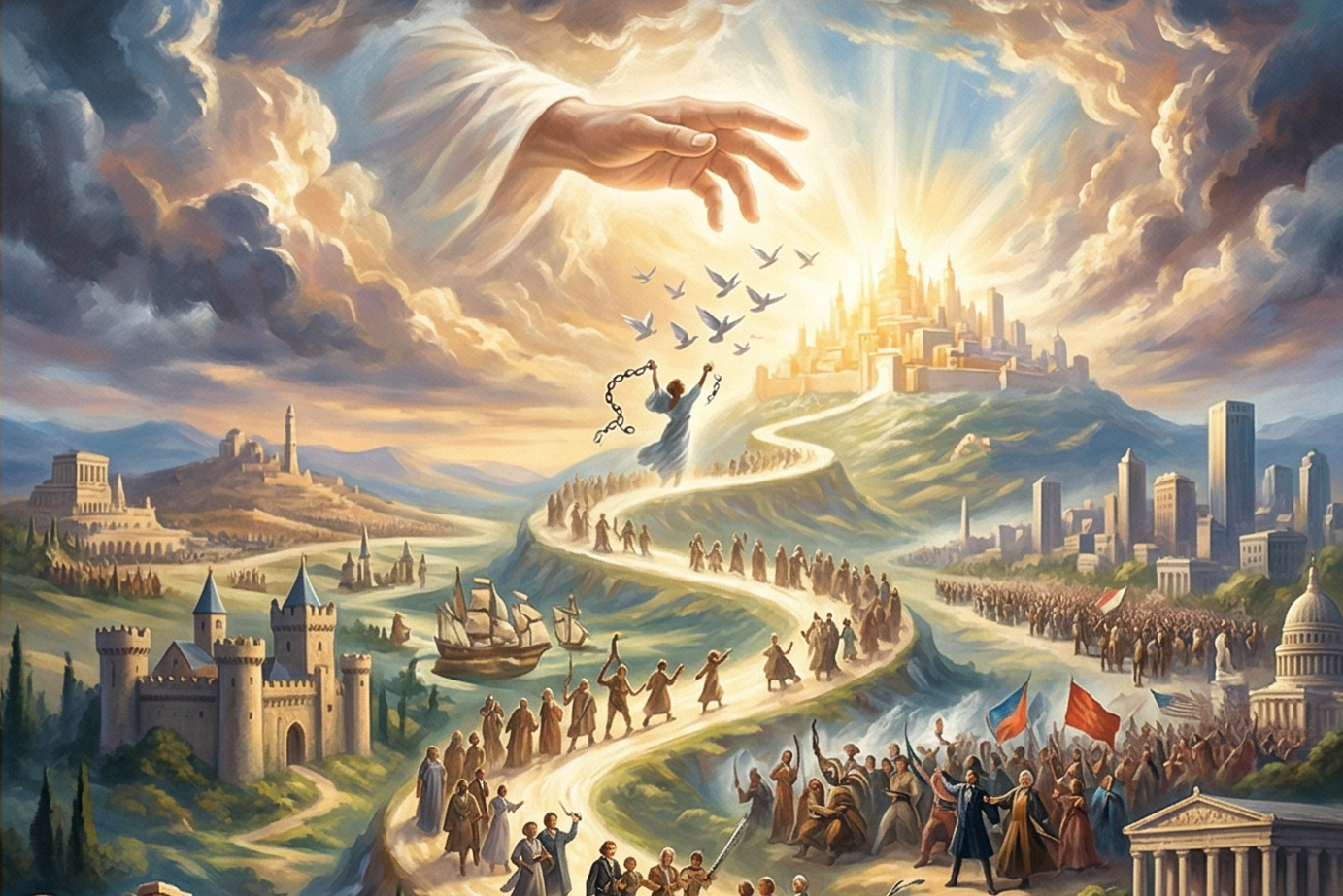
How a single passage in Revelation chapter 20 divided the Church, and what Scripture truly emphasizes
Over a single passage in Scripture, the Church has drawn swords against itself for centuries. The millennium debate is not merely a theological disagreement — it has been the exclusion of brothers and sisters, the exhaustion of spiritual energy, and perhaps a great distraction that has drawn people away from the very heart of the gospel.
I. Where the Debate Begins — Weighing the Passage First
Premillennialism, Postmillennialism, Amillennialism — each of these positions carries a long history and reflects the earnest study of countless scholars and believers. None of them should be dismissed lightly.
Yet in any theological debate, there is one question we must ask first: “How much weight does this topic carry in Scripture?” The Bible signals importance through repetition. The love of God is mentioned hundreds of times. Sin and repentance, the grace of salvation, love for one’s neighbor — these themes echo from Genesis to Revelation without ceasing.
The millennium is different. This concept appears concentrated in a single passage: Revelation 20:1–7 — just a handful of verses out of the Bible’s 1,189 chapters. It can certainly be connected to Old Testament prophecies of the messianic kingdom and Paul’s eschatological references, but the specific number of “a thousand years” and the picture of reign during that period appears only here.
One principle of biblical interpretation is that “clear passages interpret unclear ones.” Revelation chapter 20 is filled with the language of symbol and apocalyptic literature — it is an inherently difficult passage. Yet we have often used this obscure text as a tool to judge the clearest truths of the gospel. That is a fundamental reversal of priorities.
II. The Debate Through Church History — How It Became Division
Many of the early Church Fathers held premillennial views — Justin Martyr, Irenaeus, and Tertullian among them. However, through the interpretive work of Origen and Augustine, an amillennial reading gradually became dominant in the Western Church, and was further consolidated through medieval Catholic theology.
After the Reformation, interpretations multiplied. Among seventeenth-century Puritans, postmillennialism gained strong momentum — its optimism about the gradual completion of God’s kingdom through the advance of the gospel resonated with their missionary zeal. Then in the nineteenth century, John Nelson Darby and his dispensational premillennialism swept through the Protestant world, particularly among evangelicals.
The problem was that through this process, each position ceased to be a mere academic view and became a badge of orthodox faith. “Which camp are you in?” became equivalent to “Are you truly a believer?” — and with it came exclusion and condemnation of those who thought differently.
“In essentials, unity; in non-essentials, liberty; in all things, charity.” — Rupert Meldenius
III. We Must Understand the Genre of Revelation
Revelation is apocalyptic literature — a form that expresses transcendent reality within the limits of language through symbols, numbers, beasts, and colors.
In Revelation, numbers typically carry theological meaning rather than literal quantities: seven signifies completeness, twelve represents the people of God, and 144,000 symbolizes the full company of the redeemed. So what about “a thousand years”? Whether it should be read as a literal millennium or as a symbol of “the full and complete reign of God” — that question itself is not easily resolved.
Scholars of apocalyptic literature caution against reading any single vision in this genre with excessive literalism. The purpose of Revelation was not to provide a chronological timeline of future events, but to declare to persecuted saints: “God is Lord of history, and the final victory belongs to the Lamb.”
Attempting to extract a future timeline from one passage in Revelation 20 is not unlike searching for the GPS coordinates of “the valley of the shadow of death” in Psalm 23. Interpretation that ignores genre may appear to honor the text, but it can lead readers in a direction entirely contrary to what the text intends to say.
IV. What the Overreach Has Cost Us
The negative legacy of the millennium debate is not simply “wasted time.” It has taken from us things far more precious.
First, it weakened the ethical force of eschatology. The conviction that “the Lord is coming again” is inseparable from the ethical question: “How then shall we live today?” Eschatology was meant to be a compass that orients our lives. Instead, eschatology mired in debate became not a compass but a puzzle.
Second, it pushed the center to the margins. Many believers spent their energy on debate while setting aside the questions: “Do I truly love my neighbor?” and “Am I living out God’s justice in my daily life?” When peripheral things occupy the center, the center is always displaced.
Third, it fractured the body. Brothers and sisters confessing the same Christ, trusting the same gospel, reading the same Bible — divided and condemned one another over eschatological positions. The witness of love by which all people would know we are Christ’s disciples grew dim in the shadow of this debate.
V. What We Must Still Hold Fast
The eschatological texts of Scripture give us not a detailed timetable, but convictions that are non-negotiable at the core of faith:
Jesus Christ will certainly return. History moves toward its purpose under the providence of God. Evil will be finally judged, and God’s justice will be perfectly realized. The dead will rise, and God’s people will enter eternal life. These convictions can be shared across all millennial positions — and they form the backbone of the eschatology Scripture repeatedly emphasizes.
“We may not know exactly how the end will come. But we know to whom the end belongs.” — Martin Luther (in substance)
VI. What It Means to Read Scripture Faithfully
Where Scripture speaks loudly, we speak loudly. Where Scripture speaks carefully and sparingly, we hold it carefully and humbly. In theology, this might be called proportional emphasis.
The millennium is a topic Scripture addresses once or twice, carefully, in apocalyptic language. We should study it with humility, but we must not make it a boundary marker of faith. Humility on this question is not ignorance of Scripture — it is the fruit of understanding Scripture more deeply.
Choosing unity over debate, life over doctrine charts, brothers and sisters over factions — this may be the deepest lesson the millennium debate has left us. And learning that lesson may be the most faithful way to read Revelation chapter 20.
Seven Scriptures for Meditation
- Revelation 20:6 — “Blessed and holy is the one who shares in the first resurrection! Over such the second death has no power, but they will be priests of God and of Christ, and they will reign with him for a thousand years.”
Explanation: This is the most direct scriptural basis for the millennium. Regardless of how “a thousand years” is interpreted, the core message is clear — those united with Christ are blessed and holy, and death no longer holds ultimate power over them. The focus of meditation should not be on calculating timelines, but on the promise itself: “reigning with Christ.”
- 1 Thessalonians 4:16–17 — “For the Lord himself will descend from heaven with a cry of command, with the voice of an archangel, and with the sound of the trumpet of God. And the dead in Christ will rise first. Then we who are alive, who are left, will be caught up together with them in the clouds to meet the Lord in the air, and so we will always be with the Lord.”
Explanation: Paul wrote these words not to satisfy curiosity about the sequence of end-time events, but to comfort those grieving over loved ones who had died. The conclusion — “we will always be with the Lord” — is the heart of the passage. The hope of Christ’s return is strength for today’s sorrow, not material for theological debate.
- 1 Corinthians 15:24–25 — “Then comes the end, when he delivers the kingdom to God the Father after destroying every rule and every authority and power. For he must reign until he has put all his enemies under his feet.”
Explanation: History does not turn without purpose — it moves toward a destination: the complete victory of Christ, who then delivers the kingdom to the Father. This gives profound hope to believers struggling today under the forces of darkness. Every suffering we endure exists within the narrative of this final triumph.
- John 5:28–29 — “Do not marvel at this, for an hour is coming when all who are in the tombs will hear his voice and come out, those who have done good to the resurrection of life, and those who have done evil to the resurrection of judgment.”
Explanation: Jesus here clearly declares the reality of a universal resurrection and final judgment. Death is not the end — every person will stand before Christ. This passage is not meant to frighten, but to call us to account: how we live today has eternal consequences.
- Matthew 24:30–31 — “Then will appear in heaven the sign of the Son of Man, and then all the tribes of the earth will mourn, and they will see the Son of Man coming on the clouds of heaven with power and great glory. And he will send out his angels with a loud trumpet call, and they will gather his elect from the four winds, from one end of heaven to the other.”
Explanation: The return of Christ will be public, glorious, and unavoidable. “All the tribes of the earth will mourn” reminds us that that day will be judgment for the unprepared, but for the elect it will be the ultimate gathering and homecoming. Meditating on this passage lifts our eyes from the trivial concerns of daily life and restores our vision of where history is headed.
- Romans 8:19–21 — “For the creation waits with eager longing for the revealing of the sons of God. For the creation was subjected to futility, not willingly, but because of him who subjected it, in hope that the creation itself will be set free from its bondage to corruption and obtain the freedom of the glory of the children of God.”
Explanation: The hope of the last days concerns not only human souls, but the renewal of all creation. The whole created order groans and waits. This transforms eschatology from an abstract theological topic into something directly relevant to ecology, suffering, and hope today — God’s redemptive plan is cosmic in scope.
- Philippians 3:20–21 — “But our citizenship is in heaven, and from it we await a Savior, the Lord Jesus Christ, who will transform our lowly body to be like his glorious body, by the power that enables him even to subject all things to himself.”
Explanation: We are “citizens of heaven” — not as an escape from reality, but as a reorientation of identity. It is precisely because of this that our manner of life on earth should reflect who we are. The transformation of our bodies into the likeness of Christ’s glory is the final completion of God’s redemptive work, and the deepest motivation for holy living today.


