

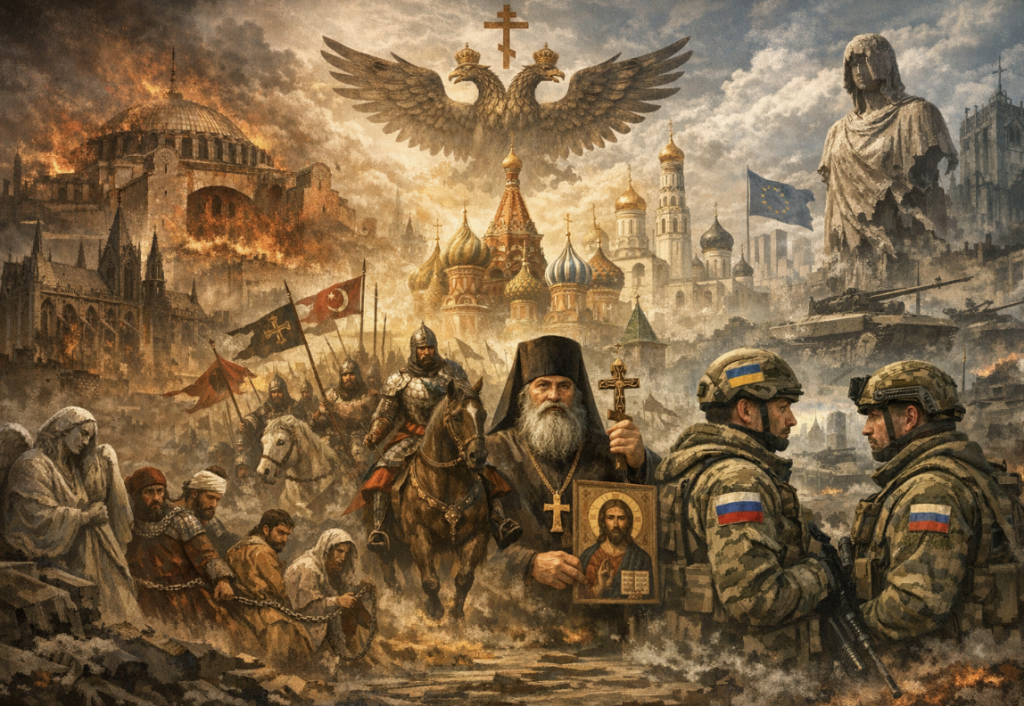
Many people tend to interpret the current war merely in terms of economic interests or territorial expansion. However, beneath the surface lies a struggle of identity shaped by thousands of years of Christian history. Today, we seek to trace the roots of this war through the keywords “Slavs” and “Orthodoxy.”
1. The Fall of Rome, and the Final Stronghold — The Slavs
Christian history has undergone monumental turning points. The Western Roman Empire fell, and even the Eastern Roman Empire (Byzantium) collapsed in 1453 when it was conquered by the Islamic forces of the Ottoman Empire.
An Age of Darkness:
Under more than 600 years of Ottoman rule, countless Christians were sold into slavery, and the spiritual foundation of Europe was deeply threatened.
A Dormant West:
At that time, Western Europe was consumed by internal corruption and power struggles, gradually losing the ability to resist this massive threat.
The Rise of the Slavs:
It was during this period that the Slavic peoples, who upheld the Greek Orthodox faith, rose as defenders of Christian civilization, halting the northward expansion of Islam. Like the charge of 25,000 cavalry, they carried a deep pride—etched into their very bones—of having risked their lives to protect their civilization.
2. “Moscow is the Third Rome”
After the fall of Constantinople, Moscow emerged claiming to be its spiritual successor.
“The first Rome has fallen. The second Rome (Constantinople) has fallen. But the third Rome (Moscow) stands, and there will be no fourth Rome.”
This idea of the “Third Rome” forms a core worldview of Russia and the Slavic Orthodox world. From their perspective, Western Christianity has already lost its spiritual integrity and fallen into corruption, while only they have preserved the pure essence of Christianity—Orthodoxy. This has fostered a strong sense of chosenness.
3. The Ukraine War: A Reenactment of a ‘Historical War’
From this perspective, the current war in Ukraine is not merely a border conflict but a struggle that determines the “true stream of history.”
Western Values vs. Slavic Values:
Russia perceives Ukraine’s alignment with Western liberalism as a betrayal of Slavic Orthodox identity and an absorption into a “corrupt” Western civilization.
The Defense of Identity:
Driven by the belief that “we are the true heirs of history,” this conflict represents a profound clash—an effort to push back Western influence and restore a Slavic-Orthodox-centered worldview.
We Must Look Beyond the War to Its Spirit
If we view the Ukraine war only through political news or economic indicators, its outcome becomes difficult to predict. This war is a fusion of centuries of accumulated Christian identity, Slavic pride, and the spiritual ambition of the “Third Rome.” It is, in essence, a recurring “clash of civilizations.”
We may not simply be witnessing a war that redraws maps, but rather a profound confrontation over “where the truth of history lies.”
Today, Western Europe has moved beyond the glory of its once-radiant Christendom and entered a post-Christian era, where grand cathedrals have become museums for tourists rather than houses of worship. The spiritual fire that once fueled the Crusades and the Reformation has faded under waves of rationalism, secular humanism, and extreme individualism. In its place, material prosperity and the pursuit of power have filled the void, creating a deep moral and spiritual emptiness.
From the perspective of the Slavic Orthodox world, this is not merely a decline in religious population, but a “civilizational suicide”—a voluntary abandonment of the spiritual identity that once formed the foundation of the civilization. In this view, a spiritually dormant and decaying West can no longer lead history and must inevitably yield its leadership to those who have preserved the purity of faith.
Modern Western society, despite its remarkable achievements in material prosperity and individual freedom, is beginning to painfully realize that the “spiritual backbone” that once sustained its civilization has been broken. In removing God, it erected secular rationalism and competitive capitalism in His place—only to encounter profound existential crises marked by alienation and nihilism.
Having dismissed its Christian heritage as an outdated relic, the West now faces the cost of that decision: the loss of meaning. It must now wrestle with a difficult question—whether a civilization stripped of its moral center can endure external challenges, whether from Slavic fundamentalism or the expansion of Islam. What is required is a deep and honest self-examination.
Beyond the great currents of history and the clash of civilizations, we earnestly hope that no more precious lives will be lost. May the sound of gunfire cease soon, and may a spring of peace return to that deeply wounded land.
Related Bible verses
- On “Wars and Civilizational Conflict” Matthew 24:6–7 “You will hear of wars and rumors of wars… Nation will rise against nation, and kingdom against kingdom.”
Explanation:This directly reflects the reality of war and reminds us that conflicts throughout history are not accidental, but occur under God’s sovereignty.
- On “Spiritual Warfare (Not Merely Political Conflict)” Ephesians 6:12 “For we do not wrestle against flesh and blood, but against… the spiritual forces of evil in the heavenly realms.”
Explanation:This aligns closely with your core argument—that behind visible wars lies a deeper spiritual dimension.
- On “Human Pride and Civilizational Superiority” Genesis 11:4 “Come, let us build ourselves a city… so that we may make a name for ourselves.”
Explanation:Whether it is the idea of the “Third Rome” or claims of civilizational legitimacy, both can fall into human-centered pride.
- On “God as the True Sovereign of History” Daniel 2:21 “He changes times and seasons; He removes kings and sets up kings.”
Explanation:This reminds us that it is not civilizations that ultimately control history, but God.
- On “The Kingdom Not of This World” John 18:36 “My kingdom is not of this world.”
Explanation:This directly challenges the idea that any earthly empire—including concepts like the “Third Rome”—can represent God’s kingdom.
- On “Moral Decline and Loss of Meaning in the Last Days” 2 Timothy 3:1–5 “In the last days perilous times will come… lovers of pleasure rather than lovers of God.”
Explanation:This corresponds to your analysis of the “post-Christian West”—marked by secularization and spiritual emptiness.
- On “Emptiness After Rejecting God” Romans 1:21–22 “Although they knew God, they did not honor Him… claiming to be wise, they became fools.”
Explanation:This precisely reflects the collapse of meaning brought by rationalism and human-centered thinking.
- On “The True Source of Peace” Matthew 5:9 “Blessed are the peacemakers.”
Explanation:This serves as the spiritual conclusion of your article—not the victory of one civilization, but the peace of God.
- On “Christ as the Only Foundation” 1 Corinthians 3:11 “For no one can lay any foundation other than the one already laid, which is Jesus Christ.”
Explanation:This rejects the idea of a purely historical or political succession (Rome → Byzantium → Moscow) as the true foundation.
- On “Ultimate Hope Beyond History” Revelation 21:4 “He will wipe every tear from their eyes… there will be no more death or mourning or crying or pain.”
Explanation:This provides a theological conclusion—our hope is not in history, but in God’s new heaven and new earth.


