

It was a spring morning.
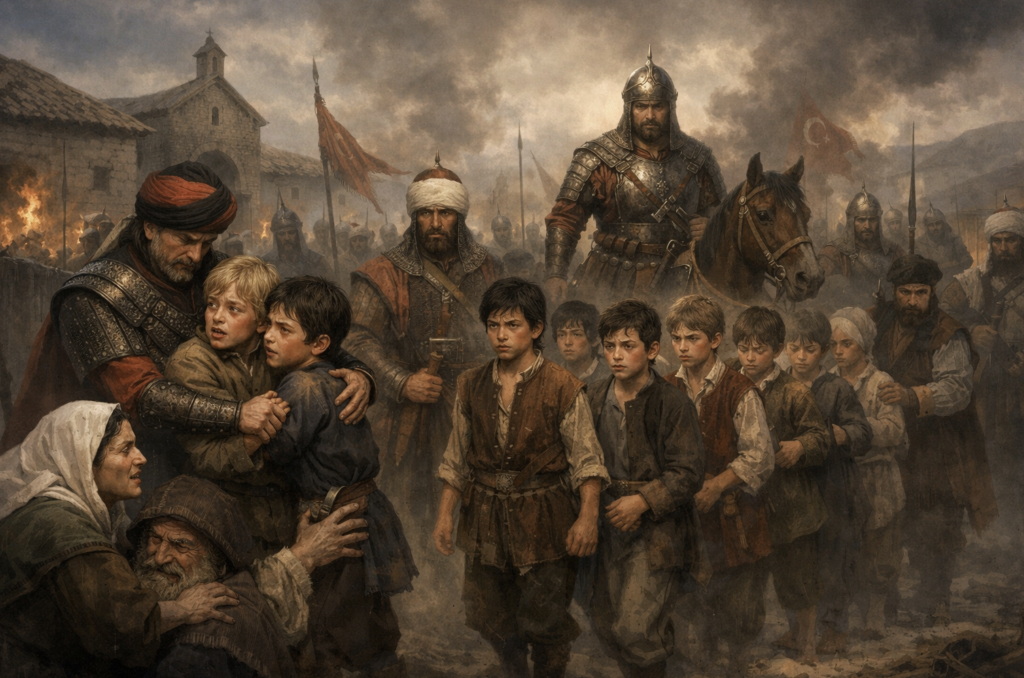
In a small mountain village in the Balkans, a Serbian farming family was starting their day. The father had gone to the fields before dawn. The mother was preparing breakfast for her son. Twelve-year-old Danilo was playing with a young goat in the yard. It was an ordinary morning.
Then came the sound of hoofbeats.
Ottoman officials appeared at the village entrance. Elaborate turbans, gleaming swords, and a scroll bearing the emperor’s seal. The moment the villagers saw that procession, they all knew. Today was the day.
The mother dropped the bowl in her hands.
Devşirme — The Terror Behind a Simple Word
The Ottoman Empire gave this practice a very ordinary name. Devşirme. In Turkish, it simply means “to collect” or “to gather.” As one harvests grain in autumn, so they harvested boys from Christian villages.
Beginning in the late 14th century, this system became deeply institutionalized as the Ottoman Empire expanded. The method was simple and brutal. Imperial officials traveled through Christian villages across the Balkans, Greece, Serbia, Bulgaria, and Albania, selecting boys and taking them away.
They did not take just anyone. That was what made it more cruel.
The healthiest child. The most sharp-eyed child. The most well-built child. The most handsome child. The very son his parents were most proud of. The sickly, the plain — they were left behind. The more beloved, the more exceptional, the more likely to be taken.
Danilo’s mother stood before her son and spread her arms wide.
The official told her to step aside.
The father came running from the fields, but it was already too late. There was nothing to be done in front of soldiers wearing swords. To resist meant death. The entire village could be burned. Faced with the emperor’s command to surrender one boy from every forty households, all that father could do was grip his son’s hand tightly.
Danilo tried not to cry. He wanted to appear strong before his father. But the moment he was placed on a horse and the village receded behind him, he heard his mother’s wailing. That sound — for his entire life, until the very end of his life — would never leave his ears.
That was the last time.
Stealing a Name
The first thing that happened to the boys when they arrived at the training grounds near Constantinople was not physical training.
It was the theft of their name.
Danilo was no longer Danilo. He was now Yusuf. Lips that had prayed in Serbian were made to memorize “Allahu Akbar” in Arabic. The Lord’s Prayer his mother had taught him was forbidden. If he was caught making the sign of the cross, he was beaten.
Language was stolen too. Serbian, Greek, Bulgarian — no mother tongue was permitted. Only Ottoman Turkish was allowed. At first, they could understand nothing. Hungry, sick, frightened — they could not speak. In that silence, the boys slowly lost their past.
Writing letters home was not allowed. Family visits were impossible. As years passed, the mother’s face began to blur. The father’s voice could no longer be remembered. The old church bell at the edge of the village, the smell of candlelight on Easter morning — all of it faded like morning mist.
That was precisely what the empire wanted.
Erase the memory and resistance disappears. Without a past, there is no longing. Without longing, there is no reason to flee. These boys were slowly, systematically remade into uprooted beings — to know only the sultan as father, only Islam as faith, only the empire as homeland.
This was repeated over decades, to tens of thousands of boys.
Children Who Became Warriors
The training was brutal.
Physical drills beginning before dawn, archery, swordsmanship, spear fighting, wrestling. If you fell, you had to rise. If you cried, you were beaten harder. The weak were weeded out. Only those who survived could become Janissaries.
And then something strange happened.
The boys who survived became genuinely strong. Genuinely brave. And they began to genuinely believe. What the transformation of these boys revealed so starkly was how flexible — no, how fragile — human identity truly is. Children uprooted so young and planted in completely different soil eventually bloomed with that soil’s flowers.
Danilo, now Yusuf, was a fine warrior. He was sincerely devoted to the Islamic faith and shared deep brotherhood with his comrades. To him, Serbia was already a distant land, the name of an enemy country.
And then the moment came.
1453 — Before the Walls of Constantinople
It was one of the greatest cities in history. Constantinople, the heart of Christian civilization for a thousand years. The capital of the Eastern Roman Empire, of Byzantium. The city where the golden dome of Hagia Sophia shone and the emperor’s palace stood tall on the hill.
Sultan Mehmet II besieged this city at the age of twenty-one. Then he gave the order for the final assault. At the vanguard stood the Janissaries.
Racing toward the walls — among those ranks were Serbians. Greeks. Bulgarians. Albanians. All of them sons born in the arms of Christian mothers.
They raised their swords against the last capital of Christian civilization.
In the moment when the last Byzantine emperor, Constantine XI, met his death inside the walls, the hands that had climbed over those walls carried the blood of Serbian mothers. He did not know. He could not have known. His mother no longer existed in his memory.
The bells of Hagia Sophia fell silent. For the first time in a thousand years. The hands that silenced those bells may have once belonged to a child who grew up listening to them ring.
This is the true horror of Devşirme. Not simply conquest — but a system that transformed victims into perpetrators. The sons of Christian homes became the weapons that dismantled the Christian world.
The Mothers Remembered
But there were those who did not forget.
The mothers left behind in their villages.
In the mountain villages of Serbia, Greece, and Bulgaria, the songs of mothers who had lost their sons were passed down by word of mouth. Poems composed in tears by women who could not write flowed from mouth to mouth, generation to generation. The Orthodox Church prayed for these children — praying that wherever they had been taken, they still carried the cross deep in their hearts, that they might one day return.
The mothers waited still.
Even when sons did not return, they remembered the names. The names the empire had stolen lived on, at least within the hearts of mothers. Danilo. Ioannis. Dragan. Nikolaos. Names that did not survive in official history were spoken every night in a mother’s prayers.
Why We Must Remember
There are those who grow uncomfortable when this story is raised.
“Isn’t this ancient history?” “What does it have to do with Muslims today?” “Aren’t you stirring up religious conflict?”
But remembering is not the same as hating.
Just as we remember the Holocaust not to hate all Germans, remembering the Devşirme is not hostility toward Muslims of today. It is paying respect to those who were erased from history. It is remembering that tens of thousands of boys — their names stolen, their faith stolen, their families stolen — and the mothers who lost them, existed.
And this history poses a very fundamental question to us.
What is faith? Can a forced belief be true belief? Can a person’s soul be changed through institutions and violence?
Devşirme showed that it could — at least on the surface. But it also shows that mothers in their hometowns called their sons’ names in prayer every night. The empire could steal the boy’s name, but it could not steal a mother’s love.
And perhaps that is the one light we can hold onto amid all this tragedy.
Scripture Meditation — 7 Passages
1. The God Who Calls Us by Name “Do not fear, for I have redeemed you; I have called you by name, you are mine.” (Isaiah 43:1) → Even when the empire stole their names, God knew each child’s name from the beginning. No violence can erase the name God has engraved.
2. God Who Is Present in Suffering “When you pass through the waters, I will be with you; and through the rivers, they shall not overwhelm you.” (Isaiah 43:2) → Even beside the boys standing alone before a foreign land, a foreign language, a foreign god — God was there. Though we cannot feel it, He does not leave.
3. God’s Love Deeper Than a Mother’s “Can a mother forget the baby at her breast and have no compassion on the child she has borne? Though she may forget, I will not forget you.” (Isaiah 49:15) → Even for the boys whose memory of their mother had grown faint with time, God’s memory never faded. His love is deeper than a mother’s love.
4. God’s Heart Toward the Oppressed “The Lord is a refuge for the oppressed, a stronghold in times of trouble.” (Psalm 9:9) → The children taken by Devşirme left no trace even in historical records. But God does not stand on the side of the powerful — He stands on the side of the oppressed.
5. The God Who Seeks the Lost “What do you think? If a man owns a hundred sheep, and one of them wanders away, will he not leave the ninety-nine on the hills and go to look for the one that wandered off?” (Matthew 18:12) → God does not give up on souls lost within the machinery of empire. Like a shepherd crossing mountains to find one sheep, He is searching still today.
6. Faith That Is Free, Not Forced “Now the Lord is the Spirit, and where the Spirit of the Lord is, there is freedom.” (2 Corinthians 3:17) → True faith cannot be manufactured by compulsion. What Devşirme revealed is that violence can change lips, but it cannot change a soul. Only where the Spirit of God dwells is there true freedom and true faith.
7. God as the Judge of History “Do not take revenge, my dear friends, but leave room for God’s wrath, for it is written: ‘It is mine to avenge; I will repay,’ says the Lord.” (Romans 12:19) → Before this history, we can choose trust over hatred. The judgment of history rests in God’s hands. Our part is to remember, to pray, and to raise our voice so that the same violence is never repeated.


