
- Bible
- Read the Bible
- Bible Versions
- Verse of the Day
- Reading Plans
- Verses by Topic
- Books of the Bible
- Bible Images
- Study
- Commentaries
- Concordances
- Dictionaries
- Encyclopedias
- Sermons
- Bible Atlas & Maps
- BP Wiki
- Devotionals
- Today's Devotionals
- Light of the World
- All Devotionals
- Inspirational Quotes
- More
- Picture Quotes
- Videos
- Inspirational
- Bible Study
- What The Bible Says
- Bible Q&As
- Daily Bread
- Bible by Genre
- Bible Stories
- Random Bible Verse
- Community
- Store
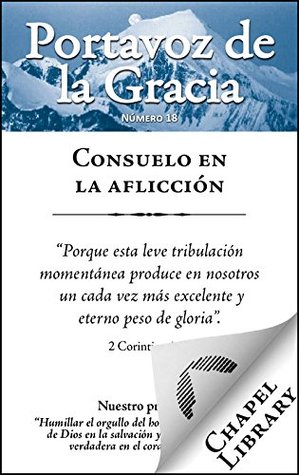
El tema de este número de Portavoz de la Gracia es “Consuelo en la aflicción”. Este fue el tema de un Portavoz muchos años atrás. Le hemos quitado el polvo, vuelto a editar y a revitalizarlo porque este tema es una realidad siempre presente para los hijos amados de Dios. A. W. Pink comienza con un artículo sobre Job, el hombre que tanto sufrió: “de él aprendemos tres verdades importantes para recordar en la aflicción”. En un segundo artículo, enfoca la dádiva de Dios al darnos su Hijo: “así como nos dio a Cristo, nos dará libremente todas las cosas”. Charles Spurgeon, quien sabía muy bien lo que era sufrir, nos ofrece dos artículos extensos: en el primero, ofrece consuelo a los sufren distintos tipos de aflicciones; en el segundo, encara la pregunta: “Si Dios me ama, ¿por qué estoy sufriendo?”. James Buchanan nos enseña que la Biblia es un gran consuelo cuando sufrimos. A esto le sigue una colección maravillosa de selecciones del libro The Mute Christian (El cristiano mudo) por Thomas Brooks. Por último, Octavius Winslow nos ayuda a comprender que el Señor Jesucristo es nuestra fuente de consolación.
“¿Está alguno entre vosotros afligido?”. Querido lector, siga el consejo de Santiago: “Haga oración” (Stg. 5:13). Luego dedíquele un tiempo a esta edición de Portavoz de la Gracia, atendiendo los consejos centrados en Cristo de hombres sabios que comprendían el consuelo en la aflicción.
“¿Está alguno entre vosotros afligido?”. Querido lector, siga el consejo de Santiago: “Haga oración” (Stg. 5:13). Luego dedíquele un tiempo a esta edición de Portavoz de la Gracia, atendiendo los consejos centrados en Cristo de hombres sabios que comprendían el consuelo en la aflicción.
BUY NOW
Kindle Edition, 106 pages
Published November 18th 2016 by Chapel Library


Group of Brands


© 2026 Bibleportal.com All rights reserved.
A.W. Pink (1886 - 1952)
Studied at Moodly Bible Institute and pastored some churches in America. He was not very accepted in his congregations which finally made him move back to England to be involved in writing ministry full-time till his death.He was strictly calvinist in this thinking but many of his writings also reflect balance and openness to other views of doctrine. Especially his teachings on antichrist and end-times were promoted well during his life. He wrote over 40 books and many pamphlets including he distributed titled: "Studies in the Scriptures."
Arthur Walkington Pink was a Christian evangelist and Biblical scholar known for his staunchly Calvinist and Puritan-like teachings.
Pink was born in Nottingham, England on April 1, 1886 and became a Christian in 1908, at the age of 22. Though born to Christian parents, prior to conversion he migrated into a Theosophical society (an occult gnostic group popular in England during that time), and quickly rose in prominence within their ranks. His conversion came from his father's patient admonitions from Scripture. It was the verse, Proverbs 14:12, 'there is a way which seemeth right unto a man, but the end thereof are the ways of death,' which particularly struck his heart and compelled him to renounce Theosophy and follow Jesus.
Desiring to grow in knowledge of the Bible, Pink immigrated to the United States to study at Moody Bible Institute. In 1916 he married Vera E. Russell (January 8, 1893 - July 17, 1962), who was from Kentucky. However, he left after just two months for Colorado, then California, then Britain. From 1925 to 1928 he served in Australia, including as pastor of two congregations from 1926 to 1928, when he returned to England, and to the United States the following year. He eventually pastored churches in Colorado, California, Kentucky, and South Carolina.
Converted in 1908 at the age of 22, Arthur Pink left England in 1910 to Study and Moody Bible Institue in Chicago, Illinois. He left after two months and pastored a church in Silverton, Colorado. He had short term pastorates in California, Kentuck and South Carolina.
His first major work, Divine Inspiration Of The Bible, was published in 1917, followed by The Sovereignty Of God, in 1918 which sold less than 2000 copies. He edited the magazine, Studies In The Scriptures, from 1922-1923, in which much of his published works appeared, but circulation was poor, never more than 1000 subscribers.
He spent three years preaching in Australia and returned to England in 1928 for a year. Returning to the United States he spent eight years in itinerant ministry. He returned to England for the last years of his life, living an isolated life.
Pink is famous for his writings, which had the most effect after his death, but his personal ministry as a pastor was largely a failure.
... Show more