
- Bible
- Read the Bible
- Bible Versions
- Verse of the Day
- Reading Plans
- Verses by Topic
- Books of the Bible
- Bible Images
- Study
- Commentaries
- Concordances
- Dictionaries
- Encyclopedias
- Sermons
- Bible Atlas & Maps
- BP Wiki
- Devotionals
- Today's Devotionals
- Light of the World
- All Devotionals
- Inspirational Quotes
- More
- Picture Quotes
- Videos
- Inspirational
- Bible Study
- What The Bible Says
- Bible Q&As
- Daily Bread
- Bible by Genre
- Bible Stories
- Random Bible Verse
- Community
- Store
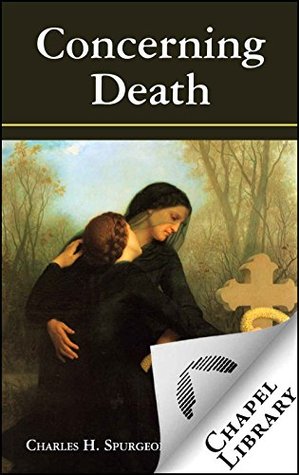
Concerning Death
by C.H. Spurgeon
Another quality eBook from Chapel Library.
“For I know that thou wilt bring me to death, and to the house appointed for all living.”
—Job 30:23
Job suffered from a terrible sickness, which filled him with pain both day and night. It is supposed that, in addition to his grievous eruptions upon the skin, he endured great difficulty in breathing. He says in the eighteenth verse, “By the great force of my disease is my garment changed: it bindeth me about as the collar of my coat” (Job 30:18). His clothes were sodden and clung to him: his skin was blackened and seemed to be tightened. He was like a man whose tunic strangles him; the collar of his garment seemed to be fast bound about his throat. Those who have suffered from it know what distress is occasioned by this complaint, especially when they are also compelled to cry, “My bones are pierced in me in the night season: and my sinews take no rest” (Job 30:17). At such a time Job thought of death; and surely if at any period in our lives we should consider our latter end, it is when the frail tent of our body begins to tremble, because the cords are loosened and the curtain is rent.
It is the general custom with sick people to talk about “getting well”; and those who visit them, even when they are gracious people, will see the tokens of death upon them, and yet will speak as if they were hopeful of their recovery. I remember a father asking me when I prayed with a consumptive girl to be sure not to mention death. In such cases, it would be far more sensible for the sick man to turn his thoughts towards eternity, and stand prepared for the great change. When our God by our affliction calls upon us to number our days, let us not refuse to do so. I admire the wisdom of Job that he does not shirk the subject of death, but dwells upon it as an appropriate topic, saying, “I know that thou wilt bring me to death, and to the house appointed for all living” (Job 30:23).
Yet Job made a mistake in the hasty conclusion which he drew from his grievous affliction. Under depression of spirit he felt sure that he must very soon die; he feared that God would not relax the blows of His hand until his body became a ruin, and then he would have rest. But he did not die at that time. He was fully recovered, and God gave him twice as much as he had before. A life of usefulness, happiness, and honor lay before him; and yet he had set up his own tombstone and reckoned himself a dead man. It is a pity for us to pretend to predict the future, for we certainly cannot see an inch before us. As it is idle with daydreams to fascinate the heart into a groundless expectation, so is it equally foolish to increase the evil of the day by forebodings of tomorrow. Who knoweth what is to be? Wherefore should I wish to uplift the corner of the curtain, and peer into what God has hidden? Some of those who have been most sure that they would die soon have lived longer than others. A prophet once prayed to die, and yet he never saw death. From the lip of Elias, who was to be caught up by a whirlwind into heaven, it was a strange prayer—“Take away my life; for I am not better than my fathers” (1Ki 19:4)…
“For I know that thou wilt bring me to death, and to the house appointed for all living.”
—Job 30:23
Job suffered from a terrible sickness, which filled him with pain both day and night. It is supposed that, in addition to his grievous eruptions upon the skin, he endured great difficulty in breathing. He says in the eighteenth verse, “By the great force of my disease is my garment changed: it bindeth me about as the collar of my coat” (Job 30:18). His clothes were sodden and clung to him: his skin was blackened and seemed to be tightened. He was like a man whose tunic strangles him; the collar of his garment seemed to be fast bound about his throat. Those who have suffered from it know what distress is occasioned by this complaint, especially when they are also compelled to cry, “My bones are pierced in me in the night season: and my sinews take no rest” (Job 30:17). At such a time Job thought of death; and surely if at any period in our lives we should consider our latter end, it is when the frail tent of our body begins to tremble, because the cords are loosened and the curtain is rent.
It is the general custom with sick people to talk about “getting well”; and those who visit them, even when they are gracious people, will see the tokens of death upon them, and yet will speak as if they were hopeful of their recovery. I remember a father asking me when I prayed with a consumptive girl to be sure not to mention death. In such cases, it would be far more sensible for the sick man to turn his thoughts towards eternity, and stand prepared for the great change. When our God by our affliction calls upon us to number our days, let us not refuse to do so. I admire the wisdom of Job that he does not shirk the subject of death, but dwells upon it as an appropriate topic, saying, “I know that thou wilt bring me to death, and to the house appointed for all living” (Job 30:23).
Yet Job made a mistake in the hasty conclusion which he drew from his grievous affliction. Under depression of spirit he felt sure that he must very soon die; he feared that God would not relax the blows of His hand until his body became a ruin, and then he would have rest. But he did not die at that time. He was fully recovered, and God gave him twice as much as he had before. A life of usefulness, happiness, and honor lay before him; and yet he had set up his own tombstone and reckoned himself a dead man. It is a pity for us to pretend to predict the future, for we certainly cannot see an inch before us. As it is idle with daydreams to fascinate the heart into a groundless expectation, so is it equally foolish to increase the evil of the day by forebodings of tomorrow. Who knoweth what is to be? Wherefore should I wish to uplift the corner of the curtain, and peer into what God has hidden? Some of those who have been most sure that they would die soon have lived longer than others. A prophet once prayed to die, and yet he never saw death. From the lip of Elias, who was to be caught up by a whirlwind into heaven, it was a strange prayer—“Take away my life; for I am not better than my fathers” (1Ki 19:4)…
BUY NOW
Kindle Edition, 24 pages
Published September 10th 2014 by Chapel Library
Subscribe
Get Bible verse every day in your inbox
Read on Mobile


Group of Brands


© 2026 Bibleportal.com All rights reserved.
C.H. Spurgeon (1834 - 1892)
Spurgeon quickly became known as one of the most influential preachers of his time. Well known for his biblical powerful expositions of scripture and oratory ability. In modern evangelical circles he is stated to be the "Prince of Preachers." He pastored the Metropolitan Tabernacle in downtown London, England.His church was part of a particular baptist church movement and they defended and preached Christ and Him crucified and the purity of the Gospel message. Spurgeon never gave altar calls but always extended the invitation to come to Christ. He was a faithful minister in his time that glorified God and brought many to the living Christ.
Charles Haddon Spurgeon was England's best-known preacher for most of the second half of the nineteenth century. In 1854, just four years after his conversion, Spurgeon, then only 20, became pastor of London's famed New Park Street Church (formerly pastored by the famous Baptist theologian John Gill).
The congregation quickly outgrew their building, moved to Exeter Hall, then to Surrey Music Hall. In these venues Spurgeon frequently preached to audiences numbering more than 10,000 - all in the days before electronic amplification.
In 1861 the congregation moved permanently to the new Metropolitan Tabernacle.
... Show more