
- Bible
- Read the Bible
- Bible Versions
- Verse of the Day
- Reading Plans
- Verses by Topic
- Books of the Bible
- Bible Images
- Study
- Commentaries
- Concordances
- Dictionaries
- Encyclopedias
- Sermons
- Bible Atlas & Maps
- BP Wiki
- Devotionals
- Today's Devotionals
- Light of the World
- All Devotionals
- Inspirational Quotes
- More
- Picture Quotes
- Videos
- Inspirational
- Bible Study
- What The Bible Says
- Bible Q&As
- Daily Bread
- Bible by Genre
- Bible Stories
- Random Bible Verse
- Community
- Store
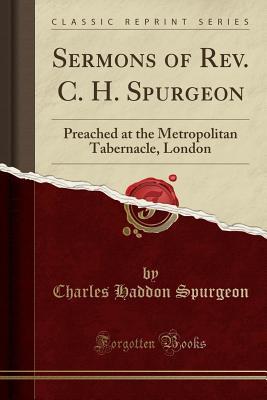
Sermons of Rev. C. H. Spurgeon: Preached at the Metropolitan Tabernacle, London (Classic Reprint)
by C.H. Spurgeon
Excerpt from Sermons of Rev. C. H. Spurgeon: Preached at the Metropolitan Tabernacle, London
I find that the great error which we-have to contend with throughout England (and it is growing more and more), is One in direct Opposition to my text, well known to you as the doctrine Of baptismal regeneration. We will confront this dogma with the assertion that baptism wit/tout faith saves no one. The text says, He that believeth and is baptized shall be saved; but whether a man be baptized or no, it asserts that lze tilat belieu et/t not shall be damned: SO that baptism does not save the unbeliever; nay, it does not in any degree exempt him from the common doom of all the ungodly. He may have baptism, or he may not have baptism; but if he believeth not, he Shall be in any case most surely damned. Let him be baptized by immersion or Sprinkling, in his infancy or in his adult age: if he be not led to put his trust in Jesus Christ -if he remaineth an unbeliever - then this terrible doom is pronounced upon him, He that believeth not Shall be damned. I am not aware that any Prot estant church in England teaches the doctrine of baptismal re generation, except one, and that happens to be' the corporation which with none too much humility calls itself the Church of England. This very powerful sect does not teach this doctrine merely through a section of its ministers, who might charitably be considered as evil branches of the vine, but it Openly, boldly, and plainly declares this doctrine in her own_appointed standard, the Book of' Common Prayer, and that in words so express, that, while language is the channel of conveying intelligible sense, no process Short of violent wresting from their plain meaning can ever make them say anything else.
About the Publisher
Forgotten Books publishes hundreds of thousands of rare and classic books. Find more at www.forgottenbooks.comwww.forgottenbooks.com
This book is a reproduction of an important historical work. Forgotten Books uses state-of-the-art technology to digitally reconstruct the work, preserving the original format whilst repairing imperfections present in the aged copy. In rare cases, an imperfection in the original, such as a blemish or missing page, may be replicated in our edition. We do, however, repair the vast majority of imperfections successfully; any imperfections that remain are intentionally left to preserve the state of such historical works.
I find that the great error which we-have to contend with throughout England (and it is growing more and more), is One in direct Opposition to my text, well known to you as the doctrine Of baptismal regeneration. We will confront this dogma with the assertion that baptism wit/tout faith saves no one. The text says, He that believeth and is baptized shall be saved; but whether a man be baptized or no, it asserts that lze tilat belieu et/t not shall be damned: SO that baptism does not save the unbeliever; nay, it does not in any degree exempt him from the common doom of all the ungodly. He may have baptism, or he may not have baptism; but if he believeth not, he Shall be in any case most surely damned. Let him be baptized by immersion or Sprinkling, in his infancy or in his adult age: if he be not led to put his trust in Jesus Christ -if he remaineth an unbeliever - then this terrible doom is pronounced upon him, He that believeth not Shall be damned. I am not aware that any Prot estant church in England teaches the doctrine of baptismal re generation, except one, and that happens to be' the corporation which with none too much humility calls itself the Church of England. This very powerful sect does not teach this doctrine merely through a section of its ministers, who might charitably be considered as evil branches of the vine, but it Openly, boldly, and plainly declares this doctrine in her own_appointed standard, the Book of' Common Prayer, and that in words so express, that, while language is the channel of conveying intelligible sense, no process Short of violent wresting from their plain meaning can ever make them say anything else.
About the Publisher
Forgotten Books publishes hundreds of thousands of rare and classic books. Find more at www.forgottenbooks.comwww.forgottenbooks.com
This book is a reproduction of an important historical work. Forgotten Books uses state-of-the-art technology to digitally reconstruct the work, preserving the original format whilst repairing imperfections present in the aged copy. In rare cases, an imperfection in the original, such as a blemish or missing page, may be replicated in our edition. We do, however, repair the vast majority of imperfections successfully; any imperfections that remain are intentionally left to preserve the state of such historical works.
Paperback, 388 pages
Published April 27th 2018 by Forgotten Books
Subscribe
Get Bible verse every day in your inbox
Read on Mobile


Group of Brands


© 2026 Bibleportal.com All rights reserved.
C.H. Spurgeon (1834 - 1892)
Spurgeon quickly became known as one of the most influential preachers of his time. Well known for his biblical powerful expositions of scripture and oratory ability. In modern evangelical circles he is stated to be the "Prince of Preachers." He pastored the Metropolitan Tabernacle in downtown London, England.His church was part of a particular baptist church movement and they defended and preached Christ and Him crucified and the purity of the Gospel message. Spurgeon never gave altar calls but always extended the invitation to come to Christ. He was a faithful minister in his time that glorified God and brought many to the living Christ.
Charles Haddon Spurgeon was England's best-known preacher for most of the second half of the nineteenth century. In 1854, just four years after his conversion, Spurgeon, then only 20, became pastor of London's famed New Park Street Church (formerly pastored by the famous Baptist theologian John Gill).
The congregation quickly outgrew their building, moved to Exeter Hall, then to Surrey Music Hall. In these venues Spurgeon frequently preached to audiences numbering more than 10,000 - all in the days before electronic amplification.
In 1861 the congregation moved permanently to the new Metropolitan Tabernacle.
... Show more