The Prince of Preachers, Charles H. Spurgeon (19th June 1834 – 31 January 1892) was not only a wonderful orator but also magnificent with his pen. The sermons he preached touched the lives of thousands. His writings still continue to reach those who read them to this very day.
Reading Spurgeon today may be secondary to the impossibility of hearing him but there is no doubt that his words still carry the weight of Biblical truth.
The Treasury Of David is regarded as Spurgeon’s Magnum Opus. He worked on this for 20 years publishing once a week in the Sword and the Trowel. The whole of the Psalms were covered in 6 volumes all of which were published between 1888 and 1890.
This is volume 4 of the Treasury of David and includes Psalms 76 through Psalm 100.
We now present this work to you on the Kindle. It includes an active table of contents to assist you in moving to the chapters of your choice.
This is a must read for every Christian.

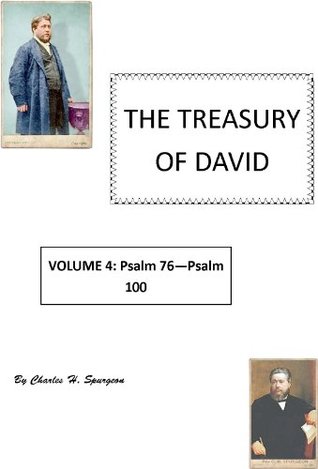


C.H. Spurgeon (1834 - 1892)
Spurgeon quickly became known as one of the most influential preachers of his time. Well known for his biblical powerful expositions of scripture and oratory ability. In modern evangelical circles he is stated to be the "Prince of Preachers." He pastored the Metropolitan Tabernacle in downtown London, England.His church was part of a particular baptist church movement and they defended and preached Christ and Him crucified and the purity of the Gospel message. Spurgeon never gave altar calls but always extended the invitation to come to Christ. He was a faithful minister in his time that glorified God and brought many to the living Christ.
Charles Haddon Spurgeon was England's best-known preacher for most of the second half of the nineteenth century. In 1854, just four years after his conversion, Spurgeon, then only 20, became pastor of London's famed New Park Street Church (formerly pastored by the famous Baptist theologian John Gill).
The congregation quickly outgrew their building, moved to Exeter Hall, then to Surrey Music Hall. In these venues Spurgeon frequently preached to audiences numbering more than 10,000 - all in the days before electronic amplification.
In 1861 the congregation moved permanently to the new Metropolitan Tabernacle.
... Show more