
- Bible
- Read the Bible
- Bible Versions
- Verse of the Day
- Reading Plans
- Verses by Topic
- Books of the Bible
- Bible Images
- Study
- Commentaries
- Concordances
- Dictionaries
- Encyclopedias
- Sermons
- Bible Atlas & Maps
- BP Wiki
- Devotionals
- Today's Devotionals
- Light of the World
- All Devotionals
- Inspirational Quotes
- More
- Picture Quotes
- Videos
- Inspirational
- Bible Study
- What The Bible Says
- Bible Q&As
- Daily Bread
- Bible by Genre
- Bible Stories
- Random Bible Verse
- Community
- Store
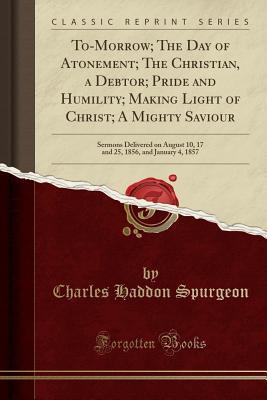
Excerpt from To-Morrow; The Day of Atonement; The Christian, a Debtor; Pride and Humility; Making Light of Christ; A Mighty Saviour: Sermons Delivered on August 10, 17 and 25, 1856, and January 4, 1857
Again, the atonement was made by a solitary kigli priest - alone and unassisted. You read in the 17th verse, And there shall be no man in the tabernacle of the congre gation when he goeth in to make an atonement in the holy place, until he come out, and have made an atonement for himself, and for his household, and for all the congregation of Israel. No other man was to be present, so that the people might be quite certain that everything was done by the High Priest alone. It is remark able, as Matthew Henry observes, that no disciple died with Christ. When he was put to death, his disciples forsook him and fled; they crucified none of his followers with him, lest any should suppose that the disciple shared the honour of atonement. Thieves were crucified with him because none would suspect that they could assist him; but if a disciple had died, it might have been imagined that he had shared the atone ment. God kept that holy circle of Calvary select to Christ, and none of his disciples must go to die there with him. 0 glorious High Priest, thou hast done it all alone. 0, glorious antitype of Aaron, no son of thine stood with thee; no Eliezer, no Phineas, burned. Incense; there was no priest, no Levite, save thyself. I have trodden the wine-press alone, and of the people there was none with me. Then give all the glory unto his holy name, for alone and unassisted he. Made atonement for your guilt. The bath of his blood is your only washing; the stream of water from his side is your perfect purification. None but Jesus, none but Jesus, has wrought out the work of cdr salvation.
About the Publisher
Forgotten Books publishes hundreds of thousands of rare and classic books. Find more at www.forgottenbooks.comwww.forgottenbooks.com
This book is a reproduction of an important historical work. Forgotten Books uses state-of-the-art technology to digitally reconstruct the work, preserving the original format whilst repairing imperfections present in the aged copy. In rare cases, an imperfection in the original, such as a blemish or missing page, may be replicated in our edition. We do, however, repair the vast majority of imperfections successfully; any imperfections that remain are intentionally left to preserve the state of such historical works.
Again, the atonement was made by a solitary kigli priest - alone and unassisted. You read in the 17th verse, And there shall be no man in the tabernacle of the congre gation when he goeth in to make an atonement in the holy place, until he come out, and have made an atonement for himself, and for his household, and for all the congregation of Israel. No other man was to be present, so that the people might be quite certain that everything was done by the High Priest alone. It is remark able, as Matthew Henry observes, that no disciple died with Christ. When he was put to death, his disciples forsook him and fled; they crucified none of his followers with him, lest any should suppose that the disciple shared the honour of atonement. Thieves were crucified with him because none would suspect that they could assist him; but if a disciple had died, it might have been imagined that he had shared the atone ment. God kept that holy circle of Calvary select to Christ, and none of his disciples must go to die there with him. 0 glorious High Priest, thou hast done it all alone. 0, glorious antitype of Aaron, no son of thine stood with thee; no Eliezer, no Phineas, burned. Incense; there was no priest, no Levite, save thyself. I have trodden the wine-press alone, and of the people there was none with me. Then give all the glory unto his holy name, for alone and unassisted he. Made atonement for your guilt. The bath of his blood is your only washing; the stream of water from his side is your perfect purification. None but Jesus, none but Jesus, has wrought out the work of cdr salvation.
About the Publisher
Forgotten Books publishes hundreds of thousands of rare and classic books. Find more at www.forgottenbooks.comwww.forgottenbooks.com
This book is a reproduction of an important historical work. Forgotten Books uses state-of-the-art technology to digitally reconstruct the work, preserving the original format whilst repairing imperfections present in the aged copy. In rare cases, an imperfection in the original, such as a blemish or missing page, may be replicated in our edition. We do, however, repair the vast majority of imperfections successfully; any imperfections that remain are intentionally left to preserve the state of such historical works.
BUY NOW
Paperback, 54 pages
Published January 16th 2019 by Forgotten Books
Subscribe
Get Bible verse every day in your inbox
Read on Mobile


Group of Brands


© 2026 Bibleportal.com All rights reserved.
C.H. Spurgeon (1834 - 1892)
Spurgeon quickly became known as one of the most influential preachers of his time. Well known for his biblical powerful expositions of scripture and oratory ability. In modern evangelical circles he is stated to be the "Prince of Preachers." He pastored the Metropolitan Tabernacle in downtown London, England.His church was part of a particular baptist church movement and they defended and preached Christ and Him crucified and the purity of the Gospel message. Spurgeon never gave altar calls but always extended the invitation to come to Christ. He was a faithful minister in his time that glorified God and brought many to the living Christ.
Charles Haddon Spurgeon was England's best-known preacher for most of the second half of the nineteenth century. In 1854, just four years after his conversion, Spurgeon, then only 20, became pastor of London's famed New Park Street Church (formerly pastored by the famous Baptist theologian John Gill).
The congregation quickly outgrew their building, moved to Exeter Hall, then to Surrey Music Hall. In these venues Spurgeon frequently preached to audiences numbering more than 10,000 - all in the days before electronic amplification.
In 1861 the congregation moved permanently to the new Metropolitan Tabernacle.
... Show more