
- Bible
- Read the Bible
- Bible Versions
- Verse of the Day
- Reading Plans
- Verses by Topic
- Books of the Bible
- Bible Images
- Study
- Commentaries
- Concordances
- Dictionaries
- Encyclopedias
- Sermons
- Bible Atlas & Maps
- BP Wiki
- Devotionals
- Today's Devotionals
- Light of the World
- All Devotionals
- Inspirational Quotes
- More
- Picture Quotes
- Videos
- Inspirational
- Bible Study
- What The Bible Says
- Bible Q&As
- Daily Bread
- Bible by Genre
- Bible Stories
- Random Bible Verse
- Community
- Store
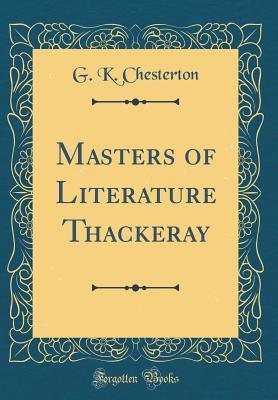
Masters of Literature Thackeray (Classic Reprint)
by G.K. Chesterton
Excerpt from Masters of Literature Thackeray
He returned with a resolution to work his own way and was admitted to the Bar; in the intervals of that leisurely career he wrote articles and drew caricatures. It was as a draughtsman that he took himself most seriously. There is a legend that he actually waited upon Dickens with a proposal to illustrate his books, then already in the blaze of popularity. Dickens, pre sumably, declined; which was a good thing for Dickens's books, but also a good thing for Thackeray's. Although the interview was futile it affects the imagination as much as the meeting with Napoleon. Thackeray's first formidable appearance in letters was in Fraser's Maga zine; where he made his name - or rather made his pseudonym. Over the signature of Michael Angelo Titmarsh (with occasional holidays of a more vulgar sort under that of James Yellowplush) he began to pour out his experiences, which were already somewhat motley and even squalid. This must always be remem bered in the silly discussion about whether Thackeray was a cynic. The false impression was given, not because he made his heroes less than his villains, but because he certainly wrote about villains before he wrote about heroes. Madame d'ivry and Captain Blackball, Mrs.
Mackenzie and Mr. Moss, can be found in his earliest and crudest sketches. It is exactly Ethel Newcome and the Colonel who do not come in till afterwards. Something of this healing and humanizing may have been efl'ected by his marriage; though its ultimate issue was, as everyone knows, painful and terrible. Mrs. Thackeray was sent to an asylum; and Thackeray said a very fine thing: I would do it over again.
About the Publisher
Forgotten Books publishes hundreds of thousands of rare and classic books. Find more at www.forgottenbooks.comwww.forgottenbooks.com
This book is a reproduction of an important historical work. Forgotten Books uses state-of-the-art technology to digitally reconstruct the work, preserving the original format whilst repairing imperfections present in the aged copy. In rare cases, an imperfection in the original, such as a blemish or missing page, may be replicated in our edition. We do, however, repair the vast majority of imperfections successfully; any imperfections that remain are intentionally left to preserve the state of such historical works.
He returned with a resolution to work his own way and was admitted to the Bar; in the intervals of that leisurely career he wrote articles and drew caricatures. It was as a draughtsman that he took himself most seriously. There is a legend that he actually waited upon Dickens with a proposal to illustrate his books, then already in the blaze of popularity. Dickens, pre sumably, declined; which was a good thing for Dickens's books, but also a good thing for Thackeray's. Although the interview was futile it affects the imagination as much as the meeting with Napoleon. Thackeray's first formidable appearance in letters was in Fraser's Maga zine; where he made his name - or rather made his pseudonym. Over the signature of Michael Angelo Titmarsh (with occasional holidays of a more vulgar sort under that of James Yellowplush) he began to pour out his experiences, which were already somewhat motley and even squalid. This must always be remem bered in the silly discussion about whether Thackeray was a cynic. The false impression was given, not because he made his heroes less than his villains, but because he certainly wrote about villains before he wrote about heroes. Madame d'ivry and Captain Blackball, Mrs.
Mackenzie and Mr. Moss, can be found in his earliest and crudest sketches. It is exactly Ethel Newcome and the Colonel who do not come in till afterwards. Something of this healing and humanizing may have been efl'ected by his marriage; though its ultimate issue was, as everyone knows, painful and terrible. Mrs. Thackeray was sent to an asylum; and Thackeray said a very fine thing: I would do it over again.
About the Publisher
Forgotten Books publishes hundreds of thousands of rare and classic books. Find more at www.forgottenbooks.comwww.forgottenbooks.com
This book is a reproduction of an important historical work. Forgotten Books uses state-of-the-art technology to digitally reconstruct the work, preserving the original format whilst repairing imperfections present in the aged copy. In rare cases, an imperfection in the original, such as a blemish or missing page, may be replicated in our edition. We do, however, repair the vast majority of imperfections successfully; any imperfections that remain are intentionally left to preserve the state of such historical works.
BUY NOW
Hardcover, 382 pages
Published December 28th 2018 by Forgotten Books
Subscribe
Get Bible verse every day in your inbox
Read on Mobile


Group of Brands


© 2026 Bibleportal.com All rights reserved.
Gilbert Keith Chesterton was one of the most influential English writers of the 20th century. His prolific and diverse output included journalism, philosophy, poetry, biography, Christian apologetics, fantasy and detective fiction.
Chesterton has been called the "prince of paradox". Time magazine, in a review of a biography of Chesterton, observed of his writing style: "Whenever possible Chesterton made his points with popular sayings, proverbs, allegories—first carefully turning them inside out.
... Show more