
- Bible
- Read the Bible
- Bible Versions
- Verse of the Day
- Reading Plans
- Verses by Topic
- Books of the Bible
- Bible Images
- Study
- Commentaries
- Concordances
- Dictionaries
- Encyclopedias
- Sermons
- Bible Atlas & Maps
- BP Wiki
- Devotionals
- Today's Devotionals
- Light of the World
- All Devotionals
- Inspirational Quotes
- More
- Picture Quotes
- Videos
- Inspirational
- Bible Study
- What The Bible Says
- Bible Q&As
- Daily Bread
- Bible by Genre
- Bible Stories
- Random Bible Verse
- Community
- Store
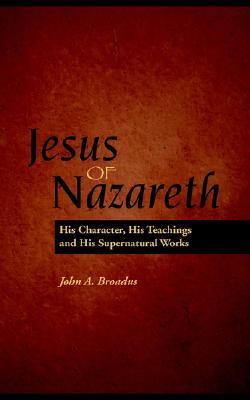
Jesus of Nazareth: His Character, Teaching and Supernatural Works
by John A. Broadus
"These lectures were delivered in March 1890, in the Hall recently erected and given to Johns Hopkins University, for the use of the Young Men's Christian Association of that institution; and the President of the YMCA specially requested their publication. They were not designed as class-room lectures, since many not connected with the University were invited to attend. "The subject treated seems to possess an ever-deepening interest at the present time. The personal character of Jesus is now widely perceived to be an important guarantee of his teachings and works. This character is presented by the first lecture in a way that to some may appear lacking in devout warmth; but the object was to gain the concurrence of every person who will calmly survey the historical facts, and thus to lay a foundation for what would follow. It is hoped that the second lecture will tend to rectify certain erroneous but quite prevalent views of the Savior's teaching; and that the third lecture may be found to have some argumentative force in regarde to his mission and claims. "The little volume is the fruit of life-time studies, and has been prepared with the author's best exertions, and a great desire to promote 'the knowledge of Jesus, the most excellent of the sciences." - from the Author's Preface JOHN ALBERT BROADUS (1827-1895) was to become one of the most influential Baptist leaders in the history of the nation. This volume is a wonderful introduction to the heart of this man who loved his Savior and Lord with a passion that was contagious.
BUY NOW
Paperback, 112 pages
Published June 16th 2005 by Solid Ground Christian Books (first published June 2005)
Subscribe
Get Bible verse every day in your inbox
Read on Mobile


Group of Brands


© 2026 Bibleportal.com All rights reserved.
John Albert Broadus was an American Baptist pastor and professor at the Southern Baptist Theological Seminary, one of the most famous preachers of his day. Charles Spurgeon deemed Broadus the “greatest of living preachers.” Church historian Albert Henry Newman later said “perhaps the greatest man the Baptists have produced.
Broadus was born in Culpepper County, Virginia, 24 January, 1827. He was educated at the University of Virginia, and from 1851 till 1853 was assistant professor of ancient languages there. He then became pastor of the Baptist church in Charlottesville, and in 1859 professor of New Testament interpretation and homiletics in the Southern Baptist theological seminary at Greenville, South Carolina, now in Louisville, Kentucky As a Greek scholar and New Testament critic.
His quiet conversational delivery brought both critics and imitators. Some men, who equated "real preaching" with soaring in the oratorical stratosphere, accused Broadus of "ruining the preachers of the South" by his example. His students, however, saw his effectiveness and in spite of his warning, many of them tried to imitate his tones, his genuine pathos, his platform manner, failing to realize that they had only a few of his external characteristics and not the qualities of his success.
... Show more