
- Bible
- Read the Bible
- Bible Versions
- Verse of the Day
- Reading Plans
- Verses by Topic
- Books of the Bible
- Bible Images
- Study
- Commentaries
- Concordances
- Dictionaries
- Encyclopedias
- Sermons
- Bible Atlas & Maps
- BP Wiki
- Devotionals
- Today's Devotionals
- Light of the World
- All Devotionals
- Inspirational Quotes
- More
- Picture Quotes
- Videos
- Inspirational
- Bible Study
- What The Bible Says
- Bible Q&As
- Daily Bread
- Bible by Genre
- Bible Stories
- Random Bible Verse
- Community
- Store
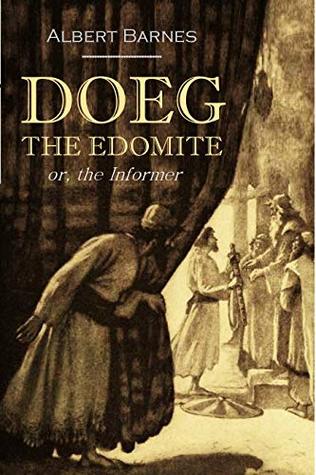
Doeg, The Edomite, Or, The Informer (1861)
by Albert Barnes
Doeg was an Edomite, chief herdsman to Saul, King of Israel. He is mentioned in the Hebrew Bible book of First Samuel, chapters 21 and 22 as well as Psalms 52, where he is depicted as an antagonist of David responsible for the demise of a large number of Hebrew priests.
In 1861 famous theologian Albert Barnes published a short 35-page teaching on Doeg, titled "Doeg, The Edomite, Or, The Informer." In this teaching Barnes, using Doeg as an example, moralizes on circumstance it is forbidden and wrong to be an informer for purposes of personal gain at the expense of others, noting:
"Perhaps all that need to be said on this point can be reduced to three heads: when it is for base purposes; when the innocent are betrayed; and when professional confidence is violated. First. When it is for base purposes. This would include all those cases where it is for gain; where it is to secure favor; and where it is from envy, malice, spite, or revenge. The case of Doeg was, manifestly, an instance of this kind, where the motive was not that of promoting public justice, or preserving the peace of the realm, but where it was to ingratiate himself into the favor of Saul, and secure his own influence."
Background story of Doeg the Informer:
Saul fostered a deep hatred against David. Probably the manner in which his victory over the giant Goliath was received by the people had something to do with it; and the king feared lest the popularity of David should become greater than his own. His anger became almost ungovernable, and several attempts had been made by him to take away David's life; but all attempts were vain because the Lord was with him, his life was precious in His sight, and great things were to be accomplished through his instrumentality. As the hatred of Saul increased, the friendship of Jonathan, his son, deepened towards David.
David made pact of friendship with Jonathan and after parting from Jonathan, David fled from Saul's jealous anger and went to Nob. He went to Ahimelech, the High Priest, claiming to be on a clandestine royal mission. Ahimelech fed David and his men with the showbread, and gave David the sword of Goliath. Doeg was present and witnessed Ahimelech's service to David. Later, Saul asked about the whereabouts of David, and his herdsman spoke up:
"Then answered Doeg the Edomite, which was set over the servants of Saul, and said, I saw the son of Jesse coming to Nob, to Ahimelech the son of Ahitub." (1 Sam 22:9) This led Saul to seek retribution against those who aided David.
In concluding his teaching, Barnes observes:
"In human nature fallen, and, as I believe, wholly destitute of holiness, or of any tendency to spiritual good, there are two classes of propensities or principles:—those which are generous, magnanimous, gentle, kind, benevolent, large-hearted, humane, noble; and there are those which are low, grovelling, sordid, sycophantic, mean, ignoble."
About the author:
Albert Barnes (1798 –1870) was an American theologian best known for his extensive Bible commentary and notes on the Old and New Testaments, published in a total of 14 volumes in the 1830's.
About Edomites:
Edomites were the descendant's of Esau who had a history of conflict with Israel. Edom was an ancient kingdom in Transjordan located between Moab to the northeast, the Arabah to the west and the Arabian Desert to the south and east. Most of its former territory is now divided between Israel and Jordan. Edom appears in written sources relating to the late Bronze Age and to the Iron Age in the Levant, such as the Hebrew Bible and Egyptian and Mesopotamian records.
In 1861 famous theologian Albert Barnes published a short 35-page teaching on Doeg, titled "Doeg, The Edomite, Or, The Informer." In this teaching Barnes, using Doeg as an example, moralizes on circumstance it is forbidden and wrong to be an informer for purposes of personal gain at the expense of others, noting:
"Perhaps all that need to be said on this point can be reduced to three heads: when it is for base purposes; when the innocent are betrayed; and when professional confidence is violated. First. When it is for base purposes. This would include all those cases where it is for gain; where it is to secure favor; and where it is from envy, malice, spite, or revenge. The case of Doeg was, manifestly, an instance of this kind, where the motive was not that of promoting public justice, or preserving the peace of the realm, but where it was to ingratiate himself into the favor of Saul, and secure his own influence."
Background story of Doeg the Informer:
Saul fostered a deep hatred against David. Probably the manner in which his victory over the giant Goliath was received by the people had something to do with it; and the king feared lest the popularity of David should become greater than his own. His anger became almost ungovernable, and several attempts had been made by him to take away David's life; but all attempts were vain because the Lord was with him, his life was precious in His sight, and great things were to be accomplished through his instrumentality. As the hatred of Saul increased, the friendship of Jonathan, his son, deepened towards David.
David made pact of friendship with Jonathan and after parting from Jonathan, David fled from Saul's jealous anger and went to Nob. He went to Ahimelech, the High Priest, claiming to be on a clandestine royal mission. Ahimelech fed David and his men with the showbread, and gave David the sword of Goliath. Doeg was present and witnessed Ahimelech's service to David. Later, Saul asked about the whereabouts of David, and his herdsman spoke up:
"Then answered Doeg the Edomite, which was set over the servants of Saul, and said, I saw the son of Jesse coming to Nob, to Ahimelech the son of Ahitub." (1 Sam 22:9) This led Saul to seek retribution against those who aided David.
In concluding his teaching, Barnes observes:
"In human nature fallen, and, as I believe, wholly destitute of holiness, or of any tendency to spiritual good, there are two classes of propensities or principles:—those which are generous, magnanimous, gentle, kind, benevolent, large-hearted, humane, noble; and there are those which are low, grovelling, sordid, sycophantic, mean, ignoble."
About the author:
Albert Barnes (1798 –1870) was an American theologian best known for his extensive Bible commentary and notes on the Old and New Testaments, published in a total of 14 volumes in the 1830's.
About Edomites:
Edomites were the descendant's of Esau who had a history of conflict with Israel. Edom was an ancient kingdom in Transjordan located between Moab to the northeast, the Arabah to the west and the Arabian Desert to the south and east. Most of its former territory is now divided between Israel and Jordan. Edom appears in written sources relating to the late Bronze Age and to the Iron Age in the Levant, such as the Hebrew Bible and Egyptian and Mesopotamian records.
BUY NOW
Kindle Edition, 38 pages
Published September 22nd 2018
Subscribe
Get Bible verse every day in your inbox
Read on Mobile


Group of Brands


© 2026 Bibleportal.com All rights reserved.
Albert Barnes was an American theologian, born at Rome, New York, on December 1, 1798. He graduated from Hamilton College, Clinton, New York, in 1820, and from Princeton Theological Seminary in 1823. Barnes was ordained as a Presbyterian minister by the presbytery of Elizabethtown, New Jersey, in 1825, and was the pastor successively of the Presbyterian Church in Morristown, New Jersey (1825-1830), and of the First Presbyterian Church of Philadelphia (1830-1867).
He was an eloquent preacher, but his reputation rests chiefly on his expository works, which are said to have had a larger circulation both in Europe and America than any others of their class.
Of the well-known Notes on the New Testament, it is said that more than a million volumes had been issued by 1870. The Notes on Job, the Psalms, Isaiah and Daniel found scarcely less acceptance. Displaying no original critical power, their chief merit lies in the fact that they bring in a popular (but not always accurate) form the results of the criticism of others within the reach of general readers. Barnes was the author of several other works of a practical and devotional kind, including Scriptural Views of Slavery (1846) and The Way of Salvation (1863). A collection of his Theological Works was published in Philadelphia in 1875.
... Show more