
- Bible
- Read the Bible
- Bible Versions
- Verse of the Day
- Reading Plans
- Verses by Topic
- Books of the Bible
- Bible Images
- Study
- Commentaries
- Concordances
- Dictionaries
- Encyclopedias
- Sermons
- Bible Atlas & Maps
- BP Wiki
- Devotionals
- Today's Devotionals
- Light of the World
- All Devotionals
- Inspirational Quotes
- More
- Picture Quotes
- Videos
- Inspirational
- Bible Study
- What The Bible Says
- Bible Q&As
- Daily Bread
- Bible by Genre
- Bible Stories
- Random Bible Verse
- Community
- Store
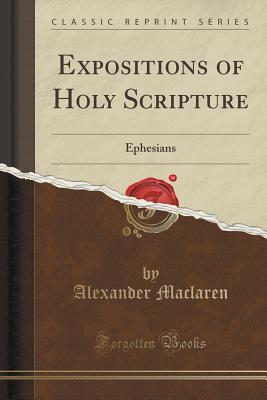
Expositions of Holy Scripture: Ephesians (Classic Reprint)
by Alexander Maclaren
Excerpt from Expositions of Holy Scripture: Ephesians
That is Paul's way of describing a church. There were plenty of very imperfect Christians in the community at Ephesus and in the other Asiatic churches to which this letter went. As we know, there were heretics amongst them, and many others to Whom the designa tion of 'holy' seemed inapplicable. But Paul classes them all under one category, and describes the whole body of believing people by these two words, which must always go together if either of them is truly applied, saints and faithful.' Now I think that from this simple designation we may gather two or three very obvious indeed, and very familiar and old-fashioned, but also very important, thoughts.
About the Publisher
Forgotten Books publishes hundreds of thousands of rare and classic books. Find more at www.forgottenbooks.comwww.forgottenbooks.com
This book is a reproduction of an important historical work. Forgotten Books uses state-of-the-art technology to digitally reconstruct the work, preserving the original format whilst repairing imperfections present in the aged copy. In rare cases, an imperfection in the original, such as a blemish or missing page, may be replicated in our edition. We do, however, repair the vast majority of imperfections successfully; any imperfections that remain are intentionally left to preserve the state of such historical works.
That is Paul's way of describing a church. There were plenty of very imperfect Christians in the community at Ephesus and in the other Asiatic churches to which this letter went. As we know, there were heretics amongst them, and many others to Whom the designa tion of 'holy' seemed inapplicable. But Paul classes them all under one category, and describes the whole body of believing people by these two words, which must always go together if either of them is truly applied, saints and faithful.' Now I think that from this simple designation we may gather two or three very obvious indeed, and very familiar and old-fashioned, but also very important, thoughts.
About the Publisher
Forgotten Books publishes hundreds of thousands of rare and classic books. Find more at www.forgottenbooks.comwww.forgottenbooks.com
This book is a reproduction of an important historical work. Forgotten Books uses state-of-the-art technology to digitally reconstruct the work, preserving the original format whilst repairing imperfections present in the aged copy. In rare cases, an imperfection in the original, such as a blemish or missing page, may be replicated in our edition. We do, however, repair the vast majority of imperfections successfully; any imperfections that remain are intentionally left to preserve the state of such historical works.
BUY NOW
Paperback, 432 pages
Published April 21st 2018 by Forgotten Books (first published July 14th 2015)
Subscribe
Get Bible verse every day in your inbox
Read on Mobile


Group of Brands


© 2026 Bibleportal.com All rights reserved.
Maclaren had been for almost sixty-five years a minister, entirely devoted to his calling. He lived more than almost any of the great preachers of his time between his study, his pulpit, his pen.
He subdued action to thought, thought to utterance and utterance to the Gospel. His life was his ministry; his ministry was his life. In 1842 he was enrolled as a candidate for the Baptist ministry at Stepney College, London. He was tall, shy, silent and looked no older than his sixteen years. But his vocation, as he himself (a consistent Calvinist) might have said, was divinely decreed. "I cannot ever recall any hesitation as to being a minister," he said. "It just had to be."
In the College he was thoroughly grounded in Greek and Hebrew. He was taught to study the Bible in the original and so the foundation was laid for his distinctive work as an expositor and for the biblical content of his preaching. Before Maclaren had finished his course of study he was invited to Portland Chapel in Southampton for three months; those three months became twelve years. He began his ministry there on June 28, 1846. His name and fame grew.
His ministry fell into a quiet routine for which he was always grateful: two sermons on Sunday, a Monday prayer meeting and a Thursday service and lecture. His parishioners thought his sermons to them were the best he ever preached. In April 1858 he was called to be minister at Union Chapel in Manchester. No ministry could have been happier. The church prospered and a new building had to be erected to seat 1,500; every sitting was taken. His renown as preacher spread throughout the English-speaking world. His pulpit became his throne. He was twice elected President of the Baptist Union. He resigned as pastor in 1905 after a ministry of forty-five years.
Maclaren's religious life was hid with Christ in God. He walked with God day by day. He loved Jesus Christ with a reverent, holy love and lived to make Him known. In his farewell sermon at Union he said: "To efface oneself is one of a preacher's first duties."
... Show more