Excerpt from Alexandri Lycopolitani Contra Manichaei Opiniones Disputatio
Omnes quotquot in b�ibliotlgecis asservantur huius commentationis libri man� scripti ut vetustate et vir tute longe superat ita parens quoque est atque fous omnium bibliothecae Laurentianae plutei IX codex 23 M ediceus (m). Duae autem eius sunt partes quattuor foliis vacuis insertis distinctae, quae sive membranae genus. Sive scribendi rationem sive librorp.m quos con tinent argumenta. Spectas, adeo, inter se discrepapt, ut; duos diversae naturae diversaeque originis. Codices invita Minerva consutos esse pateat. In priore quae insunt. Indicavit Bandini catal. Cod. Gr. Bibl, Laur. I. P. 427sqq, alter quem solum spect haec com plectitur scripta.
About the Publisher
Forgotten Books publishes hundreds of thousands of rare and classic books. Find more at
www.forgottenbooks.comwww.forgottenbooks.com
This book is a reproduction of an important historical work. Forgotten Books uses state-of-the-art technology to digitally reconstruct the work, preserving the original format whilst repairing imperfections present in the aged copy. In rare cases, an imperfection in the original, such as a blemish or missing page, may be replicated in our edition. We do, however, repair the vast majority of imperfections successfully; any imperfections that remain are intentionally left to preserve the state of such historical works.

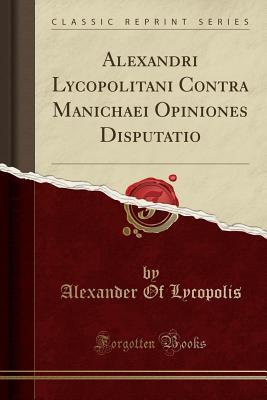


Alexander of Lycopolis (unknown - 448)
The writer of a short treatise, in twenty-six chapters, against the Manichæans (P.G., XVIII, 409-448). He must have flourished early in the fourth century, as he says in the second chapter of this work that he derived his knowledge of Manes' teaching apo ton gnorimon (from the man's friend).Despite its brevity and occasional obscurity, the work is valuable as a specimen of Greek analytical genius in the service of Christian theology, "a calm but vigorous protest of the trained scientific intellect against the vague dogmatism of the Oriental theosophies". It has been questioned whether Alexander was a Christian when he wrote this work, or ever became one afterwards. Photius says (Contra Manichæos, i, 11) that he was Bishop of Lycopolis (in the Egyptian Thebaid), but Bardenhewer opines (Patrologie, 234) that he was a pagan and a platonist.
... Show more