
- Bible
- Read the Bible
- Bible Versions
- Verse of the Day
- Reading Plans
- Verses by Topic
- Books of the Bible
- Bible Images
- Study
- Commentaries
- Concordances
- Dictionaries
- Encyclopedias
- Sermons
- Bible Atlas & Maps
- BP Wiki
- Devotionals
- Today's Devotionals
- All Devotionals
- Inspirational Quotes
- More
- Picture Quotes
- Videos
- Inspirational
- Bible Study
- What The Bible Says
- Bible Q&As
- Daily Bread
- Bible by Genre
- Bible Stories
- Random Bible Verse
- Community
- Store
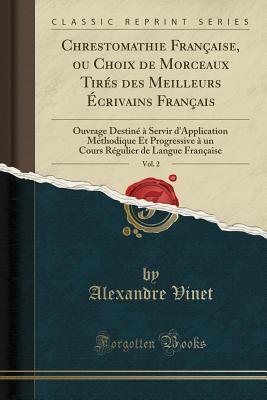
Excerpt from Chrestomathie Francaise, ou Choix de Morceaux Tires des Meilleurs Ecrivains Francais, Vol. 2: Ouvrage Destine a Servir d'Application Methodique Et Progressive a un Cours Regulier de Langue Francaise
Des mots qui naissent, qui meurent, qui ressuscitent, ce n'est la qu'une moitie, la plus apparente et la moins considerable, des vicissitudes d'un idiome. Toutefois cette moitie meme signale des faits publics d'une assez grande importance. A la verite, un grand nombre de mots ont pu etre appeles dans la langue ou rejetes de son sein par des circonstances superficielles ou par les caprices de la mode. Mais quand vous voyez des masses, des systemes entiers de mots, disparaitre ou s'introduire, leur retraite ou leur Invasion temoigne que quelque chose de grave est survenu dans les moeurs. Il y a des temps ou la langue generale se puise dans toutes les parties les plus diverses de la vie d'un peuple, ou elle en (exprime a la fois les elements rustique, pastoral, bourgeois, aristocratique, se teignant et se modifiant les uns les autres. Puis l'un ou l'au tre se retire, laissant, a la verite dans la languedes allusions et des metaphores qui ne peuvent plus s'en detacher, mais toutefois emportant, ainsi qu'une epouse repudiee, la plus grande partie de sa dot.
About the Publisher
Forgotten Books publishes hundreds of thousands of rare and classic books. Find more at www.forgottenbooks.comwww.forgottenbooks.com
This book is a reproduction of an important historical work. Forgotten Books uses state-of-the-art technology to digitally reconstruct the work, preserving the original format whilst repairing imperfections present in the aged copy. In rare cases, an imperfection in the original, such as a blemish or missing page, may be replicated in our edition. We do, however, repair the vast majority of imperfections successfully; any imperfections that remain are intentionally left to preserve the state of such historical works.
Des mots qui naissent, qui meurent, qui ressuscitent, ce n'est la qu'une moitie, la plus apparente et la moins considerable, des vicissitudes d'un idiome. Toutefois cette moitie meme signale des faits publics d'une assez grande importance. A la verite, un grand nombre de mots ont pu etre appeles dans la langue ou rejetes de son sein par des circonstances superficielles ou par les caprices de la mode. Mais quand vous voyez des masses, des systemes entiers de mots, disparaitre ou s'introduire, leur retraite ou leur Invasion temoigne que quelque chose de grave est survenu dans les moeurs. Il y a des temps ou la langue generale se puise dans toutes les parties les plus diverses de la vie d'un peuple, ou elle en (exprime a la fois les elements rustique, pastoral, bourgeois, aristocratique, se teignant et se modifiant les uns les autres. Puis l'un ou l'au tre se retire, laissant, a la verite dans la languedes allusions et des metaphores qui ne peuvent plus s'en detacher, mais toutefois emportant, ainsi qu'une epouse repudiee, la plus grande partie de sa dot.
About the Publisher
Forgotten Books publishes hundreds of thousands of rare and classic books. Find more at www.forgottenbooks.comwww.forgottenbooks.com
This book is a reproduction of an important historical work. Forgotten Books uses state-of-the-art technology to digitally reconstruct the work, preserving the original format whilst repairing imperfections present in the aged copy. In rare cases, an imperfection in the original, such as a blemish or missing page, may be replicated in our edition. We do, however, repair the vast majority of imperfections successfully; any imperfections that remain are intentionally left to preserve the state of such historical works.
BUY NOW
Paperback, 458 pages
Published April 30th 2018 by Forgotten Books
Subscribe
Get Bible verse every day in your inbox
Read on Mobile


Group of Brands


© 2026 Bibleportal.com All rights reserved.
Alexandre Vinet was born near Lausanne in Switzerland. Educated for the Protestant ministry, he was ordained in 1819, when already teacher of the French language and literature in the gymnasium at Basel; and throughout his life he was as much a critic as a theologian. His literary criticism brought him into contact with Augustin Sainte-Beuve, for whom he obtained an invitation to lecture at Lausanne, which led to his famous work on Port-Royal.
As a theologian Vinet gave a fresh impulse to Protestant theology, especially in French-speaking lands, but also in England and elsewhere. His philosophy relied strongly on conscience, defined as that by which man stands in direct personal relation with God as moral sovereign, and the seat of a moral individuality which nothing can rightly infringe.
... Show more