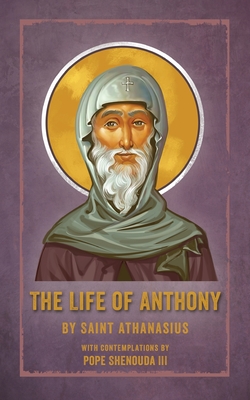
Born in Egypt, and author of some of the earliest examples of monastic literature, St Anthony has been influential across the world, from the East to the West. To this day his life stands as a testimony to the ascetical life, which was both then and now, "spoken of everywhere, and admired by everyone."
This book includes an abridged version of the Greek translation of the Life of Anthony by St Athanasius, to make it accessible for young readers. the second part of the book includes contemplations by Pope Shenouda III on the life of St Anthony, who was a very special companion of His Holiness, who was originally named Fr Antonios as a monk.
We hope you find this edition eye-opening to the wonder of St Anthony's life and to the mysteries of asceticism.



St. Athanasius (296 - 373)
Saint Athanasius of Alexandria (/ˌæθəˈneɪʃəs/; Greek: Ἀθανάσιος Ἀλεξανδρείας, Athanásios Alexandrías; c. 296–298 – 2 May 373), also called Athanasius the Great, Athanasius the Confessor or, primarily in the Coptic Orthodox Church, Athanasius the Apostolic, was the twentieth bishop of Alexandria (as Athanasius I). His episcopate lasted 45 years (c. 8 June 328 – 2 May 373), of which over 17 were spent in five exiles ordered by four different Roman emperors. Athanasius was a Christian theologian, a Church Father, the chief defender of Trinitarianism against Arianism, and a noted Egyptian leader of the fourth century..Within a few years after his death, Gregory of Nazianzus called him the "Pillar of the Church". His writings were well regarded by all Church fathers who followed, in both the West and the East, who noted their rich devotion to the Word-become-man, great pastoral concern, and profound interest in monasticism. Athanasius is counted as one of the four great Eastern Doctors of the Church in the Roman Catholic Church.[3] In the Eastern Orthodox Church, he is labeled as the "Father of Orthodoxy". Some Protestants label him as "Father of the Canon". Athanasius is venerated as a Christian saint, whose feast day is 2 May in Western Christianity, 15 May in the Coptic Orthodox Church, and 18 January in the other Eastern Orthodox Churches. He is venerated by the Oriental and Eastern Orthodox Churches, the Roman Catholic Church, the Lutherans, and the Anglican Communion.
... Show more