
- Bible
- Read the Bible
- Bible Versions
- Verse of the Day
- Reading Plans
- Verses by Topic
- Books of the Bible
- Bible Images
- Study
- Commentaries
- Concordances
- Dictionaries
- Encyclopedias
- Sermons
- Bible Atlas & Maps
- BP Wiki
- Devotionals
- Today's Devotionals
- Light of the World
- All Devotionals
- Inspirational Quotes
- More
- Picture Quotes
- Videos
- Inspirational
- Bible Study
- What The Bible Says
- Bible Q&As
- Daily Bread
- Bible by Genre
- Bible Stories
- Random Bible Verse
- Community
- Store
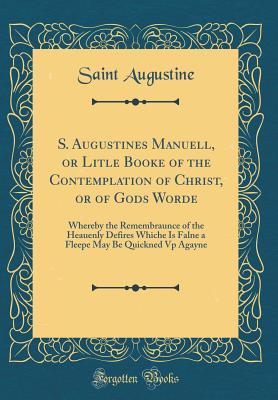
Excerpt from S. Augustines Manuell, or Litle Booke of the Contemplation of Christ, or of Gods Worde: Whereby the Remembraunce of the Heauenly Defires Whiche Is Falne a Fleepe May Be Quickned Vp Agayne
Thee, hath no pieasute in any thyng but to speabe of thee, to heate of thee, to unite of thee, to conferee of thee, arm to hethinae it selfe oftentgtnes of thy (home, so as the remembtaunte of thee may be some refreshm to me among the statutes of this marine whee with fore Due 31 can nppon most earnestly, bnto thee no BI erg with a [cube nazse eaea from the bottome of mg hart gnu when s'i call upon thee beteig 31 tall hpon thee in my seife: for 31 shoum net bee at an extent than inset in me, anb except I were in thee that: Mamest mat be in me when art in me, because thou abgnest in my mznbe: thereby no I know thee an'a thetein no 3! Fin'ae thee When 31 remember.
About the Publisher
Forgotten Books publishes hundreds of thousands of rare and classic books. Find more at www.forgottenbooks.comwww.forgottenbooks.com
This book is a reproduction of an important historical work. Forgotten Books uses state-of-the-art technology to digitally reconstruct the work, preserving the original format whilst repairing imperfections present in the aged copy. In rare cases, an imperfection in the original, such as a blemish or missing page, may be replicated in our edition. We do, however, repair the vast majority of imperfections successfully; any imperfections that remain are intentionally left to preserve the state of such historical works.
Thee, hath no pieasute in any thyng but to speabe of thee, to heate of thee, to unite of thee, to conferee of thee, arm to hethinae it selfe oftentgtnes of thy (home, so as the remembtaunte of thee may be some refreshm to me among the statutes of this marine whee with fore Due 31 can nppon most earnestly, bnto thee no BI erg with a [cube nazse eaea from the bottome of mg hart gnu when s'i call upon thee beteig 31 tall hpon thee in my seife: for 31 shoum net bee at an extent than inset in me, anb except I were in thee that: Mamest mat be in me when art in me, because thou abgnest in my mznbe: thereby no I know thee an'a thetein no 3! Fin'ae thee When 31 remember.
About the Publisher
Forgotten Books publishes hundreds of thousands of rare and classic books. Find more at www.forgottenbooks.comwww.forgottenbooks.com
This book is a reproduction of an important historical work. Forgotten Books uses state-of-the-art technology to digitally reconstruct the work, preserving the original format whilst repairing imperfections present in the aged copy. In rare cases, an imperfection in the original, such as a blemish or missing page, may be replicated in our edition. We do, however, repair the vast majority of imperfections successfully; any imperfections that remain are intentionally left to preserve the state of such historical works.
BUY NOW
Hardcover, 120 pages
Published December 30th 2018 by Forgotten Books


Group of Brands


© 2026 Bibleportal.com All rights reserved.
Aurelius Augustinus - more commonly "St. Augustine of Hippo," or simply "Augustine" - was a philosopher and theologian, and one of the most important figures in the development of Western Christianity. He framed the concepts of original sin and just war. Augustine was one of the most prolific Latin authors in terms of surviving works, and the list of his works consists of more than a hundred separate titles.
Augustine took the view that the Biblical text should not be interpreted literally if it contradicts what we know from science and our God-given reason. Many Protestants, especially Calvinists, consider him to be one of the theological fathers of Reformation teaching on salvation and divine grace.
... Show more