
- Bible
- Read the Bible
- Bible Versions
- Verse of the Day
- Reading Plans
- Verses by Topic
- Books of the Bible
- Bible Images
- Study
- Commentaries
- Concordances
- Dictionaries
- Encyclopedias
- Sermons
- Bible Atlas & Maps
- BP Wiki
- Devotionals
- Today's Devotionals
- Light of the World
- All Devotionals
- Inspirational Quotes
- More
- Picture Quotes
- Videos
- Inspirational
- Bible Study
- What The Bible Says
- Bible Q&As
- Daily Bread
- Bible by Genre
- Bible Stories
- Random Bible Verse
- Community
- Store
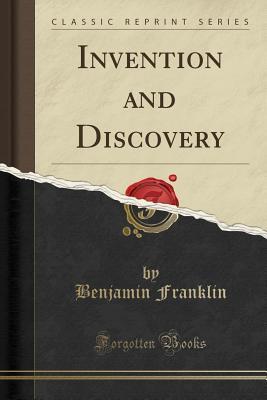
Invention and Discovery (Classic Reprint)
by Benjamin Franklin
Excerpt from Invention and Discovery
A recent wonder of electric art is its penetration by a photographic ray of substances until now called opaque. Professor Rontgen's account of how he wrought this feat forms one of the most stirring chapters in the history of science. Next follows an account of the telegraph as it dispenses with metallic conductors altogether, and trusts itself to that weightless ether which brings to the eye the luminous wave. To this succeeds a chapter which considers what elec tricity stands for as one of the supreme resources of human wit, a resource transcending even flame itself, bringing articulate speech and writing to new planes of facility and usefulness It is shown that the rapidity with which during a single century electricity has been subdued for human service, illustrates that progress has leaps as well as deliberate steps, so that at last a gulf, all but infinite, divides man from his next of kin.
About the Publisher
Forgotten Books publishes hundreds of thousands of rare and classic books. Find more at www.forgottenbooks.comwww.forgottenbooks.com
This book is a reproduction of an important historical work. Forgotten Books uses state-of-the-art technology to digitally reconstruct the work, preserving the original format whilst repairing imperfections present in the aged copy. In rare cases, an imperfection in the original, such as a blemish or missing page, may be replicated in our edition. We do, however, repair the vast majority of imperfections successfully; any imperfections that remain are intentionally left to preserve the state of such historical works.
A recent wonder of electric art is its penetration by a photographic ray of substances until now called opaque. Professor Rontgen's account of how he wrought this feat forms one of the most stirring chapters in the history of science. Next follows an account of the telegraph as it dispenses with metallic conductors altogether, and trusts itself to that weightless ether which brings to the eye the luminous wave. To this succeeds a chapter which considers what elec tricity stands for as one of the supreme resources of human wit, a resource transcending even flame itself, bringing articulate speech and writing to new planes of facility and usefulness It is shown that the rapidity with which during a single century electricity has been subdued for human service, illustrates that progress has leaps as well as deliberate steps, so that at last a gulf, all but infinite, divides man from his next of kin.
About the Publisher
Forgotten Books publishes hundreds of thousands of rare and classic books. Find more at www.forgottenbooks.comwww.forgottenbooks.com
This book is a reproduction of an important historical work. Forgotten Books uses state-of-the-art technology to digitally reconstruct the work, preserving the original format whilst repairing imperfections present in the aged copy. In rare cases, an imperfection in the original, such as a blemish or missing page, may be replicated in our edition. We do, however, repair the vast majority of imperfections successfully; any imperfections that remain are intentionally left to preserve the state of such historical works.
Paperback, 206 pages
Published April 23rd 2018 by Forgotten Books (first published September 27th 2015)
Subscribe
Get Bible verse every day in your inbox
Read on Mobile


Group of Brands


© 2026 Bibleportal.com All rights reserved.
Benjamin Franklin was an important conservative figure in the American Restoration Movement, especially as the leading antebellum conservative in the northern United States branch of the movement. He is notable as the early and lifelong mentor of Daniel Sommer, whose support of the 1889 Sand Creek Declaration set in motion events which led to the formal division of the Churches of Christ from the Disciples of Christ in 1906.
According to contemporary biographies "His early religious training was according to the Methodist faith, though he never belonged to any church until he united with the Disciples."
In 1856, Franklin began to publish the ultra-conservative American Christian Review, which he published until his death in 1878. Its influence, initially considerable, was said to have waned following the American Civil War. Franklin undertook a rigorous program of publication correspondence, and traveling lectures which took him to "many" U. S. states and Canada.
Franklin's last move was to Anderson, Indiana, where he lived from 1864 until his death.
... Show more