
- Bible
- Read the Bible
- Bible Versions
- Verse of the Day
- Reading Plans
- Verses by Topic
- Books of the Bible
- Bible Images
- Study
- Commentaries
- Concordances
- Dictionaries
- Encyclopedias
- Sermons
- Bible Atlas & Maps
- BP Wiki
- Devotionals
- Today's Devotionals
- Light of the World
- All Devotionals
- Inspirational Quotes
- More
- Picture Quotes
- Videos
- Inspirational
- Bible Study
- What The Bible Says
- Bible Q&As
- Daily Bread
- Bible by Genre
- Bible Stories
- Random Bible Verse
- Community
- Store
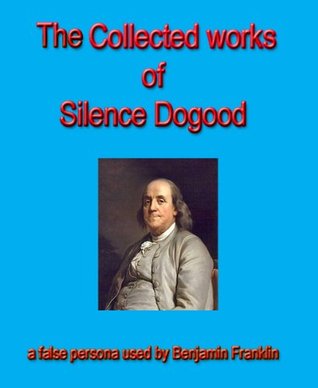
The Collected Works of Silence Dogood
by Benjamin Franklin
"THE DOGOOD PAPERS"
Franklin has told in his Autobiography how he wrote an anonymous paper when he was but sixteen years of age and put it in at night under the door of his brother's printing house. The following morning it was commented on in his hearing, and he had "the exquisite pleasure" of finding that it met with the approbation of the contributors to Couranto, as the New England Courant was then called. In all probability this article was the first of the "Dogood Papers," and March, 1722 is therefore the time of Franklin's first adventure in literature. Editorial encouragement was promptly given to the unknown author. In the same issue of the newspaper that contained his communication appeared the notice, "As the Favour of Mrs. Dogood's Correspondence is acknowledged by the Publisher of this Paper, lest any of her Letters should miscarry, he desires they may be deliver'd at his Printing-House, or at the Blue Ball in Union street, and no questions shall be ask'd of the Bearer." Thus encouraged Franklin continued to write the letters of Mrs. Silence Dogood, at fortnightly intervals, until the series ended with the fourteenth paper, published October 8, 1722.
They were first accredited to Franklin by J. T. Buckingham in 1850 ("Specimens of Newspaper Literature," I, 62), and further ascribed to him by James Parton in his "Life and Times of Franklin" (1864, Vol. I, p. 84). In the first sketch, or draft scheme, of his Autobiography Franklin claims "Mrs. Dogood's letters" as his own. They have never appeared in any collection of his writings. They are now reprinted from the file of the New England Courant in the library of the Massachusetts Historical Society.
The character of the young Franklin is interestingly revealed in these papers; and it will be seen that his sedulous attention to the language of the Spectator had already formed his literary style, and stamped it with those qualities that have given him a high and enduring place among American writers.
Franklin has told in his Autobiography how he wrote an anonymous paper when he was but sixteen years of age and put it in at night under the door of his brother's printing house. The following morning it was commented on in his hearing, and he had "the exquisite pleasure" of finding that it met with the approbation of the contributors to Couranto, as the New England Courant was then called. In all probability this article was the first of the "Dogood Papers," and March, 1722 is therefore the time of Franklin's first adventure in literature. Editorial encouragement was promptly given to the unknown author. In the same issue of the newspaper that contained his communication appeared the notice, "As the Favour of Mrs. Dogood's Correspondence is acknowledged by the Publisher of this Paper, lest any of her Letters should miscarry, he desires they may be deliver'd at his Printing-House, or at the Blue Ball in Union street, and no questions shall be ask'd of the Bearer." Thus encouraged Franklin continued to write the letters of Mrs. Silence Dogood, at fortnightly intervals, until the series ended with the fourteenth paper, published October 8, 1722.
They were first accredited to Franklin by J. T. Buckingham in 1850 ("Specimens of Newspaper Literature," I, 62), and further ascribed to him by James Parton in his "Life and Times of Franklin" (1864, Vol. I, p. 84). In the first sketch, or draft scheme, of his Autobiography Franklin claims "Mrs. Dogood's letters" as his own. They have never appeared in any collection of his writings. They are now reprinted from the file of the New England Courant in the library of the Massachusetts Historical Society.
The character of the young Franklin is interestingly revealed in these papers; and it will be seen that his sedulous attention to the language of the Spectator had already formed his literary style, and stamped it with those qualities that have given him a high and enduring place among American writers.
BUY NOW
Kindle Edition, 45 pages
Published October 24th 2011 by Evergreen Books
Subscribe
Get Bible verse every day in your inbox
Read on Mobile


Group of Brands


© 2026 Bibleportal.com All rights reserved.
Benjamin Franklin was an important conservative figure in the American Restoration Movement, especially as the leading antebellum conservative in the northern United States branch of the movement. He is notable as the early and lifelong mentor of Daniel Sommer, whose support of the 1889 Sand Creek Declaration set in motion events which led to the formal division of the Churches of Christ from the Disciples of Christ in 1906.
According to contemporary biographies "His early religious training was according to the Methodist faith, though he never belonged to any church until he united with the Disciples."
In 1856, Franklin began to publish the ultra-conservative American Christian Review, which he published until his death in 1878. Its influence, initially considerable, was said to have waned following the American Civil War. Franklin undertook a rigorous program of publication correspondence, and traveling lectures which took him to "many" U. S. states and Canada.
Franklin's last move was to Anderson, Indiana, where he lived from 1864 until his death.
... Show more