
- Bible
- Read the Bible
- Bible Versions
- Verse of the Day
- Reading Plans
- Verses by Topic
- Books of the Bible
- Bible Images
- Study
- Commentaries
- Concordances
- Dictionaries
- Encyclopedias
- Sermons
- Bible Atlas & Maps
- BP Wiki
- Devotionals
- Today's Devotionals
- Light of the World
- All Devotionals
- Inspirational Quotes
- More
- Picture Quotes
- Videos
- Inspirational
- Bible Study
- What The Bible Says
- Bible Q&As
- Daily Bread
- Bible by Genre
- Bible Stories
- Random Bible Verse
- Community
- Store
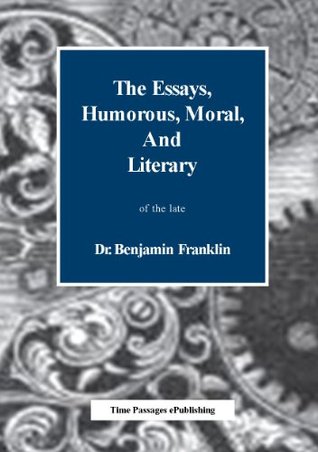
The Essays, Humourous, Moral and Literary of the late Dr. Benjamin Franklin
by Benjamin Franklin
This book features a series of Essays written by one of America's most beloved founding fathers: Dr. Benjamin Franklin. The essays included a sampling of Dr. Franklin's' writings throughout his lifetime and reflect his interest in, it would seem, everything. From his final address to the Federal or Constitutional Convention, which contained his estimation of the Constitution, to his views on slavery, the 'Free Press,' the impress of seamen, and privateering. From how to secure pleasant dreams to swimming to the resuscitation of drowned flies. From how to become wealthy to how the Parisians could be more economical.
Reading his essays gives you a glimpse into the life and attitudes during his lifetime. In the essay "To Those Who Would Remove to America." you get a glimpse of the misperceptions Europeans held of America, such as a place "where the fowls fly about ready roasted, crying, Come eat me!" as opposed to how it really was: "In short, America is the land of labor. . ." In his essay "Remarks Concerning the Savages of North America" you get a glimpse into the Native American culture at that time and learn that it was the women of the tribe that maintained the oral history of their people and how accurate that history was. In "Sketch of an English School" you learn the subjects that were being taught and which books they were being taught from.
Regardless of which subjects interest you, his writing is always enjoyable to read. From an early age Benjamin Franklin practiced his writing skill, and that practice did not go for naught.
Note from Publisher
1. This ebook contains a Table of Contents which has been hyperlinked to enable you to easily navigate throughout the book.
2. The footnotes normally positioned at the bottom of the page in the printed book have been divided into two categories endnotes and citations. Endnotes, those footnotes that expand and enlarge the text, are denoted with a superscripted E followed by a number. For example, the first endnote in a chapter would be E1, the second endnote would be E2, etc. These have been moved to the end of the chapter and can be viewed via clicking on the hyperlink in the text. Citations, those footnotes that cite the work being quoted, are denoted with a superscripted C followed by a number. The first citation in the book will be denoted by C1, the second C2, etc. You can also move directly to the Citations page via the Table of Contents.
Reading his essays gives you a glimpse into the life and attitudes during his lifetime. In the essay "To Those Who Would Remove to America." you get a glimpse of the misperceptions Europeans held of America, such as a place "where the fowls fly about ready roasted, crying, Come eat me!" as opposed to how it really was: "In short, America is the land of labor. . ." In his essay "Remarks Concerning the Savages of North America" you get a glimpse into the Native American culture at that time and learn that it was the women of the tribe that maintained the oral history of their people and how accurate that history was. In "Sketch of an English School" you learn the subjects that were being taught and which books they were being taught from.
Regardless of which subjects interest you, his writing is always enjoyable to read. From an early age Benjamin Franklin practiced his writing skill, and that practice did not go for naught.
Note from Publisher
1. This ebook contains a Table of Contents which has been hyperlinked to enable you to easily navigate throughout the book.
2. The footnotes normally positioned at the bottom of the page in the printed book have been divided into two categories endnotes and citations. Endnotes, those footnotes that expand and enlarge the text, are denoted with a superscripted E followed by a number. For example, the first endnote in a chapter would be E1, the second endnote would be E2, etc. These have been moved to the end of the chapter and can be viewed via clicking on the hyperlink in the text. Citations, those footnotes that cite the work being quoted, are denoted with a superscripted C followed by a number. The first citation in the book will be denoted by C1, the second C2, etc. You can also move directly to the Citations page via the Table of Contents.
BUY NOW
Kindle Edition, 194 pages
Published September 23rd 2010 by Time Passages ePublishing
Subscribe
Get Bible verse every day in your inbox
Read on Mobile


Group of Brands


© 2026 Bibleportal.com All rights reserved.
Benjamin Franklin was an important conservative figure in the American Restoration Movement, especially as the leading antebellum conservative in the northern United States branch of the movement. He is notable as the early and lifelong mentor of Daniel Sommer, whose support of the 1889 Sand Creek Declaration set in motion events which led to the formal division of the Churches of Christ from the Disciples of Christ in 1906.
According to contemporary biographies "His early religious training was according to the Methodist faith, though he never belonged to any church until he united with the Disciples."
In 1856, Franklin began to publish the ultra-conservative American Christian Review, which he published until his death in 1878. Its influence, initially considerable, was said to have waned following the American Civil War. Franklin undertook a rigorous program of publication correspondence, and traveling lectures which took him to "many" U. S. states and Canada.
Franklin's last move was to Anderson, Indiana, where he lived from 1864 until his death.
... Show more