
- Bible
- Read the Bible
- Bible Versions
- Verse of the Day
- Reading Plans
- Verses by Topic
- Books of the Bible
- Bible Images
- Study
- Commentaries
- Concordances
- Dictionaries
- Encyclopedias
- Sermons
- Bible Atlas & Maps
- BP Wiki
- Devotionals
- Today's Devotionals
- Light of the World
- All Devotionals
- Inspirational Quotes
- More
- Picture Quotes
- Videos
- Inspirational
- Bible Study
- What The Bible Says
- Bible Q&As
- Daily Bread
- Bible by Genre
- Bible Stories
- Random Bible Verse
- Community
- Store
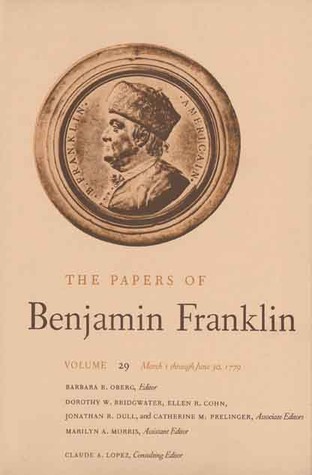
The Papers of Benjamin Franklin, Vol. 29: Volume 29: March 1 through June 30, 1779
by Benjamin Franklin
Barbara B. Oberg, editor
Dorothy W. Bridgwater, Ellen R. Cohn, Jonathan R. Dull, Catherine M. Prelinger, associate editors; Marilyn A. Morris, assistant editor; Claude A. Lopez, consulting editor
This volume marks the first full months of Franklin's tenure as sole American minister to the Court of France. Relieved from the necessity of having to work any longer with John Adams and Arthur Lee, Franklin took charge of the American mission with new-found vigor, writing on average fifty letters a month, sometimes in spurts of six or seven a day. No other period of his life has left so full a documentary record.
In the absence of a network of American consuls in France, the business of receiving cargoes, fitting out ships, supervising the procurement of supplies, and tending to the interests of American citizens abroad fell to the American minister plenipotentiary. Prominent among the naval captains with whom he dealt was John Paul Jones; this volume reveals the first attempts of Franklin and the French Court to devise a mission for the Bonhomme RichardBonhomme Richard squadron.
Busy diplomat that he was, Franklin always had time for scientific and other pursuits. His paper on the aurora borealis was delivered to the Academie des sciences. He attended experiments on the ingenious microscope solairemicroscope solaire by the young scientist of future Revolutionary fame, Jean-Paul Marat. In May, he was elected VenerableVenerable of his Masonic lodge.
During these months too, Franklin resumed his earliest profession and avocation, printing. He established a type foundry at Passy in 1778 and had his press in operation by the following spring. In this volume is reproduced the first Passy imprint that can be dated with any certainty, his invitation to an Independence Day celebration. Also in the spring he reworked an essay that he had conceived over sixty years before. Entitled "The Morals of Chess," it became one of his best-known lighter pieces.
Dorothy W. Bridgwater, Ellen R. Cohn, Jonathan R. Dull, Catherine M. Prelinger, associate editors; Marilyn A. Morris, assistant editor; Claude A. Lopez, consulting editor
This volume marks the first full months of Franklin's tenure as sole American minister to the Court of France. Relieved from the necessity of having to work any longer with John Adams and Arthur Lee, Franklin took charge of the American mission with new-found vigor, writing on average fifty letters a month, sometimes in spurts of six or seven a day. No other period of his life has left so full a documentary record.
In the absence of a network of American consuls in France, the business of receiving cargoes, fitting out ships, supervising the procurement of supplies, and tending to the interests of American citizens abroad fell to the American minister plenipotentiary. Prominent among the naval captains with whom he dealt was John Paul Jones; this volume reveals the first attempts of Franklin and the French Court to devise a mission for the Bonhomme RichardBonhomme Richard squadron.
Busy diplomat that he was, Franklin always had time for scientific and other pursuits. His paper on the aurora borealis was delivered to the Academie des sciences. He attended experiments on the ingenious microscope solairemicroscope solaire by the young scientist of future Revolutionary fame, Jean-Paul Marat. In May, he was elected VenerableVenerable of his Masonic lodge.
During these months too, Franklin resumed his earliest profession and avocation, printing. He established a type foundry at Passy in 1778 and had his press in operation by the following spring. In this volume is reproduced the first Passy imprint that can be dated with any certainty, his invitation to an Independence Day celebration. Also in the spring he reworked an essay that he had conceived over sixty years before. Entitled "The Morals of Chess," it became one of his best-known lighter pieces.
BUY NOW
Hardcover, 928 pages
Published July 29th 1992 by Yale University Press
Subscribe
Get Bible verse every day in your inbox
Read on Mobile


Group of Brands


© 2026 Bibleportal.com All rights reserved.
Benjamin Franklin was an important conservative figure in the American Restoration Movement, especially as the leading antebellum conservative in the northern United States branch of the movement. He is notable as the early and lifelong mentor of Daniel Sommer, whose support of the 1889 Sand Creek Declaration set in motion events which led to the formal division of the Churches of Christ from the Disciples of Christ in 1906.
According to contemporary biographies "His early religious training was according to the Methodist faith, though he never belonged to any church until he united with the Disciples."
In 1856, Franklin began to publish the ultra-conservative American Christian Review, which he published until his death in 1878. Its influence, initially considerable, was said to have waned following the American Civil War. Franklin undertook a rigorous program of publication correspondence, and traveling lectures which took him to "many" U. S. states and Canada.
Franklin's last move was to Anderson, Indiana, where he lived from 1864 until his death.
... Show more