
- Bible
- Read the Bible
- Bible Versions
- Verse of the Day
- Reading Plans
- Verses by Topic
- Books of the Bible
- Bible Images
- Study
- Commentaries
- Concordances
- Dictionaries
- Encyclopedias
- Sermons
- Bible Atlas & Maps
- BP Wiki
- Devotionals
- Today's Devotionals
- Light of the World
- All Devotionals
- Inspirational Quotes
- More
- Picture Quotes
- Videos
- Inspirational
- Bible Study
- What The Bible Says
- Bible Q&As
- Daily Bread
- Bible by Genre
- Bible Stories
- Random Bible Verse
- Community
- Store
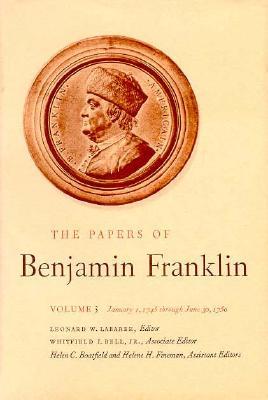
The Papers of Benjamin Franklin, Vol. 3: Volume 3, January 1, 1745 through June 30, 1750
by Benjamin Franklin
This latest volume in the continuing edition of one of America's most versatile citizens shows Franklin's interests, already diversified, beginning to broaden still more, until in 1748 he turns over the active operation of his printing office and newspaper to a partner in order to participate with more freedom in public affairs and scientific investigations.When in the autumn of 1747 Philadelphia appears threatened by incursions of French and Spanish privateers and the Quaker-controlled Assembly of Pennsylvania does nothing to defend the city, Franklin initiates and leads a movement to create a volunteer militia—the "Association/" The citizens build a battery and borrow canon, and Franklin organizes two lotteries to raise the necessary funds.In 1749 Franklin sets on foot a scheme for establishing the Academy of Philadelphia, which ultimately becomes the University of Pennsylvania. His pamphlet, "Proposals relation to the Education of Youth in Pennsylvania," here reprinted, is an important statement of his educational views.On the scientific side, in 1747 Franklin begins a series of letters describing the electrical experiments he and his friends are conducting. The English scientist Peter Collinson reads the letters to the Royal Society, and in 1751 they are printed in London as a pamphlet. In this excursion into basic scientific investigation, Franklin is the first to use the terms "positive" and "negative," "plus" and "minus" as applied to an electrical charge. here, also for the first time, an electric "battery" (Franklin's term) is described.This volume, containing exactly four times as many documents as that of the Smyth edition for the same period, will appeal to many different kinds of readers.
BUY NOW
Hardcover, 539 pages
Published September 10th 1961 by Yale University Press
Subscribe
Get Bible verse every day in your inbox
Read on Mobile


Group of Brands


© 2026 Bibleportal.com All rights reserved.
Benjamin Franklin was an important conservative figure in the American Restoration Movement, especially as the leading antebellum conservative in the northern United States branch of the movement. He is notable as the early and lifelong mentor of Daniel Sommer, whose support of the 1889 Sand Creek Declaration set in motion events which led to the formal division of the Churches of Christ from the Disciples of Christ in 1906.
According to contemporary biographies "His early religious training was according to the Methodist faith, though he never belonged to any church until he united with the Disciples."
In 1856, Franklin began to publish the ultra-conservative American Christian Review, which he published until his death in 1878. Its influence, initially considerable, was said to have waned following the American Civil War. Franklin undertook a rigorous program of publication correspondence, and traveling lectures which took him to "many" U. S. states and Canada.
Franklin's last move was to Anderson, Indiana, where he lived from 1864 until his death.
... Show more