
- Bible
- Read the Bible
- Bible Versions
- Verse of the Day
- Reading Plans
- Verses by Topic
- Books of the Bible
- Bible Images
- Study
- Commentaries
- Concordances
- Dictionaries
- Encyclopedias
- Sermons
- Bible Atlas & Maps
- BP Wiki
- Devotionals
- Today's Devotionals
- Light of the World
- All Devotionals
- Inspirational Quotes
- More
- Picture Quotes
- Videos
- Inspirational
- Bible Study
- What The Bible Says
- Bible Q&As
- Daily Bread
- Bible by Genre
- Bible Stories
- Random Bible Verse
- Community
- Store
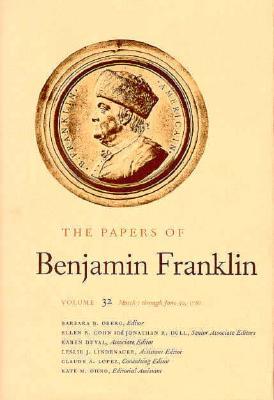
The Papers of Benjamin Franklin, Vol. 32: Volume 32: March 1 through June 30, 1780
by Benjamin Franklin
During the spring of 1780, Benjamin Franklin was midway through an eight-and-a-half-year mission to France. He was in good health, energetic, and occupied with a variety of important ministerial tasks and private pursuits. In this volume, the fifth in the sequence dealing with Franklin's tenure as sole minister to the French court, and tenth of a projected twenty volumes covering his years in France, Franklin focuses on diplomatic activities and takes on the role of expressing to France America's pressing needs in this time of economic instability and military stalemate.
Demonstrating wide-ranging talents and activities, Franklin's correspondence is singular in scope and interest. Working purposefully to surmount one difficulty after another, Franklin sought a general prisoner exchange, assisted escaped prisoners, drafted passports, honored bills that were presented to him for payment, and remained involved in the effort to assemble and ship uniforms, arms, and gunpowder to America. During these months he also bought an entire type foundry, purchased two presses, conferred about a script type he had commissioned, received shipments of paper and type from England in spite of the war, designed a method to determine the conductivity of metals, submitted to the Académie des sciences a lengthy memoir on lightning rods for the Strasbourg Cathedral, and penned a jocular essay on 'inflammable air' in response to a Royal Academy of Brussels mathematical prize question that he regarded as frivolous.
Publication of this volume was assisted by a grant from the National Historical Publications and Records Commission.
Demonstrating wide-ranging talents and activities, Franklin's correspondence is singular in scope and interest. Working purposefully to surmount one difficulty after another, Franklin sought a general prisoner exchange, assisted escaped prisoners, drafted passports, honored bills that were presented to him for payment, and remained involved in the effort to assemble and ship uniforms, arms, and gunpowder to America. During these months he also bought an entire type foundry, purchased two presses, conferred about a script type he had commissioned, received shipments of paper and type from England in spite of the war, designed a method to determine the conductivity of metals, submitted to the Académie des sciences a lengthy memoir on lightning rods for the Strasbourg Cathedral, and penned a jocular essay on 'inflammable air' in response to a Royal Academy of Brussels mathematical prize question that he regarded as frivolous.
Publication of this volume was assisted by a grant from the National Historical Publications and Records Commission.
BUY NOW
Hardcover, 744 pages
Published December 25th 1996 by Yale University Press
Subscribe
Get Bible verse every day in your inbox
Read on Mobile


Group of Brands


© 2026 Bibleportal.com All rights reserved.
Benjamin Franklin was an important conservative figure in the American Restoration Movement, especially as the leading antebellum conservative in the northern United States branch of the movement. He is notable as the early and lifelong mentor of Daniel Sommer, whose support of the 1889 Sand Creek Declaration set in motion events which led to the formal division of the Churches of Christ from the Disciples of Christ in 1906.
According to contemporary biographies "His early religious training was according to the Methodist faith, though he never belonged to any church until he united with the Disciples."
In 1856, Franklin began to publish the ultra-conservative American Christian Review, which he published until his death in 1878. Its influence, initially considerable, was said to have waned following the American Civil War. Franklin undertook a rigorous program of publication correspondence, and traveling lectures which took him to "many" U. S. states and Canada.
Franklin's last move was to Anderson, Indiana, where he lived from 1864 until his death.
... Show more