
- Bible
- Read the Bible
- Bible Versions
- Verse of the Day
- Reading Plans
- Verses by Topic
- Books of the Bible
- Bible Images
- Study
- Commentaries
- Concordances
- Dictionaries
- Encyclopedias
- Sermons
- Bible Atlas & Maps
- BP Wiki
- Devotionals
- Today's Devotionals
- Light of the World
- All Devotionals
- Inspirational Quotes
- More
- Picture Quotes
- Videos
- Inspirational
- Bible Study
- What The Bible Says
- Bible Q&As
- Daily Bread
- Bible by Genre
- Bible Stories
- Random Bible Verse
- Community
- Store
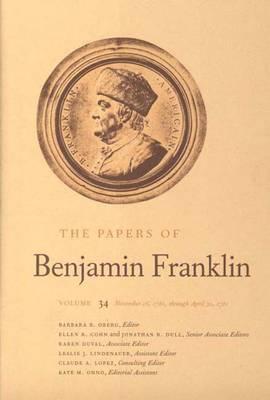
The Papers of Benjamin Franklin, Vol. 34: Volume 34: November 16, 1780, through April 30, 1781
by Benjamin Franklin
This volume spans the period from late fall 1780 through the spring of 1781 and continues the documentation of Franklin’s mission as minister plenipotentiary to France. During these eventful months, Franklin averts a financial crisis by obtaining additional loans and grants from the French government. The Continental Congress, however, not yet aware that Franklin has secured this support, appoints a special envoy to obtain assistance for the American Army. This attack on his authority so upsets Franklin that he volunteers to resign his position. Franklin also learns of Benedict Arnold’s treason and capture as well as the arrest of American artist John Trumbull. Trumbull’s friend Thomas Digges, Franklin’s agent for prisoner relief in England, goes into hiding amidst rumors that he has been misappropriating funds intended for American prisoners.
Despite these reversals and his slow recovery from an attack of gout earlier in the fall, Franklin exchanges lively and affectionate letters with his neighbor Madame Brillon, and he sends her two bagatelles, “Dialogue Between the Gout and Mr. Franklin” and “The Deformed and Handsome Leg.” His circle of correspondents expands to include three other accomplished women—the Russian writer Ekaterina Dashkova, the comtesse de Golowkin, and the comtesse d’Houdetot, who orchestrates a splendid “fête champêtre” at her estate in Franklin’s honor.
Publication of this volume was assisted by a grant from the National Historical Publications and Records Commission.
Despite these reversals and his slow recovery from an attack of gout earlier in the fall, Franklin exchanges lively and affectionate letters with his neighbor Madame Brillon, and he sends her two bagatelles, “Dialogue Between the Gout and Mr. Franklin” and “The Deformed and Handsome Leg.” His circle of correspondents expands to include three other accomplished women—the Russian writer Ekaterina Dashkova, the comtesse de Golowkin, and the comtesse d’Houdetot, who orchestrates a splendid “fête champêtre” at her estate in Franklin’s honor.
Publication of this volume was assisted by a grant from the National Historical Publications and Records Commission.
BUY NOW
Hardcover, 706 pages
Published December 11th 1998 by Yale University Press (first published 1998)
Subscribe
Get Bible verse every day in your inbox
Read on Mobile


Group of Brands


© 2026 Bibleportal.com All rights reserved.
Benjamin Franklin was an important conservative figure in the American Restoration Movement, especially as the leading antebellum conservative in the northern United States branch of the movement. He is notable as the early and lifelong mentor of Daniel Sommer, whose support of the 1889 Sand Creek Declaration set in motion events which led to the formal division of the Churches of Christ from the Disciples of Christ in 1906.
According to contemporary biographies "His early religious training was according to the Methodist faith, though he never belonged to any church until he united with the Disciples."
In 1856, Franklin began to publish the ultra-conservative American Christian Review, which he published until his death in 1878. Its influence, initially considerable, was said to have waned following the American Civil War. Franklin undertook a rigorous program of publication correspondence, and traveling lectures which took him to "many" U. S. states and Canada.
Franklin's last move was to Anderson, Indiana, where he lived from 1864 until his death.
... Show more