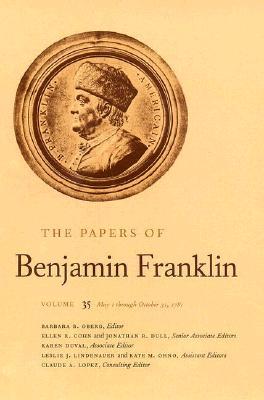
During the six months from May through October 1781, Benjamin Franklin continues to address important diplomatic, political, and economic matters as minister plenipotentiary to France. While the decisive Yorktown campaign is waged in America, Franklin, a distant observer, faces a battle of his own--to save America’s financial credit in Europe. Congress has drawn so many bills on him, on John Jay in Spain, and on John Adams in the Netherlands that Franklin, ultimately responsible for all of them, faces the danger of bankruptcy. Here, as at Yorktown, French help permits the young nation to weather the crisis.
Having recovered from a prolonged spell of gout and having learned that he will be retained as American minister in France, Franklin is revived in health and spirits. He undertakes his many public responsibilities with renewed vigor and is appointed by Congress to a five-member commission to negotiate peace with Britain. Franklin finds time for experiments with different inks and paper, masonic activities, purchasing books and exchanging them with friends, and maintaining a wide correspondence that provides exceptionally revealing glimpses of his thinking on science, politics, and Indian languages.
Publication of this volume was assisted by a grant from the National Historical Publications and Records Commission.



Benjamin Franklin was an important conservative figure in the American Restoration Movement, especially as the leading antebellum conservative in the northern United States branch of the movement. He is notable as the early and lifelong mentor of Daniel Sommer, whose support of the 1889 Sand Creek Declaration set in motion events which led to the formal division of the Churches of Christ from the Disciples of Christ in 1906.
According to contemporary biographies "His early religious training was according to the Methodist faith, though he never belonged to any church until he united with the Disciples."
In 1856, Franklin began to publish the ultra-conservative American Christian Review, which he published until his death in 1878. Its influence, initially considerable, was said to have waned following the American Civil War. Franklin undertook a rigorous program of publication correspondence, and traveling lectures which took him to "many" U. S. states and Canada.
Franklin's last move was to Anderson, Indiana, where he lived from 1864 until his death.
... Show more