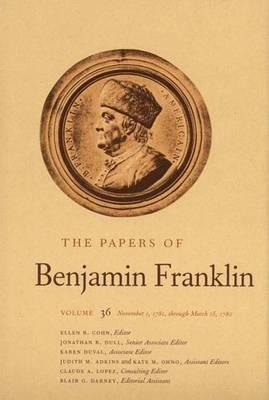
As the volume opens, Franklin despairs of living long enough to see the war come to an end. He had been plagued by continued financial demands from Congress that he could not meet and was worried about how much further he could draw on France’s goodwill. But on the evening of November 19, Vergennes received and forwarded to Franklin the news of Cornwallis’s capitulation at Yorktown a month earlier. All France celebrated the Franco-American victory, and Franklin’s life became a whirl of dinner parties and congratulations. Franklin spent the winter in excellent health and used this period of relative respite to intellectual advantage, buying books and attending scientific meetings. He could do little to hasten the war’s end, however, and waited patiently for a change of policy by the British government. With the approach of spring, he received a series of letters on the failing fortunes of Lord North and his colleagues in the House of Commons. As the volume ends, Lord Cholmondeley is on his way to Paris. His arrival will offer Franklin a chance to make contact with a new British government that might negotiate for peace.



Benjamin Franklin was an important conservative figure in the American Restoration Movement, especially as the leading antebellum conservative in the northern United States branch of the movement. He is notable as the early and lifelong mentor of Daniel Sommer, whose support of the 1889 Sand Creek Declaration set in motion events which led to the formal division of the Churches of Christ from the Disciples of Christ in 1906.
According to contemporary biographies "His early religious training was according to the Methodist faith, though he never belonged to any church until he united with the Disciples."
In 1856, Franklin began to publish the ultra-conservative American Christian Review, which he published until his death in 1878. Its influence, initially considerable, was said to have waned following the American Civil War. Franklin undertook a rigorous program of publication correspondence, and traveling lectures which took him to "many" U. S. states and Canada.
Franklin's last move was to Anderson, Indiana, where he lived from 1864 until his death.
... Show more