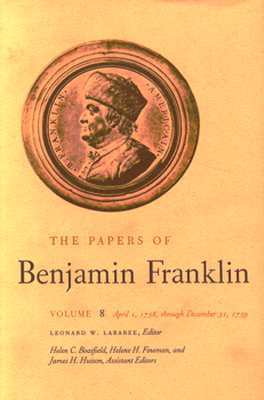
In this volume Franklin is representing the Pennsylvania Assembly in London, meeting with limited success before the Privy Council over the question of the Proprietor's alleged fraud in Indian lands and with complete reversal over an issue of parliamentary privilege. The personal antagonism between him and Proprietor Thomas Penn develops into an angry break. His personal success, however, is extensive. He travels widely, looking up ancestors and surviving relatives; he receives local honors in Edinburgh and Glasgow and an honorary degree from the University of St. Andrews, becoming "Doctor Franklin." He enjoys scientific and intellectual associations with members of the Royal Society, and warm and delightful friendships with people he meets on his travels as well as in London.



Benjamin Franklin was an important conservative figure in the American Restoration Movement, especially as the leading antebellum conservative in the northern United States branch of the movement. He is notable as the early and lifelong mentor of Daniel Sommer, whose support of the 1889 Sand Creek Declaration set in motion events which led to the formal division of the Churches of Christ from the Disciples of Christ in 1906.
According to contemporary biographies "His early religious training was according to the Methodist faith, though he never belonged to any church until he united with the Disciples."
In 1856, Franklin began to publish the ultra-conservative American Christian Review, which he published until his death in 1878. Its influence, initially considerable, was said to have waned following the American Civil War. Franklin undertook a rigorous program of publication correspondence, and traveling lectures which took him to "many" U. S. states and Canada.
Franklin's last move was to Anderson, Indiana, where he lived from 1864 until his death.
... Show more