
- Bible
- Read the Bible
- Bible Versions
- Verse of the Day
- Reading Plans
- Verses by Topic
- Books of the Bible
- Bible Images
- Study
- Commentaries
- Concordances
- Dictionaries
- Encyclopedias
- Sermons
- Bible Atlas & Maps
- BP Wiki
- Devotionals
- Today's Devotionals
- Light of the World
- All Devotionals
- Inspirational Quotes
- More
- Picture Quotes
- Videos
- Inspirational
- Bible Study
- What The Bible Says
- Bible Q&As
- Daily Bread
- Bible by Genre
- Bible Stories
- Random Bible Verse
- Community
- Store
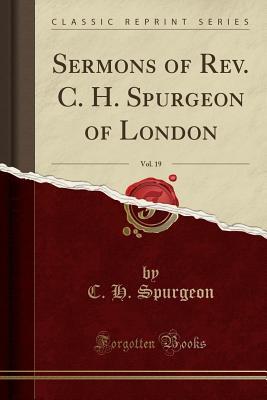
Sermons of Rev. C. H. Spurgeon of London, Vol. 19 (Classic Reprint)
by C.H. Spurgeon
Excerpt from Sermons of Rev. C. H. Spurgeon of London, Vol. 19
Mr. Spurgeon preached in the morning at the church, and in the evening at the hall.
All went well, under the new arrangement, but no one could fail to see that the evening service was working a far grander result, in numbers and in the class of non-church-goers reached; and so, after a two months' trial of this method, a movement began, looking to the building of a large tabernacle, fitted to hold the masses, and with abundant room, first, for habitual attendants to find a church home and, secondly, for the common people at large to find free we]. Come. Of course, there were those who opposed this project the idea of giving up a fine commodious church, recently enlarged and refitted, and undertaking to put up a building to hold five thousand people, was scouted as absurd. But the mass of the church felt that it was far more important to reach the people than to hold fast to the old or der; and so that building was abandoned. Unable to get control longer of Exeter Hall, on October 19, 1856, this heroic pastor and his people undertook a venture of faith. They hired the large Music Hall in Surrey Gardens, just built for M. J ullien's monster concerts, and held there the first Sabbath evening service. About per sons were assembled. Some evil-disposed persons created a panic, and in the rush seven persons were crushed to death, and four times as many were seriously injured. Mr. Spurgeon's nervous system was so terribly shocked that he was perfectly prostrated, but two weeks after was again able to preach. To avoid fear of further panic, the service at Music Hall was transferred to the morning, though the evening was regarded more favorable to large congrega tions. Yet for three years that immense hall was crowded by all classes. Thousands hitherto unaccustomed to attend church found their way to this free place of worship, and hundreds found a Sa viour. Often ten thousand souls were gathered there to hear that Simple gospel preacher. And it was no worldly bait that drew them. Even the singing was congregational, and led by a precen tor - Mr. Spurgeon lining out every hymn in old-time style.
About the Publisher
Forgotten Books publishes hundreds of thousands of rare and classic books. Find more at www.forgottenbooks.comwww.forgottenbooks.com
This book is a reproduction of an important historical work. Forgotten Books uses state-of-the-art technology to digitally reconstruct the work, preserving the original format whilst repairing imperfections present in the aged copy. In rare cases, an imperfection in the original, such as a blemish or missing page, may be replicated in our edition. We do, however, repair the vast majority of imperfections successfully; any imperfections that remain are intentionally left to preserve the state of such historical works.
Mr. Spurgeon preached in the morning at the church, and in the evening at the hall.
All went well, under the new arrangement, but no one could fail to see that the evening service was working a far grander result, in numbers and in the class of non-church-goers reached; and so, after a two months' trial of this method, a movement began, looking to the building of a large tabernacle, fitted to hold the masses, and with abundant room, first, for habitual attendants to find a church home and, secondly, for the common people at large to find free we]. Come. Of course, there were those who opposed this project the idea of giving up a fine commodious church, recently enlarged and refitted, and undertaking to put up a building to hold five thousand people, was scouted as absurd. But the mass of the church felt that it was far more important to reach the people than to hold fast to the old or der; and so that building was abandoned. Unable to get control longer of Exeter Hall, on October 19, 1856, this heroic pastor and his people undertook a venture of faith. They hired the large Music Hall in Surrey Gardens, just built for M. J ullien's monster concerts, and held there the first Sabbath evening service. About per sons were assembled. Some evil-disposed persons created a panic, and in the rush seven persons were crushed to death, and four times as many were seriously injured. Mr. Spurgeon's nervous system was so terribly shocked that he was perfectly prostrated, but two weeks after was again able to preach. To avoid fear of further panic, the service at Music Hall was transferred to the morning, though the evening was regarded more favorable to large congrega tions. Yet for three years that immense hall was crowded by all classes. Thousands hitherto unaccustomed to attend church found their way to this free place of worship, and hundreds found a Sa viour. Often ten thousand souls were gathered there to hear that Simple gospel preacher. And it was no worldly bait that drew them. Even the singing was congregational, and led by a precen tor - Mr. Spurgeon lining out every hymn in old-time style.
About the Publisher
Forgotten Books publishes hundreds of thousands of rare and classic books. Find more at www.forgottenbooks.comwww.forgottenbooks.com
This book is a reproduction of an important historical work. Forgotten Books uses state-of-the-art technology to digitally reconstruct the work, preserving the original format whilst repairing imperfections present in the aged copy. In rare cases, an imperfection in the original, such as a blemish or missing page, may be replicated in our edition. We do, however, repair the vast majority of imperfections successfully; any imperfections that remain are intentionally left to preserve the state of such historical works.
BUY NOW
Paperback, 432 pages
Published May 8th 2018 by Forgotten Books (first published August 8th 2015)
Subscribe
Get Bible verse every day in your inbox
Read on Mobile


Group of Brands


© 2026 Bibleportal.com All rights reserved.
C.H. Spurgeon (1834 - 1892)
Spurgeon quickly became known as one of the most influential preachers of his time. Well known for his biblical powerful expositions of scripture and oratory ability. In modern evangelical circles he is stated to be the "Prince of Preachers." He pastored the Metropolitan Tabernacle in downtown London, England.His church was part of a particular baptist church movement and they defended and preached Christ and Him crucified and the purity of the Gospel message. Spurgeon never gave altar calls but always extended the invitation to come to Christ. He was a faithful minister in his time that glorified God and brought many to the living Christ.
Charles Haddon Spurgeon was England's best-known preacher for most of the second half of the nineteenth century. In 1854, just four years after his conversion, Spurgeon, then only 20, became pastor of London's famed New Park Street Church (formerly pastored by the famous Baptist theologian John Gill).
The congregation quickly outgrew their building, moved to Exeter Hall, then to Surrey Music Hall. In these venues Spurgeon frequently preached to audiences numbering more than 10,000 - all in the days before electronic amplification.
In 1861 the congregation moved permanently to the new Metropolitan Tabernacle.
... Show more