
- Bible
- Read the Bible
- Bible Versions
- Verse of the Day
- Reading Plans
- Verses by Topic
- Books of the Bible
- Bible Images
- Study
- Commentaries
- Concordances
- Dictionaries
- Encyclopedias
- Sermons
- Bible Atlas & Maps
- BP Wiki
- Devotionals
- Today's Devotionals
- All Devotionals
- Inspirational Quotes
- More
- Picture Quotes
- Videos
- Inspirational
- Bible Study
- What The Bible Says
- Bible Q&As
- Daily Bread
- Bible by Genre
- Bible Stories
- Random Bible Verse
- Community
- Store
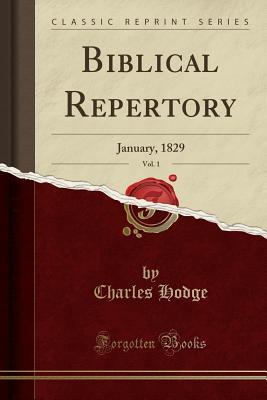
Biblical Repertory, Vol. 1: January, 1829 (Classic Reprint)
by Charles Hodge
Excerpt from Biblical Repertory, Vol. 1: January, 1829
There could be no difficulty in determining the sense of the word lop/0g, were we possessed of authentic information respecting the source from which it was immediately derived, or any peculiar circumstances which may have led the apos tle to make use of the expression. But as all such historical guides are wanting, we must find some other clue to the ih terpretation. It has been said, but never proved, that the term must be traced to the Chaldee language, * to the phra seology of Philo, or to that of the Cerinthians, in order to discover its peculiar import as used by the apostle. For my own part, I believe, that there are only two practicable me thods of making the discovery. The first is, to appeal to the apostle's own authority, by comparison, and reference to other passages. The other is, to trace the idiomatic senses of the term, in the Hebrew, Greek, or Alexandrine dialect. 1 shall have recourse to both.
About the Publisher
Forgotten Books publishes hundreds of thousands of rare and classic books. Find more at www.forgottenbooks.comwww.forgottenbooks.com
This book is a reproduction of an important historical work. Forgotten Books uses state-of-the-art technology to digitally reconstruct the work, preserving the original format whilst repairing imperfections present in the aged copy. In rare cases, an imperfection in the original, such as a blemish or missing page, may be replicated in our edition. We do, however, repair the vast majority of imperfections successfully; any imperfections that remain are intentionally left to preserve the state of such historical works.
There could be no difficulty in determining the sense of the word lop/0g, were we possessed of authentic information respecting the source from which it was immediately derived, or any peculiar circumstances which may have led the apos tle to make use of the expression. But as all such historical guides are wanting, we must find some other clue to the ih terpretation. It has been said, but never proved, that the term must be traced to the Chaldee language, * to the phra seology of Philo, or to that of the Cerinthians, in order to discover its peculiar import as used by the apostle. For my own part, I believe, that there are only two practicable me thods of making the discovery. The first is, to appeal to the apostle's own authority, by comparison, and reference to other passages. The other is, to trace the idiomatic senses of the term, in the Hebrew, Greek, or Alexandrine dialect. 1 shall have recourse to both.
About the Publisher
Forgotten Books publishes hundreds of thousands of rare and classic books. Find more at www.forgottenbooks.comwww.forgottenbooks.com
This book is a reproduction of an important historical work. Forgotten Books uses state-of-the-art technology to digitally reconstruct the work, preserving the original format whilst repairing imperfections present in the aged copy. In rare cases, an imperfection in the original, such as a blemish or missing page, may be replicated in our edition. We do, however, repair the vast majority of imperfections successfully; any imperfections that remain are intentionally left to preserve the state of such historical works.
BUY NOW
Paperback, 158 pages
Published October 1st 2018 by Forgotten Books
Subscribe
Get Bible verse every day in your inbox
Read on Mobile


Group of Brands


© 2026 Bibleportal.com All rights reserved.
Charles Hodge was the principal of Princeton Theological Seminary between 1851 and 1878. He is considered to be one of the greatest exponents and defenders of historical Calvinism in America during the 19th century.
All of the books that he authored have remained in print over a century after his death.
... Show more