
- Bible
- Read the Bible
- Bible Versions
- Verse of the Day
- Reading Plans
- Verses by Topic
- Books of the Bible
- Bible Images
- Study
- Commentaries
- Concordances
- Dictionaries
- Encyclopedias
- Sermons
- Bible Atlas & Maps
- BP Wiki
- Devotionals
- Today's Devotionals
- All Devotionals
- Inspirational Quotes
- More
- Picture Quotes
- Videos
- Inspirational
- Bible Study
- What The Bible Says
- Bible Q&As
- Daily Bread
- Bible by Genre
- Bible Stories
- Random Bible Verse
- Community
- Store
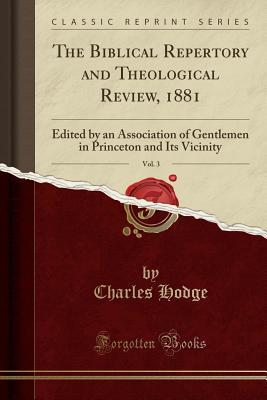
The Biblical Repertory and Theological Review, 1881, Vol. 3: Edited by an Association of Gentlemen in Princeton and Its Vicinity (Classic Reprint)
by Charles Hodge
Excerpt from The Biblical Repertory and Theological Review, 1881, Vol. 3: Edited by an Association of Gentlemen in Princeton and Its Vicinity
Thus, 'dr. Priestley, in his Institutes of the Christian Reli gion, in a very able manner vindicates the authenticity Of the facts recorded in the gospels; but in the same work, ex pressly rejects every idea Of plenary inspiration in the writers. And in our day, there are multitudes who profess to re ceive the Christian religion as substantially true, who have no belief in the inspiration Of the sacred penmen. Indeed, this distinction is recognised by almost every writer in defence of revelation; for the first step in stating the external evidence always is, to establish the miraculous facts recorded in the New Testament, by testimony merely human. And until this is satisfactorily done, no argument can be raised for the truth and divine ori in Of the Christian religion. It is evi dent, therefore, that e proof of the inspiration of the writers of the New Testament is entirely a distinct thing from the evidence of authenticity. This distinction is clearly and justly expressed in a passage quoted by Dr. Woods from Dr. Knapp.
About the Publisher
Forgotten Books publishes hundreds of thousands of rare and classic books. Find more at www.forgottenbooks.comwww.forgottenbooks.com
This book is a reproduction of an important historical work. Forgotten Books uses state-of-the-art technology to digitally reconstruct the work, preserving the original format whilst repairing imperfections present in the aged copy. In rare cases, an imperfection in the original, such as a blemish or missing page, may be replicated in our edition. We do, however, repair the vast majority of imperfections successfully; any imperfections that remain are intentionally left to preserve the state of such historical works.
Thus, 'dr. Priestley, in his Institutes of the Christian Reli gion, in a very able manner vindicates the authenticity Of the facts recorded in the gospels; but in the same work, ex pressly rejects every idea Of plenary inspiration in the writers. And in our day, there are multitudes who profess to re ceive the Christian religion as substantially true, who have no belief in the inspiration Of the sacred penmen. Indeed, this distinction is recognised by almost every writer in defence of revelation; for the first step in stating the external evidence always is, to establish the miraculous facts recorded in the New Testament, by testimony merely human. And until this is satisfactorily done, no argument can be raised for the truth and divine ori in Of the Christian religion. It is evi dent, therefore, that e proof of the inspiration of the writers of the New Testament is entirely a distinct thing from the evidence of authenticity. This distinction is clearly and justly expressed in a passage quoted by Dr. Woods from Dr. Knapp.
About the Publisher
Forgotten Books publishes hundreds of thousands of rare and classic books. Find more at www.forgottenbooks.comwww.forgottenbooks.com
This book is a reproduction of an important historical work. Forgotten Books uses state-of-the-art technology to digitally reconstruct the work, preserving the original format whilst repairing imperfections present in the aged copy. In rare cases, an imperfection in the original, such as a blemish or missing page, may be replicated in our edition. We do, however, repair the vast majority of imperfections successfully; any imperfections that remain are intentionally left to preserve the state of such historical works.
Paperback, 608 pages
Published December 9th 2018 by Forgotten Books
Subscribe
Get Bible verse every day in your inbox
Read on Mobile


Group of Brands


© 2026 Bibleportal.com All rights reserved.
Charles Hodge was the principal of Princeton Theological Seminary between 1851 and 1878. He is considered to be one of the greatest exponents and defenders of historical Calvinism in America during the 19th century.
All of the books that he authored have remained in print over a century after his death.
... Show more