
- Bible
- Read the Bible
- Bible Versions
- Verse of the Day
- Reading Plans
- Verses by Topic
- Books of the Bible
- Bible Images
- Study
- Commentaries
- Concordances
- Dictionaries
- Encyclopedias
- Sermons
- Bible Atlas & Maps
- BP Wiki
- Devotionals
- Today's Devotionals
- All Devotionals
- Inspirational Quotes
- More
- Picture Quotes
- Videos
- Inspirational
- Bible Study
- What The Bible Says
- Bible Q&As
- Daily Bread
- Bible by Genre
- Bible Stories
- Random Bible Verse
- Community
- Store
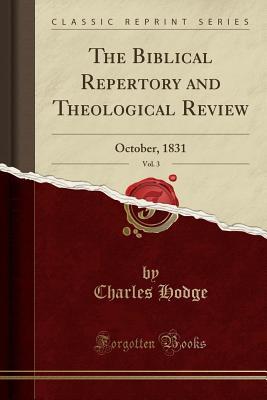
The Biblical Repertory and Theological Review, Vol. 3: October, 1831 (Classic Reprint)
by Charles Hodge
Excerpt from The Biblical Repertory and Theological Review, Vol. 3: October, 1831
Sacred Poetry and sacred Rhetoric have both shared, but too largely, m that inheritance from the heathen classics which has at once so enriched and corrupted the literature of Chris tian nations. The inspired volume alone, 1n its original and divine perfection, remains incorrupt and unmarred. Its poets and orators alone ale found guiltless of idolatry, of flattery, of selfishness, of disingenuousness, or vain glory. Whether by their antiquity, the peculiar customs and exclusive laws of their country, their unlettered condition, or solely and directly by the Holy Ghost, they were all secured from those fascinations of a foreign style and false philosophy, and an impure mytho logical fancy, which so often bewilder and betray those who essay to catch their spirit and execute their purposes. Even those devout and venerable Fathers who learned sacred eloquence from inspired lips, and employed its powers in a cause as sacred, are too often found like magnanimous, but unwary physicians, inhaling death While giving life; or like generous conquerors of a barbarous land, conferring liberty and peace, but catching tyranny and war, teaching truth, but learning error, imparting the gifts and graces of heavenly wis dom and Christian love, themselves, while, too often lin gering in wistful meditation beneath the unhallowed shades of Academus, or dwelling in unguarded speculation on the storied.
About the Publisher
Forgotten Books publishes hundreds of thousands of rare and classic books. Find more at www.forgottenbooks.comwww.forgottenbooks.com
This book is a reproduction of an important historical work. Forgotten Books uses state-of-the-art technology to digitally reconstruct the work, preserving the original format whilst repairing imperfections present in the aged copy. In rare cases, an imperfection in the original, such as a blemish or missing page, may be replicated in our edition. We do, however, repair the vast majority of imperfections successfully; any imperfections that remain are intentionally left to preserve the state of such historical works.
Sacred Poetry and sacred Rhetoric have both shared, but too largely, m that inheritance from the heathen classics which has at once so enriched and corrupted the literature of Chris tian nations. The inspired volume alone, 1n its original and divine perfection, remains incorrupt and unmarred. Its poets and orators alone ale found guiltless of idolatry, of flattery, of selfishness, of disingenuousness, or vain glory. Whether by their antiquity, the peculiar customs and exclusive laws of their country, their unlettered condition, or solely and directly by the Holy Ghost, they were all secured from those fascinations of a foreign style and false philosophy, and an impure mytho logical fancy, which so often bewilder and betray those who essay to catch their spirit and execute their purposes. Even those devout and venerable Fathers who learned sacred eloquence from inspired lips, and employed its powers in a cause as sacred, are too often found like magnanimous, but unwary physicians, inhaling death While giving life; or like generous conquerors of a barbarous land, conferring liberty and peace, but catching tyranny and war, teaching truth, but learning error, imparting the gifts and graces of heavenly wis dom and Christian love, themselves, while, too often lin gering in wistful meditation beneath the unhallowed shades of Academus, or dwelling in unguarded speculation on the storied.
About the Publisher
Forgotten Books publishes hundreds of thousands of rare and classic books. Find more at www.forgottenbooks.comwww.forgottenbooks.com
This book is a reproduction of an important historical work. Forgotten Books uses state-of-the-art technology to digitally reconstruct the work, preserving the original format whilst repairing imperfections present in the aged copy. In rare cases, an imperfection in the original, such as a blemish or missing page, may be replicated in our edition. We do, however, repair the vast majority of imperfections successfully; any imperfections that remain are intentionally left to preserve the state of such historical works.
BUY NOW
Paperback, 156 pages
Published October 27th 2018 by Forgotten Books
Subscribe
Get Bible verse every day in your inbox
Read on Mobile


Group of Brands


© 2026 Bibleportal.com All rights reserved.
Charles Hodge was the principal of Princeton Theological Seminary between 1851 and 1878. He is considered to be one of the greatest exponents and defenders of historical Calvinism in America during the 19th century.
All of the books that he authored have remained in print over a century after his death.
... Show more