
- Bible
- Read the Bible
- Bible Versions
- Verse of the Day
- Reading Plans
- Verses by Topic
- Books of the Bible
- Bible Images
- Study
- Commentaries
- Concordances
- Dictionaries
- Encyclopedias
- Sermons
- Bible Atlas & Maps
- BP Wiki
- Devotionals
- Today's Devotionals
- All Devotionals
- Inspirational Quotes
- More
- Picture Quotes
- Videos
- Inspirational
- Bible Study
- What The Bible Says
- Bible Q&As
- Daily Bread
- Bible by Genre
- Bible Stories
- Random Bible Verse
- Community
- Store
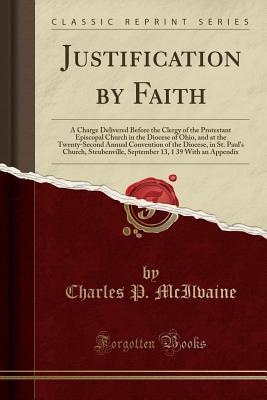
Excerpt from Justification by Faith: A Charge Delivered Before the Clergy of the Protestant Episcopal Church in the Diocese of Ohio, and at the Twenty-Second Annual Convention of the Diocese, in St. Paul's Church, Steubenville, September 13, 1 39 With an Appendix
IT is due to the Convention, at whose request this Charge is published, to say that although, in its present form, it contains many pages which were not connected with it as delivered; nothing has been added, in point of doctrine, which was not substantially before the Conven tion when the publication was requested. The unexpected delay in the issue from the press, has arisen from the desire of the author to make such arrangements with a publisher, as would relieve the Diocese from much of the expense of the edition. It has been said that the Charge was directed against the Oxford Tracts. The fact is adverted to, because otherwise it might cause a misinterpretation of some detriment to the object of the writer. Doubtless the peculiar ities of the recent Oxford divinity, on the subjectof Justification, were often in view in the writing of the Charge; and the author has no question that there is serious error enough in that divini ty, on this one subject, to furnish subject-matter for much more than an Episcopal Charge; but the reader will be disappointed if he expects to trace a reference thereto in every part of this publication. Distinctly to exhibit certain main truths involved in the great matter of a sinner's J ustification before God, and to point out certain main errors in that connection, has been the sin gle object of the writer.
About the Publisher
Forgotten Books publishes hundreds of thousands of rare and classic books. Find more at www.forgottenbooks.comwww.forgottenbooks.com
This book is a reproduction of an important historical work. Forgotten Books uses state-of-the-art technology to digitally reconstruct the work, preserving the original format whilst repairing imperfections present in the aged copy. In rare cases, an imperfection in the original, such as a blemish or missing page, may be replicated in our edition. We do, however, repair the vast majority of imperfections successfully; any imperfections that remain are intentionally left to preserve the state of such historical works.
IT is due to the Convention, at whose request this Charge is published, to say that although, in its present form, it contains many pages which were not connected with it as delivered; nothing has been added, in point of doctrine, which was not substantially before the Conven tion when the publication was requested. The unexpected delay in the issue from the press, has arisen from the desire of the author to make such arrangements with a publisher, as would relieve the Diocese from much of the expense of the edition. It has been said that the Charge was directed against the Oxford Tracts. The fact is adverted to, because otherwise it might cause a misinterpretation of some detriment to the object of the writer. Doubtless the peculiar ities of the recent Oxford divinity, on the subjectof Justification, were often in view in the writing of the Charge; and the author has no question that there is serious error enough in that divini ty, on this one subject, to furnish subject-matter for much more than an Episcopal Charge; but the reader will be disappointed if he expects to trace a reference thereto in every part of this publication. Distinctly to exhibit certain main truths involved in the great matter of a sinner's J ustification before God, and to point out certain main errors in that connection, has been the sin gle object of the writer.
About the Publisher
Forgotten Books publishes hundreds of thousands of rare and classic books. Find more at www.forgottenbooks.comwww.forgottenbooks.com
This book is a reproduction of an important historical work. Forgotten Books uses state-of-the-art technology to digitally reconstruct the work, preserving the original format whilst repairing imperfections present in the aged copy. In rare cases, an imperfection in the original, such as a blemish or missing page, may be replicated in our edition. We do, however, repair the vast majority of imperfections successfully; any imperfections that remain are intentionally left to preserve the state of such historical works.
BUY NOW
Paperback, 164 pages
Published December 20th 2018 by Forgotten Books (first published February 12th 2013)
Subscribe
Get Bible verse every day in your inbox
Read on Mobile


Group of Brands


© 2026 Bibleportal.com All rights reserved.
Charles Pettit McIlvaine was an Episcopalian bishop, author, educator and twice Chaplain of the United States Senate. In 1820 he was ordained to the deaconate in Philadelphia, and was soon after called to Christ Church in Georgetown, Washington, D.C. In 1822 he was appointed chaplain to the U.S. Senate.
From 1825 to 1827, McIlvaine served as chaplain and professor of ethics at the United States Military Academy at West Point, where his students included Robert E. Lee and Jefferson Davis.
In 1827 McIlvaine declined the presidency of The College of William & Mary but accepted a call to St. Ann's Church in Brooklyn, New York. In 1831 he was named professor of the evidences of revealed religion at the University of the City of New York.
In 1832, he became the 2nd president of Kenyon College in Gambier, Ohio, and also the second Bishop of Ohio.
He was a leading advocate of Evangelicalism, and wrote a noted rebuttal of the Oxford Movement, Oxford Divinity Compared with That of the Romish and Anglican Churches.
He was the 28th bishop consecrated in The Episcopal Church.
Bishop McIlvaine was so highly respected internationally (for his opposition to the Catholic-leaning Oxford movement within the Episcopal Church) that, shortly after the outbreak of the Civil War, President Lincoln asked him to go to England to argue against British recognition of the Confederacy. He often had coffee at Buckingham Palace, lunched with faculty members at Oxford, conversed with cabinet members, and influenced debate in the House of Commons.
... Show more