
- Bible
- Read the Bible
- Bible Versions
- Verse of the Day
- Reading Plans
- Verses by Topic
- Books of the Bible
- Bible Images
- Study
- Commentaries
- Concordances
- Dictionaries
- Encyclopedias
- Sermons
- Bible Atlas & Maps
- BP Wiki
- Devotionals
- Today's Devotionals
- Light of the World
- All Devotionals
- Inspirational Quotes
- More
- Picture Quotes
- Videos
- Inspirational
- Bible Study
- What The Bible Says
- Bible Q&As
- Daily Bread
- Bible by Genre
- Bible Stories
- Random Bible Verse
- Community
- Store
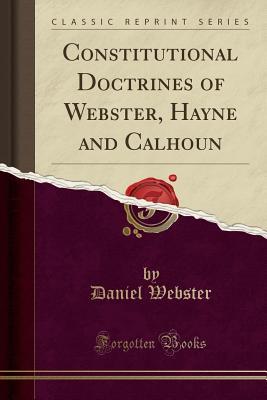
Constitutional Doctrines of Webster, Hayne and Calhoun (Classic Reprint)
by Daniel Webster
Excerpt from Constitutional Doctrines of Webster, Hayne and Calhoun
But suppose in this the Committee should be mistaken, - still there exists a sufiicient security. As high as this right of interposition on the part of a State may be regarded in relation to the General Government, the con stitutional compact provides a remedy against its abuse. There is a higher power, - placed above all by the consent of all, - the creating and preserving power of the system, - to be exercised by three-fourths of the States, - and which, un der the character of the amending power, can modify the whole system at pleasure, - and to the acts of which none can object. Admit, then, the power in question to belong to the States, - and admit its liability to abuse, - and what are the utmost consequences, but to create a presumption against the constitutionality of the power exercised by the General Gov emment, - which, if it be well founded, must compel them to abandon it; or, if not, to renounce the difficulty by obtaining the contested power in the form of an amendment to the Constitution. If, on an appeal for this purpose, the deci sion be favorable to the General Government, a disputed power will be converted into an expressly granted power but, on the other hand, if it be adverse, the refusal to grant will be tantamount to an inhibition of its exercise; and thus, in either case, the controversy will be determined. And ought not a sovereign State, as a party to the constitutional com pact, and as the guardian of her citizens and her peculiar in terests, to have the power in question? Without it, the amending power must become obsolete, and the Constitu tion, through the exercise of construction, in the end utterly subverted.
About the Publisher
Forgotten Books publishes hundreds of thousands of rare and classic books. Find more at www.forgottenbooks.comwww.forgottenbooks.com
This book is a reproduction of an important historical work. Forgotten Books uses state-of-the-art technology to digitally reconstruct the work, preserving the original format whilst repairing imperfections present in the aged copy. In rare cases, an imperfection in the original, such as a blemish or missing page, may be replicated in our edition. We do, however, repair the vast majority of imperfections successfully; any imperfections that remain are intentionally left to preserve the state of such historical works.
But suppose in this the Committee should be mistaken, - still there exists a sufiicient security. As high as this right of interposition on the part of a State may be regarded in relation to the General Government, the con stitutional compact provides a remedy against its abuse. There is a higher power, - placed above all by the consent of all, - the creating and preserving power of the system, - to be exercised by three-fourths of the States, - and which, un der the character of the amending power, can modify the whole system at pleasure, - and to the acts of which none can object. Admit, then, the power in question to belong to the States, - and admit its liability to abuse, - and what are the utmost consequences, but to create a presumption against the constitutionality of the power exercised by the General Gov emment, - which, if it be well founded, must compel them to abandon it; or, if not, to renounce the difficulty by obtaining the contested power in the form of an amendment to the Constitution. If, on an appeal for this purpose, the deci sion be favorable to the General Government, a disputed power will be converted into an expressly granted power but, on the other hand, if it be adverse, the refusal to grant will be tantamount to an inhibition of its exercise; and thus, in either case, the controversy will be determined. And ought not a sovereign State, as a party to the constitutional com pact, and as the guardian of her citizens and her peculiar in terests, to have the power in question? Without it, the amending power must become obsolete, and the Constitu tion, through the exercise of construction, in the end utterly subverted.
About the Publisher
Forgotten Books publishes hundreds of thousands of rare and classic books. Find more at www.forgottenbooks.comwww.forgottenbooks.com
This book is a reproduction of an important historical work. Forgotten Books uses state-of-the-art technology to digitally reconstruct the work, preserving the original format whilst repairing imperfections present in the aged copy. In rare cases, an imperfection in the original, such as a blemish or missing page, may be replicated in our edition. We do, however, repair the vast majority of imperfections successfully; any imperfections that remain are intentionally left to preserve the state of such historical works.
BUY NOW
Paperback, 56 pages
Published May 20th 2018 by Forgotten Books (first published September 27th 2015)
Subscribe
Get Bible verse every day in your inbox
Read on Mobile


Group of Brands


© 2026 Bibleportal.com All rights reserved.
Daniel Webster was a leading American statesman during the nation's Antebellum Period. He first rose to regional prominence through his defense of New England shipping interests. His increasingly nationalistic views and the effectiveness with which he articulated them led Webster to become one of the most famous orators and influential Whig leaders of the Second Party System.
Daniel Webster was an attorney, and served as legal counsel in several cases that established important constitutional precedents that bolstered the authority of the Federal government. As Secretary of State, he negotiated the Webster-Ashburton Treaty that established the definitive eastern border between the United States and Canada.
Webster tried three times to achieve the Presidency; all three bids failed, the final one in part because of his compromises. Similarly, Webster's efforts to steer the nation away from civil war toward a definite peace ultimately proved futile. Despite this, Webster came to be esteemed for these efforts and was officially named by the U.S. Senate in 1957 as one of its five most outstanding members.
... Show more