
- Bible
- Read the Bible
- Bible Versions
- Verse of the Day
- Reading Plans
- Verses by Topic
- Books of the Bible
- Bible Images
- Study
- Commentaries
- Concordances
- Dictionaries
- Encyclopedias
- Sermons
- Bible Atlas & Maps
- BP Wiki
- Devotionals
- Today's Devotionals
- Light of the World
- All Devotionals
- Inspirational Quotes
- More
- Picture Quotes
- Videos
- Inspirational
- Bible Study
- What The Bible Says
- Bible Q&As
- Daily Bread
- Bible by Genre
- Bible Stories
- Random Bible Verse
- Community
- Store
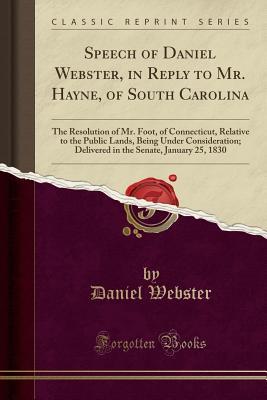
Excerpt from Speech of Daniel Webster, in Reply to Mr. Hayne, of South Carolina: The Resolution of Mr. Foot, of Connecticut, Relative to the Public Lands, Being Under Consideration; Delivered in the Senate, January 25, 1830
I hope there is none here, who, considering the subject in the calm light of philosophy, will make an objection dishonorable to Virginia - that at the moment they are securing the rights of their citizens, an objection is started, that there is a spark of hope, that those unfortunate men now held in bondage, may, by the operation ofthe General Government.
About the Publisher
Forgotten Books publishes hundreds of thousands of rare and classic books. Find more at www.forgottenbooks.comwww.forgottenbooks.com
This book is a reproduction of an important historical work. Forgotten Books uses state-of-the-art technology to digitally reconstruct the work, preserving the original format whilst repairing imperfections present in the aged copy. In rare cases, an imperfection in the original, such as a blemish or missing page, may be replicated in our edition. We do, however, repair the vast majority of imperfections successfully; any imperfections that remain are intentionally left to preserve the state of such historical works.
I hope there is none here, who, considering the subject in the calm light of philosophy, will make an objection dishonorable to Virginia - that at the moment they are securing the rights of their citizens, an objection is started, that there is a spark of hope, that those unfortunate men now held in bondage, may, by the operation ofthe General Government.
About the Publisher
Forgotten Books publishes hundreds of thousands of rare and classic books. Find more at www.forgottenbooks.comwww.forgottenbooks.com
This book is a reproduction of an important historical work. Forgotten Books uses state-of-the-art technology to digitally reconstruct the work, preserving the original format whilst repairing imperfections present in the aged copy. In rare cases, an imperfection in the original, such as a blemish or missing page, may be replicated in our edition. We do, however, repair the vast majority of imperfections successfully; any imperfections that remain are intentionally left to preserve the state of such historical works.
BUY NOW
Paperback, 38 pages
Published January 10th 2019 by Forgotten Books
Subscribe
Get Bible verse every day in your inbox
Read on Mobile


Group of Brands


© 2026 Bibleportal.com All rights reserved.
Daniel Webster was a leading American statesman during the nation's Antebellum Period. He first rose to regional prominence through his defense of New England shipping interests. His increasingly nationalistic views and the effectiveness with which he articulated them led Webster to become one of the most famous orators and influential Whig leaders of the Second Party System.
Daniel Webster was an attorney, and served as legal counsel in several cases that established important constitutional precedents that bolstered the authority of the Federal government. As Secretary of State, he negotiated the Webster-Ashburton Treaty that established the definitive eastern border between the United States and Canada.
Webster tried three times to achieve the Presidency; all three bids failed, the final one in part because of his compromises. Similarly, Webster's efforts to steer the nation away from civil war toward a definite peace ultimately proved futile. Despite this, Webster came to be esteemed for these efforts and was officially named by the U.S. Senate in 1957 as one of its five most outstanding members.
... Show more