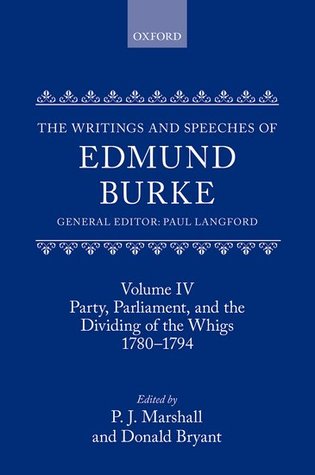
This fourth volume in the Writings and Speeches of Edmund Burke series is also the last of the three Party and Parliament volumes, which follow Edmund Burke through from the opening of a newly elected Parliament which assembled on 31 October 1780 to his retirement from the Commons in 1794.
This volume addresses Burke's views on the authority of Parliament over the British provinces in India, and his concerns about the implications of the French Revolution for British politics. He also expresses his views on issues that had always greatly interested him, such as the reform of criminal law, the confinement of debtors, and the abolition of what he regarded as outmoded economic regulations.
The texts for the items, which have appeared in previous editions of Burke's Works, have been reconstructed, largely by the use of manuscripts, and many of the shorter speeches appear here in print for the first time.



Edmund Burke, was born in Dublin, January 12, educated at a Quaker boarding school and at Trinity College, Dublin. In 1750 he entered the Middle Temple, London, but soon abandoned law for literary work.
The best of Burke's writings and speeches belong to this period, and may be described as a defense of sound constitutional statesmanship against prevailing abuse and misgovernment. In 1788 he opened the trial of Warren Hastings by the speech which will always rank among the masterpieces of English eloquence.
Burke had vast knowledge of political affairs, a glowing imagination, passionate sympathies, and an inexhaustible wealth of powerful and cultured expression. However, his delivery was awkward and speeches which today captivate the reader only served to empty the benches of the House of Commons (some speeches were in excess of eight hours).
One of the foremost political thinkers of 18th century England, Burke died July 9, 1797, and was buried in a little church at Beaconsfield.
... Show more