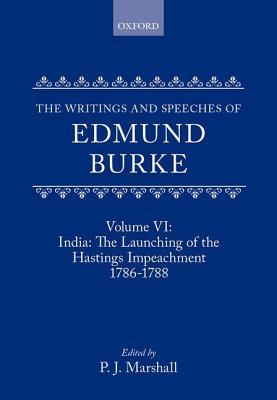
This volume continues the story of Burke and the affairs of the East India Company which was begun in Volume V (OUP 1981, GBP70.00, 0-19-822417-6). By 1786, Burke had fixed on Warren Hastings as the main culprit for the abuses that seemed to him so glaring. He greeted Hastings's return to Britain with a parliamentary attack which culminated in a trial by impeachment in the House of Lords. This was to be one of Burke's major preoccupations for the rest of his life. The material presented in this volume covers two years of proceedings in the House of Commons and the first session of the trial in the Lords. Its highlights are two great set-piece speeches delivered to the Commons, which can be reconstructed from manuscript material as well as from contemporary reports; and the four-day oration with which Burke opened the prosecution before the Lords: for this a complete verbatim shorthand record exists. The material in these and other speeches is not only central to an understanding of Burke and India, but to his moral and political thought as a whole in the years immediately before the outbreak of the French Revolution.



Edmund Burke, was born in Dublin, January 12, educated at a Quaker boarding school and at Trinity College, Dublin. In 1750 he entered the Middle Temple, London, but soon abandoned law for literary work.
The best of Burke's writings and speeches belong to this period, and may be described as a defense of sound constitutional statesmanship against prevailing abuse and misgovernment. In 1788 he opened the trial of Warren Hastings by the speech which will always rank among the masterpieces of English eloquence.
Burke had vast knowledge of political affairs, a glowing imagination, passionate sympathies, and an inexhaustible wealth of powerful and cultured expression. However, his delivery was awkward and speeches which today captivate the reader only served to empty the benches of the House of Commons (some speeches were in excess of eight hours).
One of the foremost political thinkers of 18th century England, Burke died July 9, 1797, and was buried in a little church at Beaconsfield.
... Show more