
- Bible
- Read the Bible
- Bible Versions
- Verse of the Day
- Reading Plans
- Verses by Topic
- Books of the Bible
- Bible Images
- Study
- Commentaries
- Concordances
- Dictionaries
- Encyclopedias
- Sermons
- Bible Atlas & Maps
- BP Wiki
- Devotionals
- Today's Devotionals
- Light of the World
- All Devotionals
- Inspirational Quotes
- More
- Picture Quotes
- Videos
- Inspirational
- Bible Study
- What The Bible Says
- Bible Q&As
- Daily Bread
- Bible by Genre
- Bible Stories
- Random Bible Verse
- Community
- Store
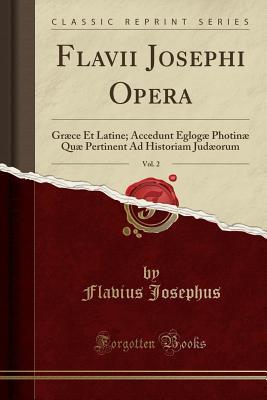
Flavii Josephi Opera, Vol. 2: Gr�ce Et Latine; Accedunt Eglog� Photin� Qu� Pertinent Ad Historiam Jud�orum (Classic Reprint)
by Flavius Josephus
Excerpt from Flavii Josephi Opera, Vol. 2: Gr�ce Et Latine; Accedunt Eglog� Photin� Qu� Pertinent Ad Historiam Jud�orum
Josephi opera postquam proximis post inventam artem typograpbi cam temporibus plusquam vicies Latine edita essent, Grace primum prodierunt Basilea: a. 1544 opera Amoldi Peraxyli Arlenu, c'odicibut ex quibus ederentur non prudenter delectis, sed, ut fer6bat illorum temporum in arte critica infantia, omnium prope qui adhuc innotue runt nequissimis arreptis. Ea editio postquam aliquoties alibi repetiu esset, - levissimis factis mutationibus, primus qui paullo diligentiorem in hoc scriptore operam poneret Joannes Hudsonus exstitit, qui non solum novum interpretationem Latinam confecit, sed etiam melioris note exemplaria manuscripta, inter qua eminent Vossiana Leiden sia, conquirere coepit, quorum ope innumera quidem priorum editio num vitia correxit in editione Oxoniensi a. T7ao sed longe plurime men aliis agenda reliquit. Quibus perfieiendis prorsu! Imperem se gen sit qui editionem Hudsonianam utilibus inutilibusque aooessiodbus anotam sex annis post Lugduni Batavorum� repetivit Sighertus Bever campus, licet non solum eadem omnes que Hudsono presto ci emu! Librorum Mss. Copia, sed nova etiam et eximia suppeterent. Post Havd campum qui Josephi opera attigerunt duos tantum invenio quo. Bac loco memorem clari nominis viros, alterum Jo. Aug. Ernestium, qui in Antiquitatum. �u'daicarum libris multa egregio etneadavit in Ohm tionibus post mortem ejus editis 1 795, alterum Ed. Cardvvellum, qui Belli Judaioi historiam longe quam adhuc ferebatur emendatioremwm ampio vetustionim oodicum apparatu Oxonii edidit a. 1837. Eo igifl ? In loco 'quum rem esse videret eruditissimus hujus Bibliotheca editor, Ambr. F. Didot, nullamque qua repeti posset editionem omnia bxphi scripta complectentem inveniret, ego exemplar Hudsonianum ei con cessi, cu}us in marginibus plurima vulgata lectionis vitia ex oodicibu: emendaveram alia ex conjecturis vel aliorum vel meis correxeram li cet bene sentirem quam longe hmc omnia ab ea absint perfection.
About the Publisher
Forgotten Books publishes hundreds of thousands of rare and classic books. Find more at www.forgottenbooks.comwww.forgottenbooks.com
This book is a reproduction of an important historical work. Forgotten Books uses state-of-the-art technology to digitally reconstruct the work, preserving the original format whilst repairing imperfections present in the aged copy. In rare cases, an imperfection in the original, such as a blemish or missing page, may be replicated in our edition. We do, however, repair the vast majority of imperfections successfully; any imperfections that remain are intentionally left to preserve the state of such historical works.
Josephi opera postquam proximis post inventam artem typograpbi cam temporibus plusquam vicies Latine edita essent, Grace primum prodierunt Basilea: a. 1544 opera Amoldi Peraxyli Arlenu, c'odicibut ex quibus ederentur non prudenter delectis, sed, ut fer6bat illorum temporum in arte critica infantia, omnium prope qui adhuc innotue runt nequissimis arreptis. Ea editio postquam aliquoties alibi repetiu esset, - levissimis factis mutationibus, primus qui paullo diligentiorem in hoc scriptore operam poneret Joannes Hudsonus exstitit, qui non solum novum interpretationem Latinam confecit, sed etiam melioris note exemplaria manuscripta, inter qua eminent Vossiana Leiden sia, conquirere coepit, quorum ope innumera quidem priorum editio num vitia correxit in editione Oxoniensi a. T7ao sed longe plurime men aliis agenda reliquit. Quibus perfieiendis prorsu! Imperem se gen sit qui editionem Hudsonianam utilibus inutilibusque aooessiodbus anotam sex annis post Lugduni Batavorum� repetivit Sighertus Bever campus, licet non solum eadem omnes que Hudsono presto ci emu! Librorum Mss. Copia, sed nova etiam et eximia suppeterent. Post Havd campum qui Josephi opera attigerunt duos tantum invenio quo. Bac loco memorem clari nominis viros, alterum Jo. Aug. Ernestium, qui in Antiquitatum. �u'daicarum libris multa egregio etneadavit in Ohm tionibus post mortem ejus editis 1 795, alterum Ed. Cardvvellum, qui Belli Judaioi historiam longe quam adhuc ferebatur emendatioremwm ampio vetustionim oodicum apparatu Oxonii edidit a. 1837. Eo igifl ? In loco 'quum rem esse videret eruditissimus hujus Bibliotheca editor, Ambr. F. Didot, nullamque qua repeti posset editionem omnia bxphi scripta complectentem inveniret, ego exemplar Hudsonianum ei con cessi, cu}us in marginibus plurima vulgata lectionis vitia ex oodicibu: emendaveram alia ex conjecturis vel aliorum vel meis correxeram li cet bene sentirem quam longe hmc omnia ab ea absint perfection.
About the Publisher
Forgotten Books publishes hundreds of thousands of rare and classic books. Find more at www.forgottenbooks.comwww.forgottenbooks.com
This book is a reproduction of an important historical work. Forgotten Books uses state-of-the-art technology to digitally reconstruct the work, preserving the original format whilst repairing imperfections present in the aged copy. In rare cases, an imperfection in the original, such as a blemish or missing page, may be replicated in our edition. We do, however, repair the vast majority of imperfections successfully; any imperfections that remain are intentionally left to preserve the state of such historical works.
BUY NOW
Paperback, 530 pages
Published April 23rd 2018 by Forgotten Books
Subscribe
Get Bible verse every day in your inbox
Read on Mobile


Group of Brands


© 2026 Bibleportal.com All rights reserved.
Flavius Josephus was born Joseph ben Mattathias in Jerusalem in 37 CE a few years after the time of Jesus, during the time of the Roman occupation of the Jewish homeland. In his early twenties he was sent to Rome to negotiate the release of several priests held hostage by Emperor Nero. When he returned home after completing his mission he found the nation beginning a revolution against the Romans.
Despite his foreboding that the cause was hopeless, he was drafted into becoming commander of the revolutionary forces in Galilee, where he spent more time controlling internal factions than fighting the Roman army. When the city of Jotapata he was defending fell to the Roman general Vespasian, Josephus and his supporters hid in a cave and entered into a suicide pact, which Josephus oddly survived.
Taken prisoner by Vespasian, Josephus presented himself as a prophet. Noting that the war had been propelled by an ancient oracle that foretold a world ruler would arise from Judaea, Josephus asserted that this referred to Vespasian, who was destined to become Emperor of Rome. Intrigued, Vespasian spared his life. When this prophecy came true, and Vespasian became Emperor, he rewarded Josephus handsomely, freeing him from his chains and eventually adopting him into his family, the Flavians. Josephus thus became Flavius Josephus.
During the remainder of the war, Josephus assisted the Roman commander Titus, Vespasian's son, with understanding the Jewish nation and in negotiating with the revolutionaries. Called a traitor, he was unable to persuade the defenders of Jerusalem to surrender to the Roman siege, and instead became a witness to the destruction of the city and the Holy Temple.
Living at the Flavian court in Rome, Josephus undertook to write a history of the war he had witnessed. The work, while apparently factually correct, also served to flatter his patron and to warn other provinces against the folly of opposing the Romans. He first wrote in his native language of Aramaic, then with assistance translated it into Greek (the most-used language of the Empire). It was published a few years after the end of the war, in about 78 CE. He was about 40 years old.
Josephus subsequently improved his language skills and undertook a massive work in Greek explaining the history of the Jews to the general non-Jewish audience. He emphasized that the Jewish culture and Bible were older than any other then existing, hence called his work the Jewish Antiquities. Approximately half the work is a rephrasing of the Hebrew Bible, while much of the rest draws on previous historians. This work was published in 93 or 94 CE, when he was about 56 years old.
Josephus wrote at least two smaller books, including his autobiography, in which he recounts his life from birth until the writing of the Antiquities. The year he died is unknown.
... Show more