The Jewish War or Judean War, also referred to in English as The Wars of the Jews, is a book written by Josephus, a Roman-Jewish historian of the 1st century. Divided into seven books, it opens with a summary of Jewish history from the capture of Jerusalem by the Seleucid ruler Antiochus IV Epiphanes in 164 BC to the first stages of the First Jewish-Roman War (Book I and II). The next five books detail the unfolding of the war, under Roman generals Vespasian and Titus, to the death of the last Sicarii. The book was written about 75 AD, originally in Josephus's "paternal tongue," probably Aramaic, though this version has not survived. It was later translated into Greek, probably under the supervision of Josephus himself. The sources of knowledge of the First Jewish-Roman War are: this account of Josephus, the Talmud (Gittin 57b), Midrash Eichah, and the Hebrew inscriptions on the Jewish coins minted, and Book V of Tacitus' Histories. The text also survives in an Old Slavonic version, as well as Hebrew which contains material not found in the Greek version, and which is lacking other material found in the Greek version.

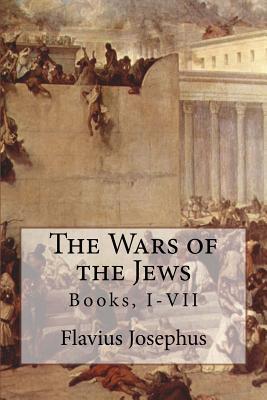


Flavius Josephus was born Joseph ben Mattathias in Jerusalem in 37 CE a few years after the time of Jesus, during the time of the Roman occupation of the Jewish homeland. In his early twenties he was sent to Rome to negotiate the release of several priests held hostage by Emperor Nero. When he returned home after completing his mission he found the nation beginning a revolution against the Romans.
Despite his foreboding that the cause was hopeless, he was drafted into becoming commander of the revolutionary forces in Galilee, where he spent more time controlling internal factions than fighting the Roman army. When the city of Jotapata he was defending fell to the Roman general Vespasian, Josephus and his supporters hid in a cave and entered into a suicide pact, which Josephus oddly survived.
Taken prisoner by Vespasian, Josephus presented himself as a prophet. Noting that the war had been propelled by an ancient oracle that foretold a world ruler would arise from Judaea, Josephus asserted that this referred to Vespasian, who was destined to become Emperor of Rome. Intrigued, Vespasian spared his life. When this prophecy came true, and Vespasian became Emperor, he rewarded Josephus handsomely, freeing him from his chains and eventually adopting him into his family, the Flavians. Josephus thus became Flavius Josephus.
During the remainder of the war, Josephus assisted the Roman commander Titus, Vespasian's son, with understanding the Jewish nation and in negotiating with the revolutionaries. Called a traitor, he was unable to persuade the defenders of Jerusalem to surrender to the Roman siege, and instead became a witness to the destruction of the city and the Holy Temple.
Living at the Flavian court in Rome, Josephus undertook to write a history of the war he had witnessed. The work, while apparently factually correct, also served to flatter his patron and to warn other provinces against the folly of opposing the Romans. He first wrote in his native language of Aramaic, then with assistance translated it into Greek (the most-used language of the Empire). It was published a few years after the end of the war, in about 78 CE. He was about 40 years old.
Josephus subsequently improved his language skills and undertook a massive work in Greek explaining the history of the Jews to the general non-Jewish audience. He emphasized that the Jewish culture and Bible were older than any other then existing, hence called his work the Jewish Antiquities. Approximately half the work is a rephrasing of the Hebrew Bible, while much of the rest draws on previous historians. This work was published in 93 or 94 CE, when he was about 56 years old.
Josephus wrote at least two smaller books, including his autobiography, in which he recounts his life from birth until the writing of the Antiquities. The year he died is unknown.
... Show more