
- Bible
- Read the Bible
- Bible Versions
- Verse of the Day
- Reading Plans
- Verses by Topic
- Books of the Bible
- Bible Images
- Study
- Commentaries
- Concordances
- Dictionaries
- Encyclopedias
- Sermons
- Bible Atlas & Maps
- BP Wiki
- Devotionals
- Today's Devotionals
- Light of the World
- All Devotionals
- Inspirational Quotes
- More
- Picture Quotes
- Videos
- Inspirational
- Bible Study
- What The Bible Says
- Bible Q&As
- Daily Bread
- Bible by Genre
- Bible Stories
- Random Bible Verse
- Community
- Store
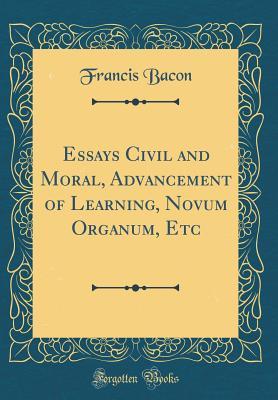
Essays Civil and Moral, Advancement of Learning, Novum Organum, Etc (Classic Reprint)
by Francis Bacon
Excerpt from Essays Civil and Moral, Advancement of Learning, Novum Organum, Etc
- would best advance his ends. Thus, when, as one of her majesty's counsel, he had to plead against Essex in 1600, after his complete failure in Ireland, he treated him not tenderly, as he admits, hoping thereby to retain the queen's goodwill, and afterwards use it in favour of Essex. Six weeks later Essex was liberated, but forbidden to come to Court. Bacon wrote to Essex, that though he loved few persons better than himself, yet he loved the queen's service and her favour, and the good of his country more. He appeared for the Crown at Essex's trial for treason in 1601, and largely helped to secure his conviction. Prof. Gardiner palliates his appearing thus against his former friend and bene factor by referring to the insecurity of the State and the necessity of preventing ambitious men from gaining undue authority, and then producing revolt and anarchy. But if Bacon's so-called love for Essex had had any real existence we cannot believe that he would have aided in bringing a death sentence on him. Even if all were the fault of Essex, Others might have been allowed to point the arrow, wing it for flight, and take the deathly aim. In the last years of Elizabeth's reign Bacon busied himself in the advocacy of religious toleration in Ireland, and the establish ment of courts of justice there without English technicalities. He also proposed the introduction, as a sort of garrison, of English settlers.
About the Publisher
Forgotten Books publishes hundreds of thousands of rare and classic books. Find more at www.forgottenbooks.comwww.forgottenbooks.com
This book is a reproduction of an important historical work. Forgotten Books uses state-of-the-art technology to digitally reconstruct the work, preserving the original format whilst repairing imperfections present in the aged copy. In rare cases, an imperfection in the original, such as a blemish or missing page, may be replicated in our edition. We do, however, repair the vast majority of imperfections successfully; any imperfections that remain are intentionally left to preserve the state of such historical works.
- would best advance his ends. Thus, when, as one of her majesty's counsel, he had to plead against Essex in 1600, after his complete failure in Ireland, he treated him not tenderly, as he admits, hoping thereby to retain the queen's goodwill, and afterwards use it in favour of Essex. Six weeks later Essex was liberated, but forbidden to come to Court. Bacon wrote to Essex, that though he loved few persons better than himself, yet he loved the queen's service and her favour, and the good of his country more. He appeared for the Crown at Essex's trial for treason in 1601, and largely helped to secure his conviction. Prof. Gardiner palliates his appearing thus against his former friend and bene factor by referring to the insecurity of the State and the necessity of preventing ambitious men from gaining undue authority, and then producing revolt and anarchy. But if Bacon's so-called love for Essex had had any real existence we cannot believe that he would have aided in bringing a death sentence on him. Even if all were the fault of Essex, Others might have been allowed to point the arrow, wing it for flight, and take the deathly aim. In the last years of Elizabeth's reign Bacon busied himself in the advocacy of religious toleration in Ireland, and the establish ment of courts of justice there without English technicalities. He also proposed the introduction, as a sort of garrison, of English settlers.
About the Publisher
Forgotten Books publishes hundreds of thousands of rare and classic books. Find more at www.forgottenbooks.comwww.forgottenbooks.com
This book is a reproduction of an important historical work. Forgotten Books uses state-of-the-art technology to digitally reconstruct the work, preserving the original format whilst repairing imperfections present in the aged copy. In rare cases, an imperfection in the original, such as a blemish or missing page, may be replicated in our edition. We do, however, repair the vast majority of imperfections successfully; any imperfections that remain are intentionally left to preserve the state of such historical works.
Hardcover, 516 pages
Published January 10th 2019 by Forgotten Books
Subscribe
Get Bible verse every day in your inbox
Read on Mobile


Group of Brands


© 2026 Bibleportal.com All rights reserved.
Sir Francis Bacon, 1st Viscount St Alban KC, son of Nicholas Bacon by his second wife Anne (Cooke) Bacon, was an English philosopher, statesman, scientist, lawyer, jurist, and author. He served both as Attorney General and Lord Chancellor of England. Although his political career ended in disgrace, he remained extremely influential through his works, especially as philosophical advocate and practitioner of the scientific revolution. Bacon was knighted in 1603, created Baron Verulam in 1618, and Viscount St Alban in 1621.
There are some scholars who believe that Bacon's vision for a Utopian New World in North America was laid out in his novel The New Atlantis, which depicts a mythical island, Bensalem, in the Pacific Ocean west of Peru. He envisioned a land where there would be greater rights for women, the abolishing of slavery, elimination of debtors' prisons, separation of church and state, and freedom of religious and political expression. Francis Bacon played a leading role in creating the British colonies, especially in Virginia, the Carolinas, and Newfoundland.
Thomas Jefferson considered Francis Bacon to be one of the three greatest men who ever lived, "Bacon, Locke and Newton" were "the three greatest men that have ever lived, without any exception." Francis Bacon's influence can also be seen on a variety of religious and spiritual authors, and on groups that have utilized his writings in their own belief systems.
... Show more