
- Bible
- Read the Bible
- Bible Versions
- Verse of the Day
- Reading Plans
- Verses by Topic
- Books of the Bible
- Bible Images
- Study
- Commentaries
- Concordances
- Dictionaries
- Encyclopedias
- Sermons
- Bible Atlas & Maps
- BP Wiki
- Devotionals
- Today's Devotionals
- Light of the World
- All Devotionals
- Inspirational Quotes
- More
- Picture Quotes
- Videos
- Inspirational
- Bible Study
- What The Bible Says
- Bible Q&As
- Daily Bread
- Bible by Genre
- Bible Stories
- Random Bible Verse
- Community
- Store
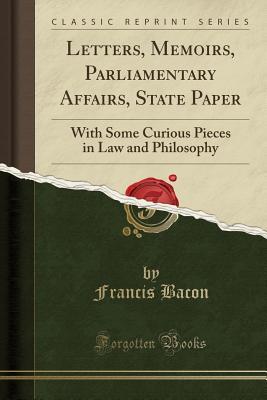
Letters, Memoirs, Parliamentary Affairs, State Paper: With Some Curious Pieces in Law and Philosophy (Classic Reprint)
by Francis Bacon
Excerpt from Letters, Memoirs, Parliamentary Affairs, State Paper: With Some Curious Pieces in Law and Philosophy
Having many years past transcribed from the originals, several Letters and Memoires of the Lord Bacon, which had never been made publick, and disposed them with others, in a series of time: I then engaged my self to make a supplement thereto, if I might be obliged with other of his Lordship's genuine writings. And to that end, a Gentleman long since deceased, gave me the opportunity of copying some other of his Lordship's letters, which had been a part of the former collection: But not having a sufficient number, and being soon concerned in affairs of another nature, I laid aside all thoughts of troubling my self or others in the same kind, till the Right Honourable the Earl of Oxford was pleased to put into my hands, some neglected manuscripts and loose papers, to fee whether any of the Lord Bacon's compositions lay concealed there, that were fit to be published. Upon the perusal, I found some of them written, and others amended with his Lordship's own hand, and believed that all of them had been in the possession of Dr. Rawley, his Lordship's Chaplain, and faithful Editor of many of his Works. I found, that several of the Treatises had been published by him, and that others, certainly genuine, which had not, were fit to be transcribed, and so preserved, if not divulged.
About the Publisher
Forgotten Books publishes hundreds of thousands of rare and classic books. Find more at www.forgottenbooks.comwww.forgottenbooks.com
This book is a reproduction of an important historical work. Forgotten Books uses state-of-the-art technology to digitally reconstruct the work, preserving the original format whilst repairing imperfections present in the aged copy. In rare cases, an imperfection in the original, such as a blemish or missing page, may be replicated in our edition. We do, however, repair the vast majority of imperfections successfully; any imperfections that remain are intentionally left to preserve the state of such historical works.
Having many years past transcribed from the originals, several Letters and Memoires of the Lord Bacon, which had never been made publick, and disposed them with others, in a series of time: I then engaged my self to make a supplement thereto, if I might be obliged with other of his Lordship's genuine writings. And to that end, a Gentleman long since deceased, gave me the opportunity of copying some other of his Lordship's letters, which had been a part of the former collection: But not having a sufficient number, and being soon concerned in affairs of another nature, I laid aside all thoughts of troubling my self or others in the same kind, till the Right Honourable the Earl of Oxford was pleased to put into my hands, some neglected manuscripts and loose papers, to fee whether any of the Lord Bacon's compositions lay concealed there, that were fit to be published. Upon the perusal, I found some of them written, and others amended with his Lordship's own hand, and believed that all of them had been in the possession of Dr. Rawley, his Lordship's Chaplain, and faithful Editor of many of his Works. I found, that several of the Treatises had been published by him, and that others, certainly genuine, which had not, were fit to be transcribed, and so preserved, if not divulged.
About the Publisher
Forgotten Books publishes hundreds of thousands of rare and classic books. Find more at www.forgottenbooks.comwww.forgottenbooks.com
This book is a reproduction of an important historical work. Forgotten Books uses state-of-the-art technology to digitally reconstruct the work, preserving the original format whilst repairing imperfections present in the aged copy. In rare cases, an imperfection in the original, such as a blemish or missing page, may be replicated in our edition. We do, however, repair the vast majority of imperfections successfully; any imperfections that remain are intentionally left to preserve the state of such historical works.
BUY NOW
Paperback, 568 pages
Published October 14th 2018 by Forgotten Books
Subscribe
Get Bible verse every day in your inbox
Read on Mobile


Group of Brands


© 2026 Bibleportal.com All rights reserved.
Sir Francis Bacon, 1st Viscount St Alban KC, son of Nicholas Bacon by his second wife Anne (Cooke) Bacon, was an English philosopher, statesman, scientist, lawyer, jurist, and author. He served both as Attorney General and Lord Chancellor of England. Although his political career ended in disgrace, he remained extremely influential through his works, especially as philosophical advocate and practitioner of the scientific revolution. Bacon was knighted in 1603, created Baron Verulam in 1618, and Viscount St Alban in 1621.
There are some scholars who believe that Bacon's vision for a Utopian New World in North America was laid out in his novel The New Atlantis, which depicts a mythical island, Bensalem, in the Pacific Ocean west of Peru. He envisioned a land where there would be greater rights for women, the abolishing of slavery, elimination of debtors' prisons, separation of church and state, and freedom of religious and political expression. Francis Bacon played a leading role in creating the British colonies, especially in Virginia, the Carolinas, and Newfoundland.
Thomas Jefferson considered Francis Bacon to be one of the three greatest men who ever lived, "Bacon, Locke and Newton" were "the three greatest men that have ever lived, without any exception." Francis Bacon's influence can also be seen on a variety of religious and spiritual authors, and on groups that have utilized his writings in their own belief systems.
... Show more