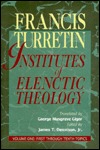
This is Francis Turretin's magnum opus, a massive work of Reformed scholasticism. Written originally in Latin with sentences frequently lasting nearly a half a page, Turretin's Institutes are at once familiar, profound, erudite, thorough and precise, detailed, comprehensive, historically significant, and truly Reformed, etc. Turretin organized his Institutes into 20 topics (loci) that range from "Prolegomena" (that is, very necessary introductory considerations) to "The Last Things." Each topic (locus) is organized by specific questions. The work is Elenctic (polemic or argumentitive), for a large chunk of this work is written against the Roman Catholics, Arminians, Socinians, Anabaptists, Molinists and others.
Translated by George Musgrave Giger Edited by James T. Dennison Jr.
Volume 1: Topics 1-10
Topic I: Theology
Topic II: The Holy Scriptures
Topic III: The One and Triune God
Topic IV: The Decrees of God in General and Predestination in Particular
Topic V: Creation
Topic VI: The Actual Providence of God
Topic VII: Angels
Topic VIII: The State of Man Before the Fall and the Covenant of Nature
Topic IX: Sin in General and in Particular
Topic X: The Free Will of Man in a State of Sin



Francis Turretin was a Swiss-Italian Protestant theologian. Turretin is especially known as a zealous opponent of the theology of the Academy of Saumur (embodied by Moise Amyraut and called Amyraldianism), as an earnest defender of the Calvinistic orthodoxy represented by the Synod of Dort, and as one of the authors of the Helvetic Consensus, which defended the formulation of double predestination from the Synod of Dort and the verbal inspiration of the Bible.
Turretin greatly influenced the Puritans, but until recently, he was a mostly forgotten Protestant scholastic from the annals of church history, though the rough English translation of his Institutes of Elenctic Theology is increasingly read by students of theology. John Gerstner called Turretin "the most precise theologian in the Calvinistic tradition."
... Show more